"Congestion Worsens from Singapore Port to Shenzhen Port"
Export Industry Seeks Detours Such as Using Russian Railways
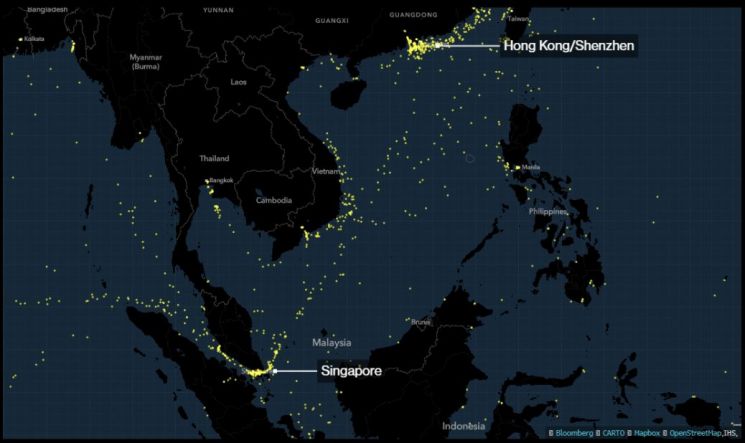 Due to the impact of Typhoon 'Gonpas', congestion is occurring at Hong Kong Port and Singapore Port [Image source=Bloomberg News]
[Asia Economy Reporter Kim Suhwan] Analysts have suggested that the typhoon hitting Hong Kong and southern China is worsening the ongoing global logistics crisis by negatively impacting maritime logistics.
On the 14th (local time), Bloomberg reported that "the typhoon striking southern China, combined with the global supply shortage caused by COVID-19, is causing vessel congestion from Shenzhen Port to Singapore Port."
Previously, major countries such as the United States and the United Kingdom have faced a shortage of logistics workers to transport goods due to labor shortages in the logistics industry following the COVID-19 pandemic. This has led to container accumulation at major ports and an increase in vessels waiting to dock, a phenomenon known as 'containergeddon,' triggering a global logistics crisis.
Amid this, the typhoon hitting southern China is showing signs of causing a logistics crisis in the Asian region as well, raising concerns that the global supply shortage could worsen.
Earlier this week, the 'Gonpas' typhoon that struck Hong Kong led local authorities to close the stock market and schools the previous day.
According to Bloomberg, 67 vessels are currently waiting at Hong Kong Port due to the typhoon's impact. This is 22% higher than the daily average number of waiting vessels recorded since April.
The typhoon has also reportedly affected Singapore Port. Bloomberg stated that 37 vessels are currently waiting to dock at Singapore Port, an 18% increase compared to usual.
Given that Singapore Port is a logistics hub in Asia, concerns are rising that the ripple effects of vessel congestion could be even greater.
Bloomberg also reported vessel congestion at Busan Port, where it takes about three days for ships to berth. As a result, Busan Port is unable to properly handle transshipment cargo volumes, leading to container accumulation at the port.
Major ports in Malaysia and Vietnam have also seen waiting vessels increase by 25% and 38%, respectively, compared to usual.
Analyst Eom Kyung-ah of Shin Young Securities told Bloomberg on the same day, "Shipping companies are focusing on resolving logistics difficulties in preparation for increased demand ahead of the winter holidays," adding, "This month will be the most challenging period."
The Singapore Logistics Association stated, "Currently, most ports in Southeast Asia require up to three days for berthing," and added, "The global port congestion is bringing more uncertainty to the shipping industry."
The association further noted, "Maritime logistics costs have increased sixfold compared to before the COVID-19 pandemic."
In response, exporters and shipping companies appear to be seeking alternative routes to avoid vessel congestion.
Bloomberg reported that some China-origin container ships bound for Europe are stopping at Busan Port, after which containers are loaded onto trains and sent to Europe via Russia.
© The Asia Business Daily(www.asiae.co.kr). All rights reserved.
![Clutching a Stolen Dior Bag, Saying "I Hate Being Poor but Real"... The Grotesque Con of a "Human Knockoff" [Slate]](https://cwcontent.asiae.co.kr/asiaresize/183/2026021902243444107_1771435474.jpg)

















