Savings Banks, Total Cumulative Salaries in H1 Reach 330.5 Billion KRW
10.2% Increase in One Year... Record High Level
Major Firms Like SBI and OK Savings Bank Lead Salary Raises
Year-End Bonus Expectations Rise Based on Performance
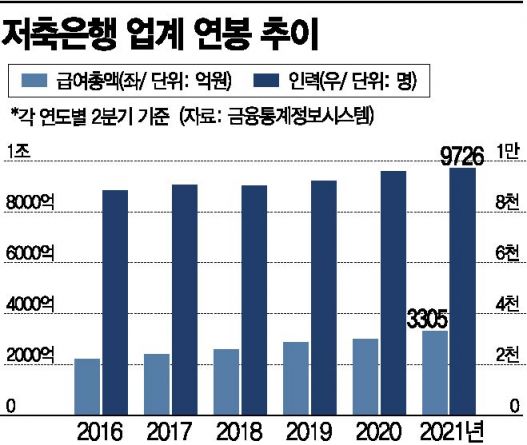
[Asia Economy Reporter Song Seung-seop] Salaries in the major savings bank industry are expected to reach an all-time high this year. This is largely due to the likelihood of substantial bonus payments and salary increases based on loan performance. Large savings banks have already caught up with commercial banks' wage levels and are aggressively recruiting digital and IT talent, so total salary amounts are expected to rise sharply.
According to the industry on the 15th, the cumulative total salary for the first half of the year among 79 savings banks was 330.5 billion KRW, the largest ever for the second quarter. This is an increase of 30.8 billion KRW (10.2%) compared to the same period last year, which was around 299.7 billion KRW. Compared to five years ago, it is comparable to the cumulative total salary for three quarters (336.8 billion KRW).
Considering the industry workforce (9,726 employees), the average annual salary per savings bank employee this year is estimated to be about 67.96 million KRW. This is an increase of 3.63 million KRW (5.6%) from 64.33 million KRW at the end of last year. However, since year-end bonuses and performance pay are excluded, the actual increase rate is expected to be higher.
Rapid salary increases were led by large savings banks at the forefront of the industry. The bank with the highest total salary payment was OK Savings Bank. As of the first half, it spent 32.099 billion KRW on salaries. This is an increase of 11.07 billion KRW (52.6%) compared to 21.029 billion KRW spent in the first half of last year.
SBI Savings Bank’s salary payment for the second quarter totaled 27.054 billion KRW, and considering the number of employees, the average annual salary is expected to reach 90.02 million KRW. Adding performance bonuses, the annual salary is expected to exceed 100 million KRW. At the end of last year, SBI Savings Bank already recorded the highest average salary in the industry at 82 million KRW per person. The performance bonuses paid were also the highest, averaging 20 million KRW per person.
The Driving Forces Behind Rapid Salary Increases: 'Mid-Interest Loans & Digital'
Welcome Savings Bank and Pepper Savings Bank also ranked high, spending 24.221 billion KRW and 20.94 billion KRW respectively. Although their average salaries last year ranged from 56 million KRW to 80 million KRW, which was lower than other large banks, their average salaries increased by nearly 6 million KRW. Considering that some commercial banks only raised salaries by about 5 million KRW during this period, this represents a steep increase.
The rapid salary increases are attributed to strong loan growth driven by mid-interest loans and a balloon effect, despite policy risks such as the household debt total volume regulation implemented this year. The strategy to strengthen digital and mobile services to attract the 20s and 30s as new customer groups was also effective.
SBI Savings Bank recorded operating revenue of 672.2 billion KRW in the first half, a 23.3% increase compared to the same period last year. Net income also rose 44.9% to 193.6 billion KRW. OK Savings Bank’s operating revenue (576 billion KRW) and net income (148.3 billion KRW) increased by 19.3% and 53.8%, respectively.
Salary levels in the industry are expected to continue rising. As demand for non-face-to-face financial services rapidly increases, savings banks are offering premiums to recruit digital and IT talent. Major savings banks have hired a large number of employees in financial IT development, information security, and MyData sectors through frequent and experienced hires this year.
Within the industry, expectations for performance bonuses are also growing due to strong results. A savings bank official said, "Although about three months of business days remain, performance is expected to improve," adding, "While the scale and timing are unknown, there is a possibility of performance bonuses."
© The Asia Business Daily(www.asiae.co.kr). All rights reserved.

















