"Celestial Brightness Changes 100 Times... Signal Turns On and Off Randomly"
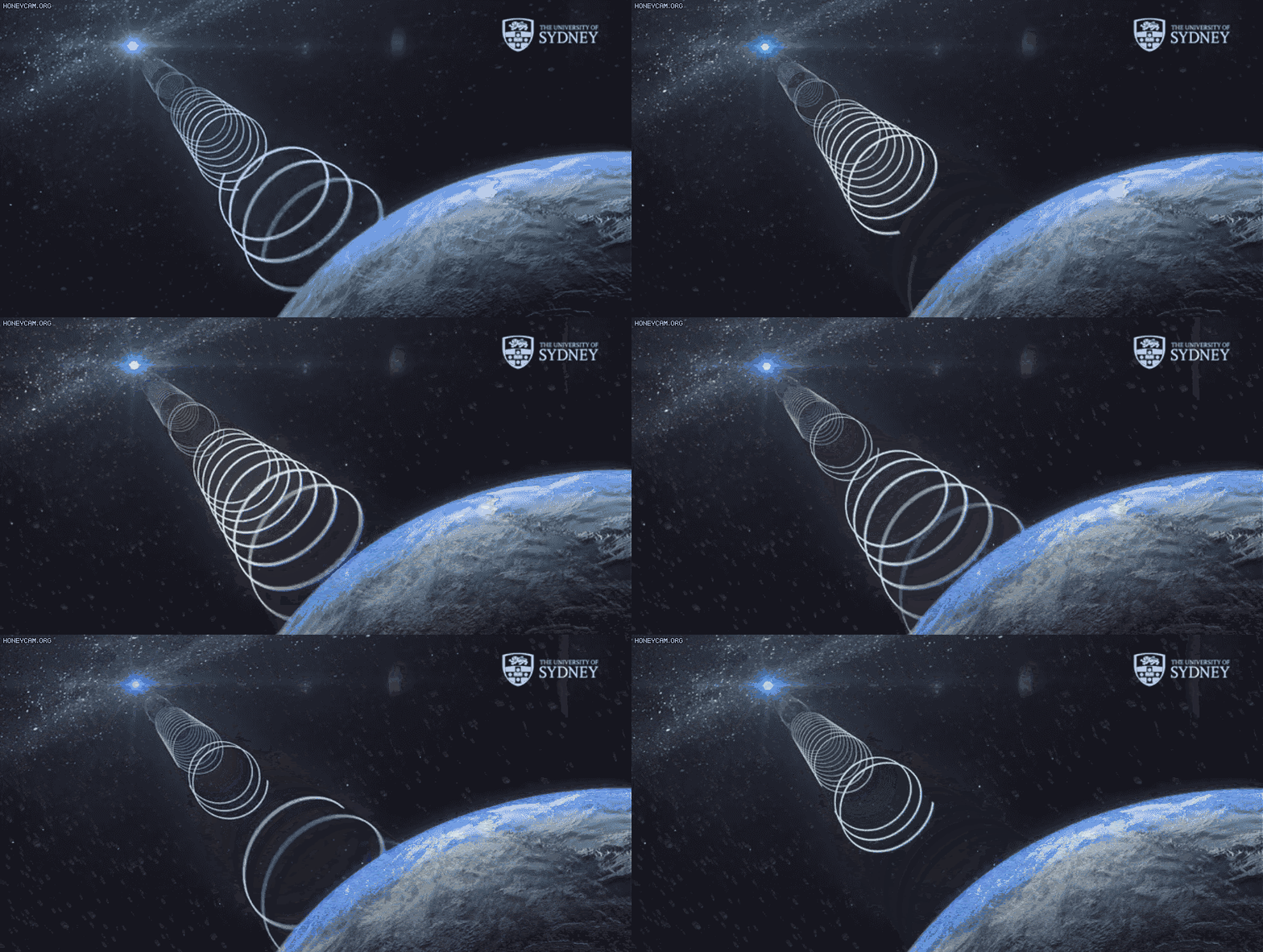 ASKAP J173608.2-321635 reaching Earth. Photo by Sebastian Zentilomo/University of Sydney Provided [Image source=Yonhap News]
[Asia Economy Reporter Park Hyun-joo] Recently, a radio source emitting strange radio signals that do not match any known celestial objects has been detected at the center of our galaxy, and this has been reported to the academic community. It is believed to be a new type of celestial object.
An international research team led by Dr. Tara Murphy, a physics professor at the University of Sydney, Australia, published their study on the mysterious radio signals captured by the radio telescope "Australian Square Kilometre Array Pathfinder (ASKAP)" in the journal Astrophysical Journal.
Initially, the team hypothesized that the radio source might be a pulsar, a neutron star that rotates rapidly and emits short, regular signals, or a star emitting solar flares, which are massive explosions on the star's surface. However, the signals emitted by the radio source did not match those from these types of celestial objects.
Wang Zhiteng (王子騰), a doctoral student and the first author of the paper, said, "The brightness of the celestial object changed dramatically by a factor of 100, and the signal randomly turned on and off. We have never seen such a signal before." He added, "The strangest characteristic is that the radio signal is highly polarized, meaning the light vibrates in only one direction and this direction rotates over time."
The research team first detected this signal while surveying new variable stars using ASKAP, which operates 36 dish antennas connected to function as a single telescope.
Professor Murphy, the supervising professor, reported that the radio source named ASKAP J173608.2-321635 "initially was not visible at all, then gradually brightened, disappeared, and reappeared, showing unique and strange behavior."
The team captured this radio signal six times over nine months starting last year and attempted observations using optical telescopes but detected nothing. They also tried observing with the Parkes radio telescope but achieved no significant results.
Subsequently, based on the fact that the radio signals were intermittently detected for 15 minutes at intervals of several weeks, the team used the more advanced South African radio telescope "MeerKAT" to retry and finally succeeded in observation.
However, unlike the ASKAP observations where the radio signals lasted for several weeks, with MeerKAT the signals disappeared within just one day, showing a dramatic difference. Because of this, additional observations using MeerKAT did not reveal much about the identity of the radio source.
Professor David Kaplan of the University of Wisconsin-Milwaukee said, "The information we have shows some similarities to a new type of mysterious celestial object known as 'Galactic Center Radio Transient (GCRT),' but there are also differences. We do not know much about this radio source, which only deepens the mystery."
Professor Murphy predicted, "When the intercontinental Square Kilometre Array (SKA) radio telescope becomes operational within the next 10 years, it will help solve mysteries like the one discovered this time."
© The Asia Business Daily(www.asiae.co.kr). All rights reserved.