Raising Awareness of Waste and Environmental Issues and Enhancing Residents' Understanding of Resource Circulation... Efforts for Resource Circulation by Village Clean Coordinators, Our Neighborhood Earth Care, and Earth Saving Groups
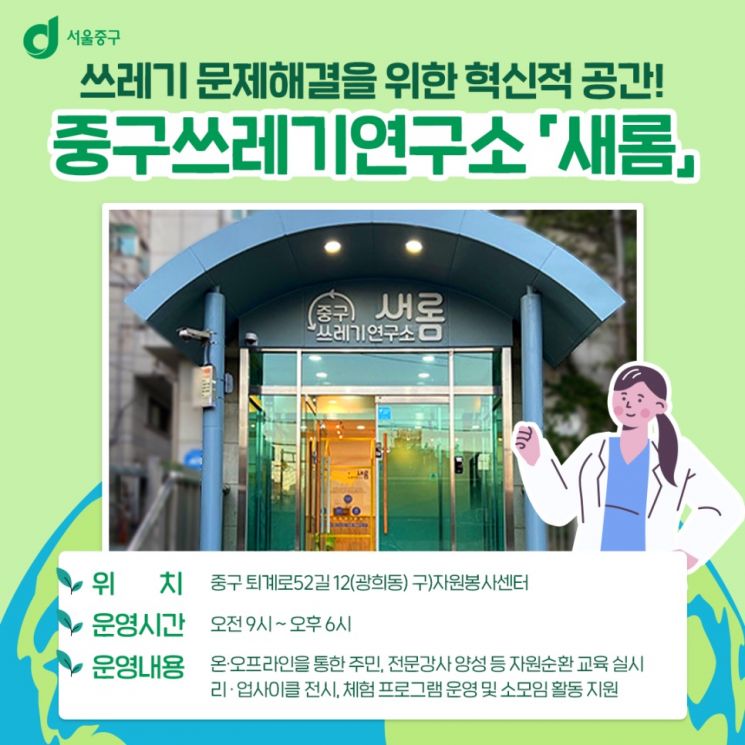
[Asia Economy Reporter Jong-il Park] Jung-gu, Seoul (Mayor Seo Yang-ho) will open the waste research center 'Saerom' on the 12th to seek creative solutions from the perspective of resource circulation regarding the anticipated waste crisis following the termination of the metropolitan landfill site operation in 2025 amid a surge in household waste due to COVID-19.
The waste research center 'Saerom' is a specialized educational facility established to raise residents' awareness of waste issues and resource circulation and to actively respond to the ongoing climate change crisis, inspired by the 'waste generation site treatment principle,' which states that waste generated in a region should be treated in that region.
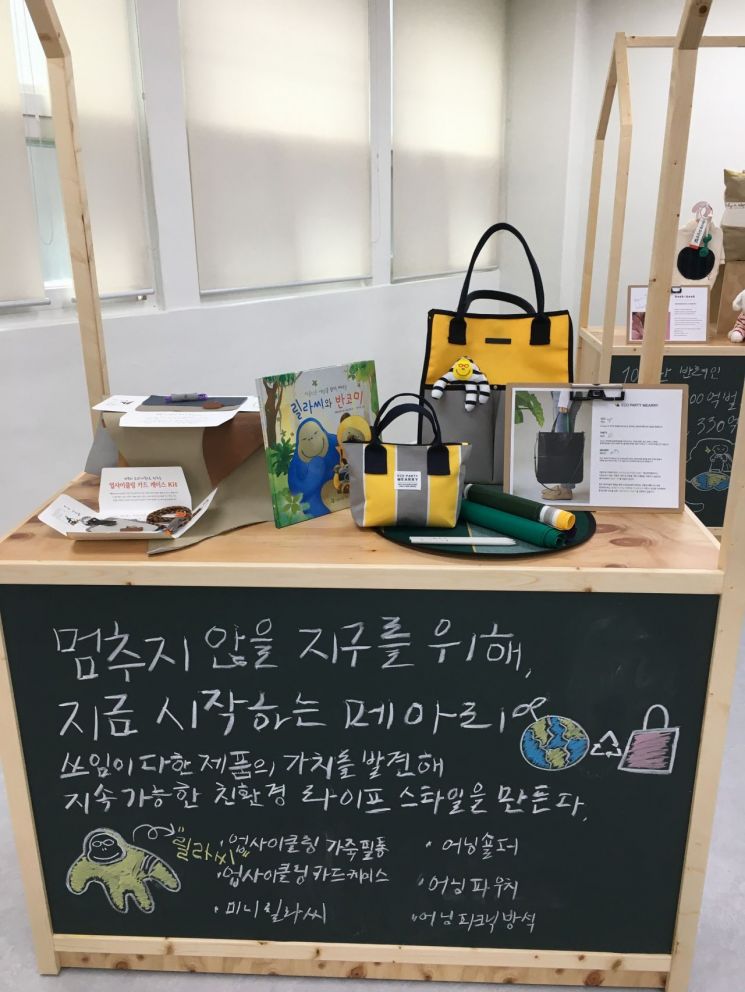
Located in Gwanghui-dong (52-2 Toegye-ro-gil), 'Saerom' is a specialized space designed to provide eco-friendly resource circulation education and support various related exhibitions and gatherings for residents to practice good disposal habits (emptying, rinsing, separating, not mixing) and the 4R eco-friendly habits in daily life [Refuse (not buying unnecessary items), Reduce, Reuse, Recycle]. It also serves as a resource circulation hub for promoting high-quality recyclable exchange projects such as paper packs and batteries.
In particular, children and adolescents, the future generation leaders, will be able to directly experience the enormous impact that waste and environmental issues have on the planet through 'Saerom' and will be provided with effective educational programs to practice proper waste separation and eco-friendly habits from an early age.
Since the introduction of the household waste total input quota system in 2020, the district has been implementing various policies to reduce waste.
The 'Village Clean Coordinator' project, launched in March, hires social job personnel by neighborhood to promote proper waste disposal culture through resident awareness campaigns on recycling separation and prohibition of illegal dumping, as well as to patrol habitual illegal dumping areas and manage blind spots in cleaning.
Additionally, the online resource circulation education program 'Our Neighborhood Earth Caretakers' educates residents on waste issues, the concept of resource circulation, waste separation, and zero-waste practices.
The district also selects 18 teams (69 members) for the 'Earth Saving Groups,' where residents form activity groups to learn and discuss various environmental topics and find solutions independently, providing each team with 200,000 KRW in activity funds.
Furthermore, a tour program is operated to change residents' perceptions of recycling sorting centers and treatment facilities.
As a result of these multifaceted efforts, as of the end of August, the district's household waste input rate was 57.2% of the district's quota of 65,045 tons, the best performance among Seoul's autonomous districts.
At the opening ceremony of 'Saerom,' the district signed a business agreement with Taekwang Industrial/Daehan Chemical Fiber, a leading local textile company, to promote a 'Waste PET Bottle Resource Circulation Joint Project.'
Unlike colored PET bottles, transparent PET bottles are high-quality recyclable resources with high resource circulation value, being recycled into eco-friendly clothing, bags, and more.
Along with the 'Separate Collection Day System for Transparent PET Bottles' to be expanded to single-family homes in December, this agreement is expected to enhance the recycling value of waste PET bottles and establish a resource circulation system that can reduce costs.
Starting with building a collection cooperation system to promote high-quality recycling of transparent PET bottles with Taekwang Industrial/Daehan Chemical Fiber, various activities will be carried out to realize a sustainable circular economy, including proper separation education and discovering and spreading excellent cases of resource circulation practice.
Mayor Seo Yang-ho said, "While clean waste treatment is important, proper disposal habits that connect good disposal to good use through eco-friendly practices are even more crucial," adding, "We will work together with all residents to make Jung-gu a resource circulation city."
© The Asia Business Daily(www.asiae.co.kr). All rights reserved.
![Clutching a Stolen Dior Bag, Saying "I Hate Being Poor but Real"... The Grotesque Con of a "Human Knockoff" [Slate]](https://cwcontent.asiae.co.kr/asiaresize/183/2026021902243444107_1771435474.jpg)

















