Local Interview in Washington, USA
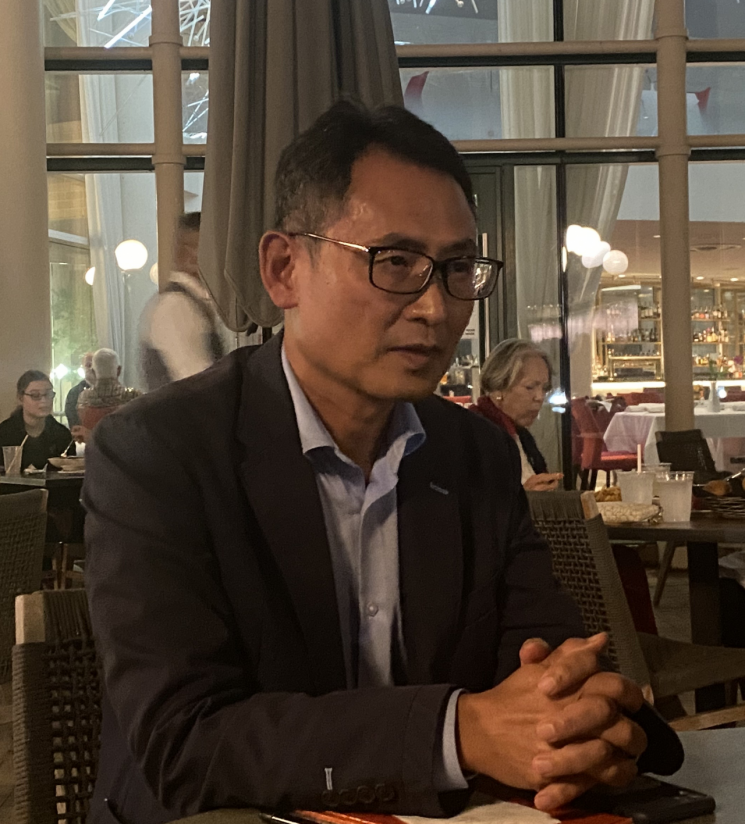 Heo Jang, Executive Director of the International Monetary Fund (IMF), is holding an interview in Washington, USA, on the 12th (local time).
[Washington (USA) = Asia Economy Reporter Son Sunhee] "We assess that Chinese authorities have policy measures to prevent the worsening of the 'Hengda crisis.' However, if they intervene too quickly without resolving structural problems, such incidents may recur repeatedly in the future, and conversely, if intervention is too delayed, costs may arise."
On the 12th (local time), in an interview held in Washington, USA, IMF Managing Director Kristalina Georgieva commented on the so-called 'Hengda crisis,' which has recently emerged as a negative factor in the global financial market, saying, "We expect the Chinese government to respond by judging the appropriate timing and scale."
Recently, concerns have spread that the bankruptcy crisis of Hengda Group, China's largest private real estate developer, could shock the international financial markets, including emerging countries. It is said that some IMF board members, composed of 24 representatives from various countries, also raised concerns about the Hengda crisis.
Managing Director Georgieva drew a line against excessive crisis theories, stating, "So far, the impact of the Hengda Group crisis on China's real estate development industry or financial market has been limited." The basis is that most of the debt of Chinese companies is denominated in yuan, and the Chinese government ultimately holds a significant stake in the banks bearing these companies' debts. She judged that the situation is sufficiently controllable through policy intervention by the Chinese government.
However, Managing Director Georgieva expressed caution, saying, "If the risk expands to the entire financial market, it could affect not only the Chinese economy and financial market but also the international financial market, so continuous monitoring of the situation is necessary." She analyzed, "Although banks' direct exposure to Hengda Group is limited, if anxiety spreads throughout the real estate development sector, the risks of various related financial institutions may increase, which would negatively impact the Chinese economy. If the Chinese economy contracts and financial conditions deteriorate, global investment sentiment may shrink, worsening the financial conditions of emerging economies." In this regard, the IMF's 'Global Financial Stability Report' released that day separately included an assessment of risks related to Hengda Group.
Meanwhile, regarding South Korea's fiscal management situation, Managing Director Georgieva evaluated, "Despite a sharp increase in national debt due to COVID-19 response, it remains stable compared to other countries," but emphasized, "Systematic fiscal soundness management is necessary to prepare for future aging." Especially about the 'Fiscal Rules' bill pending in the National Assembly, she urged, "I hope a final version will be derived by broadly gathering opinions from the National Assembly, academia, and others based on the government's proposal," and pointed out, "Considering the interest and expectations credit rating agencies have shown toward the introduction of fiscal rules, delays in legislation may weaken the credibility of South Korea's efforts to improve fiscal soundness."
Regarding the recent high inflation rate in the mid-2% range despite the South Korean government's efforts to stabilize prices, she said, "It is a temporary phenomenon due to supply disruptions and rising energy and food prices," and predicted, "Considering idle labor and the GDP output gap (actual growth rate - potential growth rate), it is expected to fall back to the 1% range next year."
Also, as the South Korean government is actively promoting a phased return to normal life (With COVID), the IMF also shares the consensus that the complete end of COVID-19 will be difficult, Managing Director Georgieva conveyed. She said, "COVID-19 will not completely disappear with vaccination alone," and suggested, "Therefore, it is necessary to improve healthcare systems in each country to prepare for the 'pandemic to endemic' transition."
A pandemic refers to a 'global outbreak' of a specific disease, while an endemic means a 'local disease.' In other words, it is a forecast that COVID-19 will not disappear after global spread but will become a native disease, a concept consistent with the government's 'With COVID' response.
Managing Director Georgieva added, "I understand that major countries overseas are also promoting a transition to a sustainable quarantine system coexisting with COVID-19 as fatality rates decline with increased vaccination rates."
© The Asia Business Daily(www.asiae.co.kr). All rights reserved.

















