Citibank Labor and Management Begin Discussions on Voluntary Retirement Plan Last Week
Union: "Need to Know Sale Method to Decide on Voluntary Retirement"
Partial Sale and Gradual Phase-Out Likely to Prolong Situation
Unlikely to Complete Retail Banking Withdrawal Within This Year
[Asia Economy Reporter Song Seung-seop] The labor and management of Citibank Korea have entered full-scale negotiations over the domestic consumer finance withdrawal strategy and voluntary retirement plan. It is expected that the union's acceptance of voluntary retirement will be determined according to the sale scenario, and there are observations that it will be impossible to complete the process within the year as originally planned by the management.
According to the financial sector on the 12th, Citibank set up a negotiation table between labor and management last week to discuss the conditions for voluntary retirement. Since the meeting was largely a courtesy meeting between labor and management officials, detailed condition adjustments are expected to continue from this week.
Previously, Citibank proposed a voluntary retirement plan that separately pays up to 700 million KRW as a special retirement allowance, covering most of the remaining annual salary. This was based on the judgment that downsizing before the sale was necessary due to the large number of high-salary personnel. The main point is that if there are more than five years left until retirement age, 90% is paid; if less than five years remain, the remaining months are multiplied by the monthly salary. Additionally, a scholarship of 10 million KRW per university student child is provided.
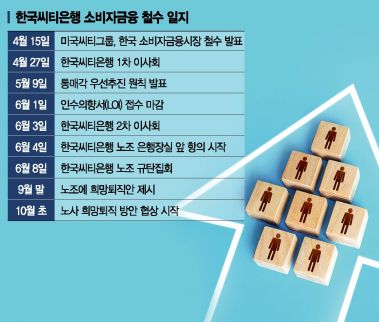
In the industry, there is growing speculation that the sale method of Citibank will be decided or disclosed during the voluntary retirement negotiation process. This is because the union demanded to know the sale method from the management in order to discuss voluntary retirement. A Citibank union official explained, "In the case of the sales department, employees need to know where the company is being sold to decide on voluntary retirement," adding, "Even departments not being sold need to know what roles they will have in future internal reallocations."
Citibank is currently considering its consumer finance withdrawal strategy among full sale, partial sale, and phased closure (liquidation). Initially, Citibank planned to hold a meeting in July to finalize the exit strategy direction, but the decision has been postponed repeatedly, and no judgment has been made yet.
Once Citibank decides on the sale method, the schedule for voluntary retirement and exit strategy is also expected to change. The fastest scenario is for the management to successfully complete the full sale of retail finance as demanded by the union and some political circles. Since the management's voluntary retirement proposal is evaluated as 'exceptional' and the opinion among employees is generally positive, if a sudden agreement is reached, the sale process is likely to accelerate rapidly.
Voluntary Retirement Entangled with Sale... Sale Within the Year Practically Impossible

The situation becomes complicated from the partial sale procedure. Financial companies that have expressed interest in acquisition have shown reluctance to take over all employees due to labor cost burdens, making the full sale plan practically unfeasible. The market also evaluates that partial sale, splitting off profitable business units such as wealth management (WM) or credit cards, is the most realistic sale method. Furthermore, since the union has shown a stance that it is fundamentally difficult to accept partial sales, negotiations are bound to be prolonged.
If most departments undergo phased closure or if the sale negotiations fail, leading to the liquidation of the entire retail finance, there is a heightened risk of strong union opposition and large-scale strikes. The Citibank union already obtained strike rights with 93.2% approval from union members through a strike vote in June. If labor and management escalate to a hardline confrontation, customers will suffer inconvenience and damage, and a large-scale unemployment crisis will ensue.
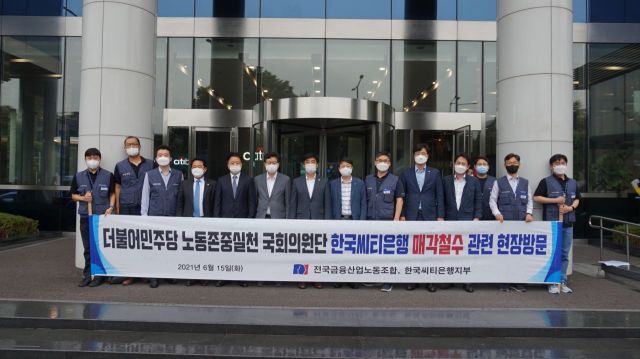
As the presidential election approaches, there is also a sensed atmosphere of concern over unexpected political variables. With the Democratic Party and People Power Party presidential candidates launching full-scale campaigns, voices may be raised regarding labor issues arising from financial company sales. In fact, in June, six lawmakers from the Democratic Party's Labor Respect Practice Group visited Citibank to request measures for customer protection and employment stability.
However, the industry consensus is that a sale within the year has become impossible regardless of the scenario. Historically, Citibank's voluntary retirement negotiations have taken about a month on average. Now, with the sale issue involved, it inevitably takes more time. Even if workforce restructuring is completed quickly, a preferred bidder must be selected and approval from the Financial Services Commission obtained. In Australia, where Citigroup is also pursuing retail finance sales alongside Korea, the final buyer was decided in August, but due to approval procedures, the process is expected to be completed by March next year at the earliest.
The financial authorities are also maintaining a cautious stance regarding the Citibank sale. On the 6th, at the National Assembly's Finance and Economy Committee audit, Financial Services Commission Chairman Ko Seung-beom responded to the question, "Is partial sale of Citibank subject to FSC approval?" by saying, "We will review it later after the sale method is decided."
© The Asia Business Daily(www.asiae.co.kr). All rights reserved.

![Clutching a Stolen Dior Bag, Saying "I Hate Being Poor but Real"... The Grotesque Con of a "Human Knockoff" [Slate]](https://cwcontent.asiae.co.kr/asiaresize/183/2026021902243444107_1771435474.jpg)
















