Expansion of Additional School Attendance in November with Transition to With-Corona
Infection Routes of Student Confirmed Cases at School One-Third of Family Level
Second Semester Attendance Rate 78.8%, Up from 73.1% in First Semester
16-17 Year-Old Vaccination Reservation Rate 47.3% in One Week
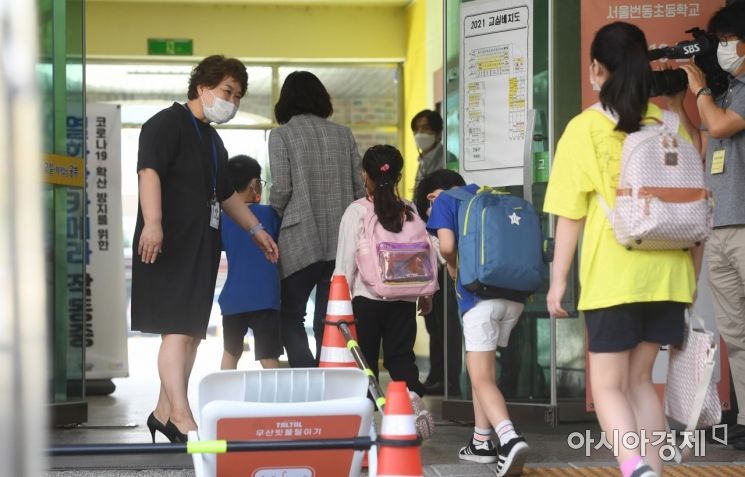 On the 6th, students are attending school at Beondong Elementary School in Gangbuk-gu, Seoul, where face-to-face classes have expanded in areas under Level 4 social distancing. In regions with Level 4 distancing, grades 1 and 2 in elementary school attend every day, grades 3 to 6 attend at no more than half capacity, and middle school students attend at no more than two-thirds capacity. For high schools, seniors (grade 3) who are exempt from density restrictions attend every day, while grades 1 and 2 attend at half capacity or may also attend fully.
[Sejong=Asia Economy Reporter Han Jinju] The Ministry of Education is considering expanding additional in-person attendance in the metropolitan area in line with the 'With Corona' (gradual recovery of daily life) quarantine system that will change from early next month.
At a press briefing held at the Government Complex Sejong on the 12th, Deputy Prime Minister and Minister of Education Yoo Eun-hye said, "We will begin full-scale preparations for plans to restore daily life in schools in cooperation with education offices and the Korea Disease Control and Prevention Agency," adding, "It is time to expand in-person attendance further, especially in the metropolitan area where the current attendance rate remains at 68.9%, and to prepare plans to normalize educational activities such as experiential activities and club activities, which have been restricted until now."
The Ministry of Education plans to review the content, level, and timing of educational recovery, including additional expansion of in-person attendance and normalization of educational activities, in line with the government's With Corona policy. They will consult with quarantine authorities, metropolitan and provincial education offices, and gather opinions from teachers and parents.
According to the Ministry of Education, even after the expansion of in-person attendance in September, the proportion of infection routes among confirmed student cases attributed to schools (16.45%) remained about one-third of that attributed to families (46.9%). The start of COVID-19 vaccinations for children and adolescents from the 18th and the fact that adult vaccination rates have exceeded 80% for the first dose, reducing infection risk, are among the reasons for promoting expanded in-person attendance.
Since the second semester began, the attendance rate has increased, and the number of schools switching entirely to remote classes when student cases occur has decreased. As of the fifth week of September, the average daily number of confirmed student cases was 192.0, but the number of schools that switched to remote classes was 84, down from 108 schools in the first week of April.
The attendance rate for kindergartens and elementary, middle, and high schools in the second semester was 78.8% in September, up from 73.1% in the first semester. By region, non-metropolitan areas mostly at level 3 social distancing had an attendance rate of 91.3%, while the metropolitan area at level 4 had 65.8%. The highest attendance rate was in Jeonnam (98%), and the lowest was in Gyeonggi (67.6%). Since September 6, the attendance criteria were relaxed to allow full attendance at level 3 social distancing and up to two-thirds attendance at level 4, leading to an increase in attending students.
Vaccinations for children and adolescents are also progressing steadily. As of the 11th, the reservation rate for vaccinations for 16-17-year-olds, which began on the 5th, was 47.3% (424,890 people). Reservations for vaccinations for 12-15-year-olds will begin on the 18th. Vaccinations for those aged 12 and older are being implemented not only in Korea but also in the United States, Germany, the United Kingdom, and Japan.
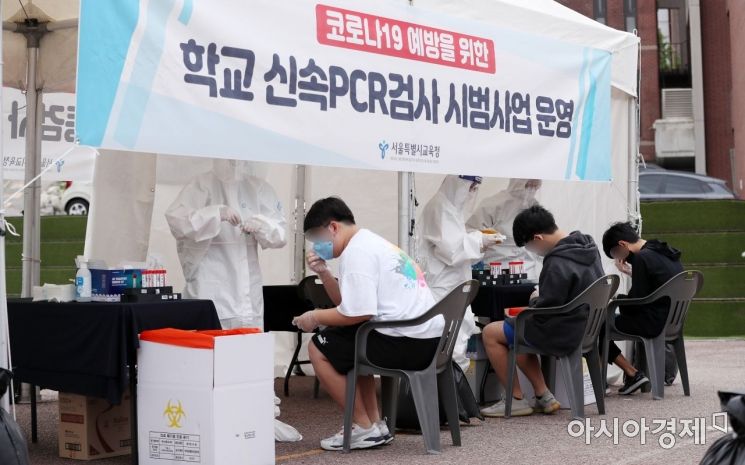 On the morning of the 28th, students at Dongseong High School in Jongno-gu, Seoul, underwent rapid self-molecular diagnostic gene amplification (rapid PCR) tests as they arrived at school. Photo by Joint Press Corps
The atmosphere is also gradually shifting toward expanding in-person classes at universities. As of October, the proportion of in-person classes at universities was 25.2%.
As of October 1, the proportion of in-person classes at universities increased by 4.1 percentage points from the previous month to 25.2%, while the proportion of remote classes decreased by 4.4 percentage points to 44.6%. The proportion of in-person classes is higher at junior colleges (26.7%) than at general universities (24.6%).
In particular, in-person classes are mainly conducted for experimental, practical, and skill-based courses (45.0%), which increased by 7.5 percentage points compared to the previous month. For theoretical and integrated courses, in-person classes (18.6%) are about one-third of the remote class rate (51.6%).
Seoul National University and Sungkyunkwan University have decided to gradually expand in-person classes from this month only for experimental, practical, skill-based, or small-sized classes. Chungbuk National University also conducts in-person classes for courses where the number of students is less than half of the capacity and for courses exceeding 50% capacity, with the consent of the students.
The Ministry of Education recommended further expansion of in-person classes from October, and currently, 88.0% of those aged 18-29 have completed the first dose of vaccination. The completion rate for the second dose is 49.0%.
The Ministry of Education explained, "The vaccination rate is relatively high among the main age group of university students in their early 20s (19-25 years old). As the vaccination rate increases, a high infection prevention effect can be expected, so active encouragement of vaccination among campus members is necessary."
© The Asia Business Daily(www.asiae.co.kr). All rights reserved.
![Clutching a Stolen Dior Bag, Saying "I Hate Being Poor but Real"... The Grotesque Con of a "Human Knockoff" [Slate]](https://cwcontent.asiae.co.kr/asiaresize/183/2026021902243444107_1771435474.jpg)

















