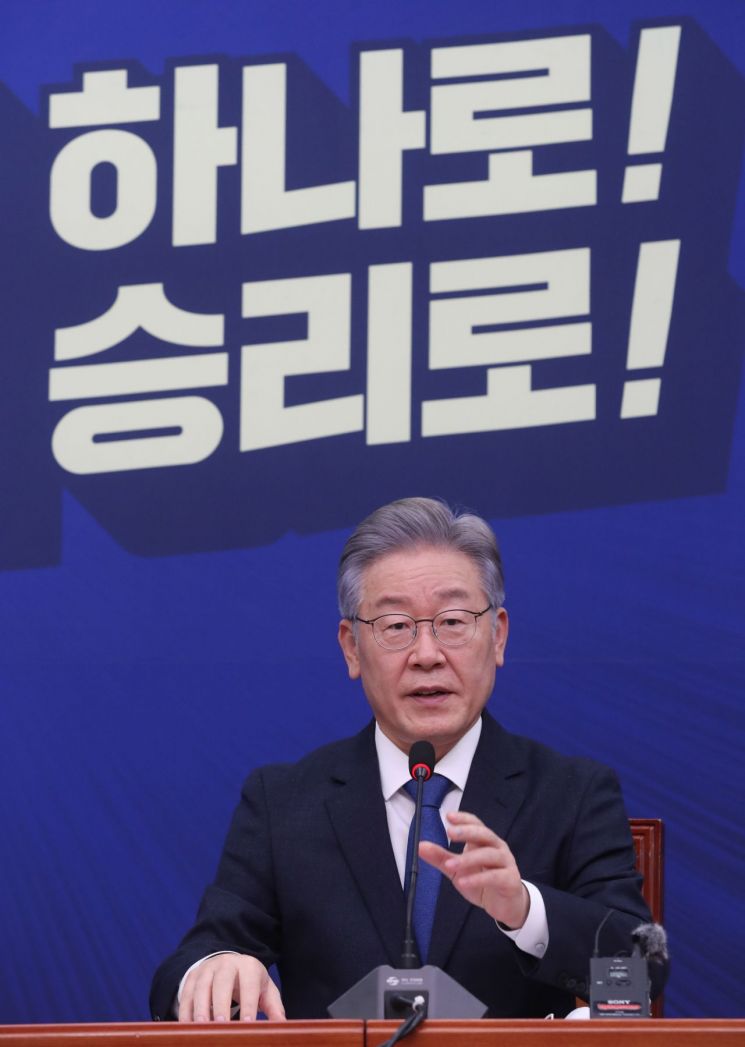
[Asia Economy Reporter Kwon Jae-hee] Major Japanese media outlets have collectively reported that Lee Jae-myung, Governor of Gyeonggi Province, has been confirmed as the Democratic Party's presidential candidate. In particular, Japanese media focused on Lee's tough remarks directed at Japan.
Japan's largest daily, Yomiuri Shimbun, on the 12th published a print article titled "South Korean Presidential Election, Ruling Party Candidate a Hardliner on Japan," reporting that after Lee was selected as the Democratic Party's presidential candidate, he expressed his ambition to "surpass Japan." The article also mentioned that Lee said Japan's export restrictions were "completely overcome in a short period," describing him as "a figure well known for his tough remarks against Japan."
In a separate related article, Yomiuri referred to Lee's past statements on the comfort women issue, including that it was "a long-term collective sexual violence against Korean women," and predicted that if he takes power, he is likely to continue the Moon Jae-in administration's hardline stance on Korea-Japan relations.
The newspaper also introduced scandals surrounding Lee, such as the Daejang-dong allegations and a women's scandal.
Asahi Shimbun reported that Lee has caused controversy with blunt remarks and was involved in a women's scandal, and that he made strong statements about Japan, calling it "an invading country that occupied the Korean Peninsula by force" and "an adversary nation."
Mainichi Shimbun introduced Lee, who is sometimes called "South Korea's Trump" due to his outspoken behavior, as having gained nationwide support evenly from non-mainstream factions within the Democratic Party to become the presidential candidate, and highlighted his key pledge of introducing a basic income that provides the minimum necessary money for living.
Mainichi added that at his campaign announcement, Lee emphasized the significance of basic income by saying, "I will create a society where anyone can enjoy at least a minimum level of economic prosperity and do what they want."
However, regarding relations with Japan, Lee is described as a "hardliner," advocating a full review of the 2015 Korea-Japan comfort women agreement and strongly opposing the depiction of Dokdo on the Tokyo Olympic and Paralympic Organizing Committee's website.
Tokyo Shimbun introduced that Lee, who has made tough remarks targeting Japan, said in an interview with their paper last year, "I am not hostile to Japan. Political diplomacy and economic-social issues should be distinguished."
The newspaper forecasted that Lee, lacking national government experience and with uncertain diplomatic skills, will face a test of his sense of balance in handling Korea-Japan, US-China conflicts, and North Korea issues.
Nihon Keizai Shimbun explained that Lee presents himself as a pragmatist who values reality over ideology, and that his flagship pledge is the introduction of a basic income system based on pragmatism.
The paper reported that Lee's camp advocates pragmatism in diplomacy as well, promising to build a future-oriented Korea-Japan relationship if he takes power, but predicted complications in Korea-Japan relations.
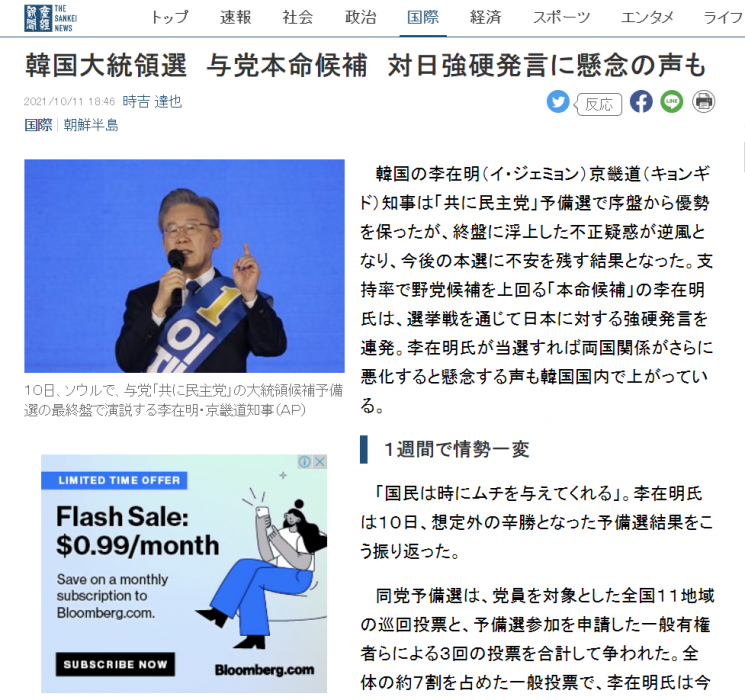
The right-leaning Sankei Shimbun detailed Lee's past remarks related to Japan and claimed that voices expressing unease about his stance toward Japan are also emerging in South Korea.
© The Asia Business Daily(www.asiae.co.kr). All rights reserved.


















