Foreigners Net Sell 517.8 Billion KRW This Month
IT Supply Disrupted by China's Power Restrictions
Target Stock Price Lowered to 90,000 KRW Range
"Volatile Market Continues; Q3 Earnings Turnaround Is Key"
[Asia Economy Reporter Song Hwajeong] Samsung Electronics' stock price has fallen below the 70,000 won mark for the first time in over 10 months, intensifying market uncertainty.
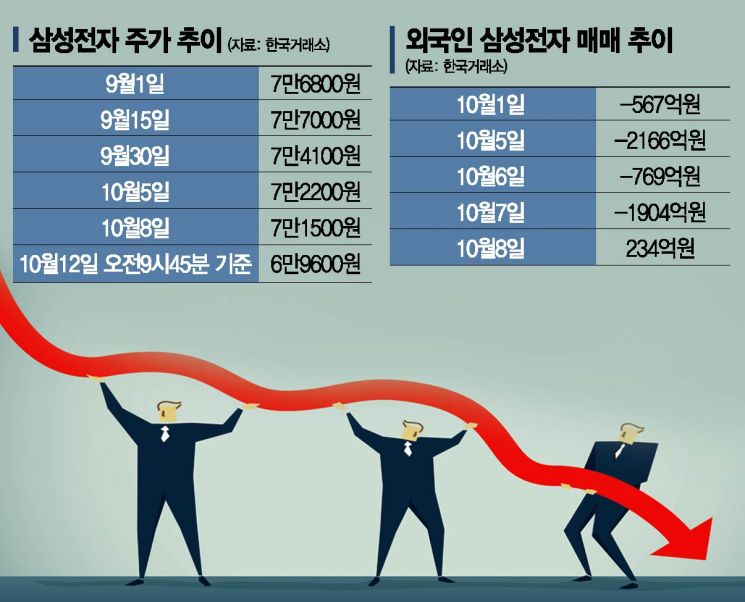
As of 10:01 AM on the 12th, Samsung Electronics was trading at 69,500 won, down 2,000 won (2.8%) from the previous day. This is the first time since early December last year that the price has dropped into the 60,000 won range. Samsung Electronics has fallen 3.5% so far this month until the previous day. During the same period, the KOSPI dropped 3.67%, showing a similar trend to Samsung Electronics.
Foreign selling is dragging down Samsung Electronics' stock price. Foreign investors have net sold Samsung Electronics by 517.8 billion won since the beginning of this month until the previous trading day, making it the most sold stock. Except for one day this month, foreign investors have shown a selling trend every day.
Samsung Electronics, which has been hampered all year by IT supply chain disruptions, appears to be struggling again as the recently emerged China power restriction issue negatively affects the memory market. Choi Doyeon, a researcher at Shinhan Financial Investment, said, "Due to the extension of IT supply chain disruptions caused by China's power restriction issue, we slightly lower Samsung Electronics' memory performance forecast for next year and reduce the target stock price by 4% to 96,000 won," adding, "The IT supply chain disruption issue is likely to peak in the fourth quarter, and October to November will be the period to confirm the peak of uncertainty."
Securities firms are steadily lowering Samsung Electronics' target stock price. KB Securities lowered Samsung Electronics' target price from 105,000 won to 100,000 won on the same day. KB Securities researcher Yoo Woohyeong explained, "Due to China's power shortage, production disruptions of post-processing parts such as printed circuit boards (PCBs) and supply shortages of non-memory semiconductors are prolonging," adding, "Set manufacturers are simultaneously experiencing demand forecast uncertainties and production disruptions." Eugene Investment & Securities also lowered the target price from 100,000 won to 93,000 won, citing concerns about economic slowdown, increased safe-haven sentiment, renewed instability in exchange rates and interest rates, and emerging stagflation (economic slowdown with inflation) debates.
The decline of Samsung Electronics, the market leader, is expected to further amplify anxiety in the stock market, which is already shaken by domestic and international uncertainties. On the same day, the KOSPI fell more than 1%, putting the 2,900-point level in jeopardy. Shinhan Financial Investment researcher Noh Donggil analyzed, "The KOSPI has recorded a decline rate surpassing the year’s high due to rising U.S. interest rates, worsening global supply chain disruptions, and difficulties in U.S. fiscal policy," adding, "The impact of global supply chain disruptions is difficult to gauge immediately and could lead to slower growth and reduced corporate profits this year."
NH Investment & Securities researcher Kim Younghwan said, "The risk in the stock market has partially eased as the U.S. debt ceiling negotiation deadline is likely to be extended to December," but added, "However, risks such as the Chinese real estate market, global supply chain disruptions, and the potential re-ignition of the U.S.-China trade dispute remain, so the stock market is expected to continue fluctuating with high volatility around the current index level rather than showing a sharp rebound in the short term."
For market instability to ease, third-quarter earnings are expected to be crucial. Daishin Securities researcher Kim Jiyoon said, "For a trend reversal to an upward trajectory in the KOSPI, it is necessary to resolve risk factors or have events that can reverse the weakened investment sentiment or resume upward revisions of earnings forecasts," adding, "The immediate third-quarter earnings season results are important, and if the third-quarter earnings record a significant earnings shock far below consensus, the domestic stock market may face a difficult environment for some time."
© The Asia Business Daily(www.asiae.co.kr). All rights reserved.

















