Korean Researchers Confirm Brain Activity More Active When Defending Food Than Taking It Through Ultra-Small Wireless Brain Signal Measurement Device in Animal Experiments
Brain Activity Found More Active When Defending Food Than Taking It
[Asia Economy Reporter Kim Bong-su] There is an old saying, "Starting a business (創業) is easy, but maintaining it (守成) is difficult." It means that protecting what you have achieved is harder than attaining the goal. A Korean research team has indirectly proven that this human proverb is based on animal instincts by analyzing brain signals of animals. Brain activity was found to be more intense when animals tried to defend food than when they tried to seize it.
The Institute for Basic Science (IBS) announced on the 12th that the research team led by Shin Hee-seop, Honorary Research Fellow of the Center for Cognition and Sociality, in collaboration with the team led by Cho Il-joo, Director of the Brain Science Institute at the Korea Institute of Science and Technology (KIST), developed an "ultra-small wireless brain signal measurement system" and conducted animal experiments that led to this conclusion.
"Competition" is a representative social interaction, but although the medial prefrontal cortex has been known to be involved, little has been revealed neuroscientifically. Most existing brain signal measurement tools are wired and heavy, limiting their use in animal experiments. Recently developed wireless systems faced difficulties in social experiments requiring multiple animals due to signal interference between systems.
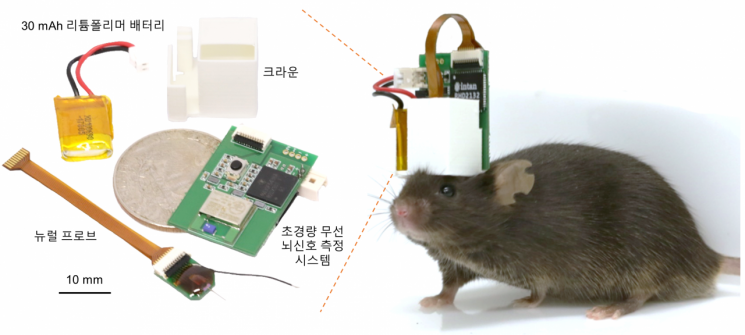
The research team overcame these limitations by developing an "ultra-small wireless brain signal measurement system." This system applies Bluetooth wireless communication and signal analysis chips to simultaneously measure and analyze brain activity of multiple mice wirelessly in real time. It is very small and light (1.5x1.5x2cm, 3.4g), causing no restrictions on animal behavior.
To find the link between behavior and brain activity during competition, the researchers equipped two food-deprived mice with the developed system and conducted a food competition experiment. When two mice entered the starting area inside a rectangular box simultaneously, food was provided on the opposite side to induce competition. Analysis of the medial prefrontal cortex confirmed that brain activity increased when the mice seized or defended the food. This shows that the medial prefrontal cortex is directly related to the behavior of seizing and defending targets during competition.
In particular, brain activity became more intense when the behavior shifted from seizing the opponent's food to defending it. This means that defending a target during competition is more difficult and important than acquiring it.
Director Cho Il-joo said, "We have developed a useful tool for observing changes in brain signals according to behavior," adding, "We plan to add various functions such as drug delivery and light stimulation to contribute to elucidating brain operation principles and conquering brain diseases."
Honorary Research Fellow Shin Hee-seop stated, "This is the first time that important behavioral types in freely behaving animal competition have been discovered and the corresponding brain signals observed," and added, "We plan to expand its application to various sociality studies including competition."
The research results were published online on the 5th in the international journal Biosensors and Bioelectronics (IF 10.618).
© The Asia Business Daily(www.asiae.co.kr). All rights reserved.
![Clutching a Stolen Dior Bag, Saying "I Hate Being Poor but Real"... The Grotesque Con of a "Human Knockoff" [Slate]](https://cwcontent.asiae.co.kr/asiaresize/183/2026021902243444107_1771435474.jpg)
















