Ministry of Environment: "Impact of Strengthened Emission Standards, Seasonal Management System Implementation, Voluntary Reduction Efforts by Businesses, and Economic Conditions"
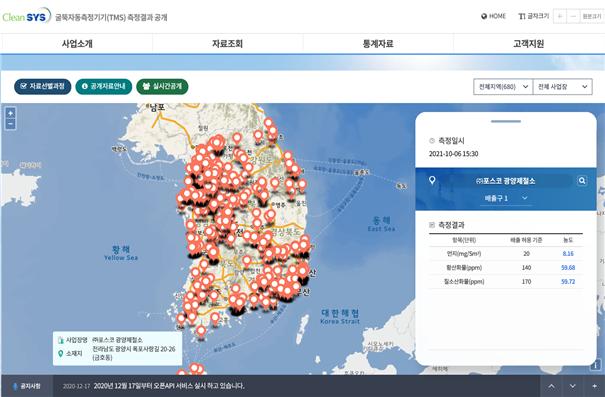
[Sejong=Asia Economy Reporter Joo Sang-don] The Ministry of Environment announced on the 11th that the total annual air pollutant emissions in 2020 from 648 large-scale business sites nationwide equipped with automatic stack monitoring systems (TMS) amounted to 205,091 tons, a decrease of 72,604 tons (26%) compared to 2019.
This statistic analyzed the annual emissions of seven types of air pollutants, including nitrogen oxides, measured in real-time at 648 business sites equipped with automatic stack monitoring systems out of 4,104 large-scale business sites (Types 1 to 3) nationwide.
By pollutant, nitrogen oxides accounted for the largest share at 145,934 tons (71%). This was followed by sulfur oxides at 51,706 tons (25%), dust at 4,577 tons (2%), and carbon monoxide at 2,284 tons (1%).
The emissions of dust, sulfur oxides, and nitrogen oxides, which are major causes of fine dust, totaled 202,218 tons, a decrease of 72,544 tons (26%) compared to the previous year (2019), showing a continuous downward trend over the past five years.
An official from the Ministry of Environment stated, "This appears to be the combined effect of policies such as strengthening emission standards for business sites, the introduction of nitrogen oxide emission charges, the expansion of voluntary reduction agreements among large business sites, as well as economic factors."
By industry, power generation accounted for the largest share of total emissions at 77,936 tons (38%). This was followed by cement manufacturing at 50,295 tons (25%), iron and steel manufacturing at 44,491 tons (22%), and petrochemical products at 18,911 tons (9%).
The reductions compared to the previous year (2019) were in the order of power generation (-34,282 tons), iron and steel manufacturing (-13,380 tons), cement manufacturing (-13,292 tons), and petrochemical products (-8,021 tons).
The Ministry of Environment estimates that the main reasons for the emission reductions are the decrease in coal usage due to seasonal management systems and reduced power generation in the power generation sector, and improvements in pollution control facilities in the iron and steel manufacturing sector.
Meanwhile, a survey conducted on 22 major business sites with high emissions in the top pollutant-emitting industries (power generation, cement, manufacturing, and petroleum refining) found that the policies incentivizing pollutant reduction were, in order, ▲strengthening emission standards ▲voluntary reduction agreements ▲fine dust seasonal management system ▲nitrogen oxide emission charges ▲disclosure of pollutant measurement concentrations. The main methods for reducing major pollutants were found to be replacement or installation of pollution control facilities, fuel replacement, and use of alternative fuels.
© The Asia Business Daily(www.asiae.co.kr). All rights reserved.

















