Financial Sector Raises Loan Thresholds Amid Household Loan Volume Regulations
Real Demand Borrowers 'Panic'... Loan Shortage Expected to Worsen Toward Year-End
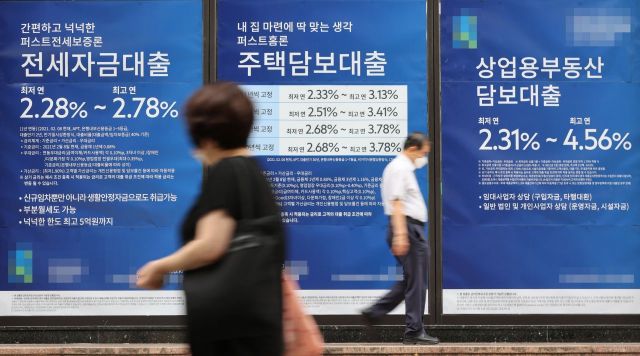
[Asia Economy Reporter Kim Jin-ho] Due to the financial authorities' strong determination to maintain this year's 'household loan total volume regulation' at the 6% level, a clear 'regulatory balloon effect' is emerging not only in banks but also in the secondary financial sector. Major commercial banks, as well as Toss Bank, which just launched this week, are facing the reality of exhausting their loan limits. This tightening of loans is expected to continue until the end of the year, raising concerns that actual borrowers may suffer.
According to the financial sector on the 9th, Kakao Bank will completely suspend new loans for high-credit borrowers' unsecured loans, general jeonse and monthly rent deposit loans, and employee bridge loans until the end of the year. Having already stopped issuing overdraft loans, Kakao Bank has decided to block all loans except those for vulnerable groups.
The background of this decision is the impact of the financial authorities' total household debt regulation. Kakao Bank explained that this measure is to comply with the financial authorities' household debt total volume regulation standards.
Toss Bank, which started operations on the 5th, is also expected to suspend loan issuance as early as this holiday period. This is because it exhausted 40% (about 200 billion KRW) of its loan limit within just three days of operation. The financial authorities have instructed Toss Bank not to exceed 500 billion KRW in loans by the end of the year.
The proportion of Toss Bank's loan amount in the total household debt scale is not large. However, as comprehensive loan tightening is occurring mainly in the banking sector, there has been a significant increase in speculative demand seeking Toss Bank, where loans are relatively easier to obtain.
On the 8th, K Bank also decided to limit individual unsecured loan limits to 'within the annual income range.' For three unsecured loan products?unsecured loans, overdraft loans, and Credit Loan Plus, which has a strong mid-interest loan characteristic?the individual limit will be applied within 100% of the annual income.
The situation is similar in the mutual finance sector. As demanders who cannot pass the bank loan threshold flock, there is a recent trend of completely suspending household loans.
First, the Korea Forestry Cooperative plans to completely suspend household loans for quasi-members and non-members starting next week. This includes suspending unsecured loans, mortgage loans, and even non-residential secured loan products secured by land or forest land. The Fisheries Cooperative has already completely suspended new household loans since the 1st. Not only non- and quasi-members but also members cannot receive new mortgage loans, jeonse deposit loans, or interim payment group loans.
The largest, the National Agricultural Cooperative Federation, also suspended new group loans, jeonse deposit loans, and mortgage loans for non-members and quasi-members at nationwide agricultural and livestock cooperatives in August.
The problem lies with actual borrowers. The pressure of household loan total volume regulation is bound to intensify toward the end of the year. This means more financial companies will stop issuing loans in the future. Borrowers who had planned jeonse or mortgage loans for the autumn moving season are already in a panic. On major real estate communities, dozens of posts asking which banks or branches still offer loans appear daily. A financial sector official pointed out, "The sudden loan suspension decisions by financial companies can only be bewildering for actual borrowers," adding, "Measures to protect actual borrowers must be prepared to alleviate their anxiety."
Meanwhile, the financial authorities plan to announce additional household debt measures, including the early introduction of the Debt Service Ratio (DSR) and regulations on jeonse loans, by mid-month. On the 6th, Financial Services Commission Chairman Ko Seung-beom stated at the National Assembly audit that while managing actual borrowers' loans is inevitable, additional measures will be prepared to minimize their damage.
© The Asia Business Daily(www.asiae.co.kr). All rights reserved.

















