[Asia Economy Reporter Suyeon Woo] In the third quarter of this year, Samsung Electronics surpassed quarterly sales of 70 trillion won for the first time, achieving record-high sales. This was thanks to the semiconductor market boom fueled by the COVID-19 special demand. Not only Samsung but also LG Electronics is expected to post record-breaking third-quarter results by continuing to benefit from the COVID-19 demand surge.
On the 8th, Samsung Electronics announced that its third-quarter sales for this year were tentatively estimated at 73 trillion won, with an operating profit of 15.8 trillion won. Compared to the same period last year, sales increased by 9% and operating profit by 28%. This is the first time Samsung Electronics' quarterly sales have exceeded 70 trillion won, marking the highest quarterly sales ever.
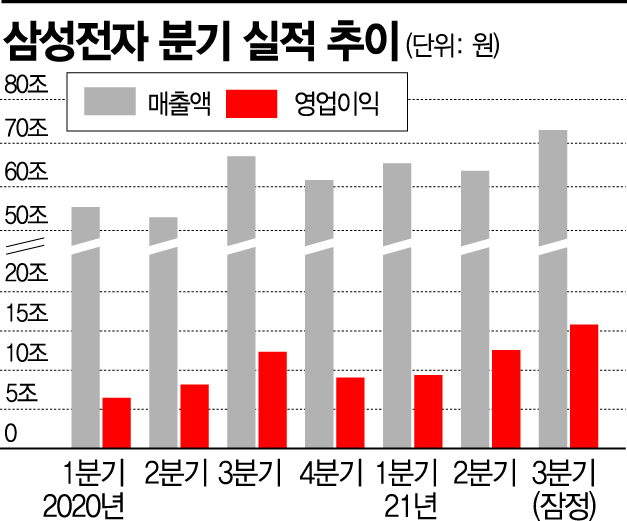
Samsung Electronics' record-high quarterly sales were driven by strong performance in the semiconductor and smartphone businesses. The prolonged COVID-19 pandemic led to peak non-face-to-face demand, pushing memory semiconductor prices to their highest levels, and the launch of new smartphone models such as the Z lineup contributed to the boom.
In particular, Samsung Electronics is estimated to have earned over 10 trillion won in operating profit from the semiconductor division alone in the third quarter, accounting for more than 60% of the company's total operating profit. In the third quarter, favorable market conditions were created not only in the memory semiconductor market but also in the non-memory foundry market in terms of price, demand, and costs.
At the end of the third quarter, the fixed transaction price of DRAM (based on DDR4 8Gb) rose 7.8% quarter-on-quarter to $4.1, and the foundry division saw price increases for the first time since entering the business. Strong demand for mobile and server DRAM continued, and cost reduction effects from improved production yields were significant. Additionally, the weak Korean won exchange rate also contributed to profit improvement.
However, the situation does not look easy from the fourth quarter onward. The 'COVID-19 special demand' that peaked in the third quarter is expected to ease, potentially leading to stagnation in semiconductor prices as well as demand for home appliances and smartphones. As vaccine distribution expands worldwide, the explosive growth in non-face-to-face demand caused by COVID-19, such as remote work and online education, is expected to subside somewhat.
Meanwhile, LG Electronics, which has also benefited from the 'COVID-19 special demand' since last year, is forecasting record-breaking third-quarter results. The securities industry estimates LG Electronics' third-quarter performance at sales of 18.15 trillion won and operating profit of 1.1239 trillion won. If the preliminary results to be announced on the 12th meet the consensus of 18 trillion won in sales, it will mark the highest quarterly performance in history.
In particular, the Home Appliance & Air Solution (H&A) division is expected to record sales in the mid-to-high 6 trillion won range and operating profit in the high 500 billion won range, likely overtaking Whirlpool to claim the top spot in the global home appliance market for the year. The TV division (H&E) is also expected to achieve its highest annual sales due to an increased proportion of premium OLED TV sales. However, provisions related to recall costs for GM electric vehicles could be a final variable affecting the results.
Park Hyung-woo, a researcher at Shinhan Financial Investment, analyzed, "Although raw material prices and fixed costs are increasing, profitability is being defended by raising the average selling price (ASP) of sets through expanded sales of premium home appliances and OLED TVs. However, one-time costs related to recalls by electric vehicle clients are expected to be reflected in the third or fourth quarter."
© The Asia Business Daily(www.asiae.co.kr). All rights reserved.


















