KOSPI Rebounded to 3200 After Last Year's Crash
Recently Dropped to 2900 Due to Domestic and Global Uncertainties
Generation 2030, Entered After 'Donghak Ant Movement', Expresses Anxiety
Increased Debt from 'Debt Investment' and 'Yeongkkeul' Also a Burden
Experts: "High-Risk Investments Raise Debt Risks for Youth"
"Need to Reduce Investing with Borrowed Money"
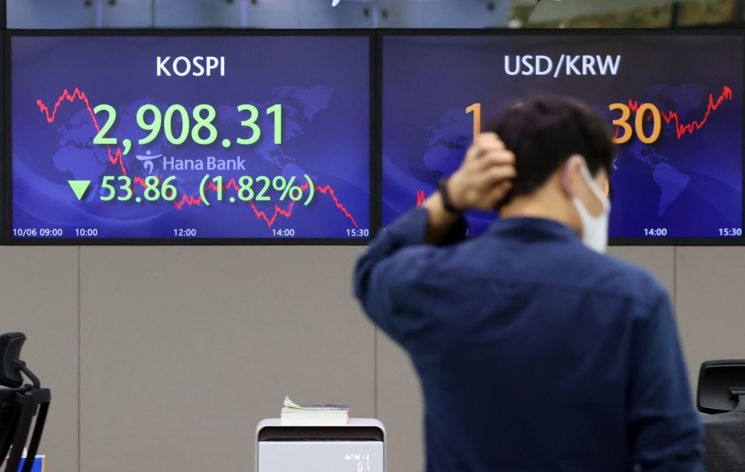 On the afternoon of the 6th, when the KOSPI closed sharply down 53.86 points (1.82%) from the previous day at 2908.31, a dealer is heading to their seat at the Hana Bank dealing room in Jung-gu, Seoul. / Photo by Yonhap News
[Asia Economy Reporter Lim Juhyung] #Kim (29), who started investing in stocks for the first time last year, recently suffered significant losses due to the decline in the KOSPI. Once dreaming of 'early retirement' by growing assets through investments, Kim confessed, "After being hit by several market crashes, my confidence disappeared," adding, "Lately, I've been focusing only on stock charts, so my work is suffering, and I'm wondering if I should get out at this point."
Recently, due to global inflation surges and expectations of the US tapering quantitative easing, external uncertainties have made the stock market unstable, leading the 2030 generation to experience their first market crash since starting stock investments. Notably, some among them have invested using loans such as overdraft accounts, raising concerns that if market instability intensifies, young people could suffer significant damage. Experts advise avoiding high-risk investments during times of financial market instability.
On the 5th, the KOSPI index closed at 2,962.17, down 57.01 points (1.89%) from the previous session, breaking below the 3,000 mark for the first time in about six months since March. This occurred just a week after the 3,100 level collapsed on the 28th of last month. Since then, the KOSPI has been hovering around the 2,950 range, showing sluggish movement.
The KOSPI's weakness appears to be due to external uncertainties. Rising energy and raw material prices, global supply chain disruptions have caused inflation to surge in the US and Europe, and the US Federal Reserve (FED) has announced plans to taper quantitative easing. Additionally, bankruptcy rumors surrounding China's largest real estate developer, Evergrande Group (Hengda 恒大), have negatively impacted investor sentiment.
In this regard, the US financial media outlet 'The Wall Street Journal (WSJ)' recently pointed out, "Warnings have emerged in the financial sector that stock market volatility may increase over the coming weeks or months," noting that "concerns about market overheating have been periodically voiced."
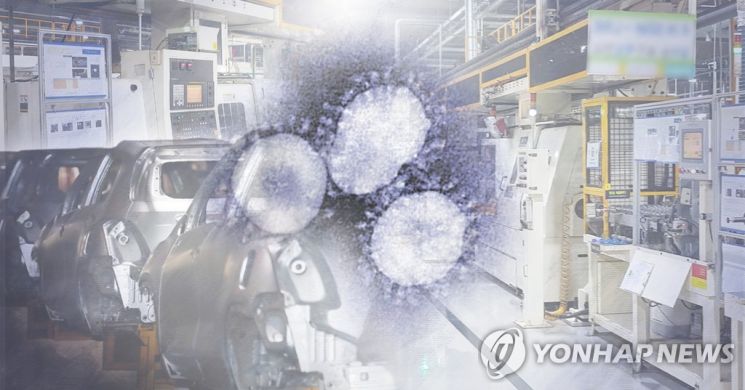 Since the COVID-19 pandemic, global supply chains have shown signs of instability, with energy and raw material prices rising. / Photo by Yonhap News
Given this situation, the so-called 'Joorini (stock + beginner)' 2030 generation, who opened stock accounts swept up by last year's investment craze, are also shaken.
They had entered the stock market en masse starting from March last year when the KOSPI dropped to the 1,500 level due to the COVID-19 pandemic. This was a so-called 'Buy the dip' strategy. According to data from the Korea Financial Investment Association, the number of active domestic stock trading accounts surpassed 30 million for the first time at that time, and some securities firms estimated that about 60% of the new accounts opened between February and March last year belonged to customers in their 20s and 30s.
Subsequently, the KOSPI dramatically rebounded to the 3,200 level in January. Many new investors who bought at low prices made significant gains. Among some netizens, a new term 'Donghak Ant Movement' became popular, referring to individual investors buying stocks left by foreign institutions to defend stock prices.
Among the younger generation, interest in the 'FIRE (Financial Independence, Retire Early)' movement has also increased. The FIRE movement is a neologism formed from the initials of 'Financial Independence, Retire Early,' referring to workers who accumulate assets through steady stock investments and retire early in their 40s.
However, as the stock market became unstable from the end of last month, young investors experiencing their 'first market crash' are feeling anxious.
A 20-something office worker, A, who opened a stock account in June last year, said, "I mainly invest overseas rather than domestically, but after losing more than 1 million KRW at once during the crash, I got really scared," adding, "I liquidated all my remaining stocks and am not even looking at them now."
Another office worker, B (31), said, "After experiencing a market crash, even 'long-term investing' doesn't go as planned. I keep opening charts and paying attention to stocks, so I can't focus on work," lamenting, "At this rate, I can't even afford living expenses, let alone become part of the FIRE movement."
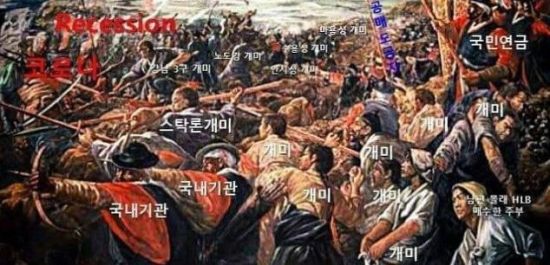 During last year's investment boom, some netizens described the situation where individual investors were buying stocks as foreign investors and foreigners were exiting the market as the "Donghak Ant Movement," a newly coined term. / Photo by Internet Community Capture
The increased debt burden following the investment craze has also become a problem. According to data received by Jeon Jae-su, a member of the National Assembly's Political Affairs Committee from the Democratic Party, from the Financial Supervisory Service on the 21st of last month, the outstanding loan balance for people in their 20s reached 2.5787 trillion KRW as of the end of June this year. The loan amount for people in their 20s surged by nearly 500 billion KRW last year alone, when the COVID-19 pandemic began, showing a sharp recent increase.
There is a view that the craze for so-called 'debt investing' (borrowing to invest) and 'younggeul' (investing by gathering all one's resources, even one's soul) has caused a debt bomb. According to a survey conducted by the Korea Financial Investor Protection Foundation earlier this year targeting 2,000 adults, 29% of people in their 20s started or resumed financial investments after COVID-19, higher than 20.5% for those in their 30s, 20.2% for those in their 40s, and 12.6% for those in their 50s.
Due to the characteristics of early career workers, people in their 20s have lower income and fewer accumulated assets compared to middle-aged groups. According to the Korea Institute of Finance, as of the end of last year, the youth's loan-to-income ratio (LTI) growth rate was about 24%, showing a sharp increase compared to other generations. This means their debt burden is rapidly increasing relative to their income.
Experts warn that high debt levels put young people at risk of financial hardship and advise reducing high-risk investments.
Professor Kim Taegi of Dankook University's Department of Economics said, "The popularity of high-risk investments such as debt investing and younggeul has increased the debt risk among young people in their 20s. This happened as they sought capital income through investments amid reduced labor income due to COVID-19," adding, "If the stock market remains unstable in this situation, the younger generation could suffer significant losses, so caution is needed."
He continued, "In such an environment, it is better to make wise investments rather than chasing high-risk, high-return opportunities," recommending, "Capital investments should be made with one's disposable funds, and borrowing to invest excessively should be avoided."
© The Asia Business Daily(www.asiae.co.kr). All rights reserved.
![Clutching a Stolen Dior Bag, Saying "I Hate Being Poor but Real"... The Grotesque Con of a "Human Knockoff" [Slate]](https://cwcontent.asiae.co.kr/asiaresize/183/2026021902243444107_1771435474.jpg)


















