KAIST Professor Kim Ha-il and Seoul National University Bundang Hospital Professor Choi Sung-hee Joint Research Team
Inhibiting Serotonin Receptor Signaling in Adipose Tissue Reduces Fat and Improves Inflammation
[Asia Economy Reporter Kim Bong-su] Domestic researchers have discovered that partially inhibiting the action of the neurotransmitter serotonin within fat cells, which induces feelings of happiness in humans, improves diabetes and fatty liver, representative adult metabolic diseases. Since drug development utilizing this finding is already underway, a positive outlook has emerged for the treatment of diabetes and fatty liver.
The Korea Advanced Institute of Science and Technology (KAIST) announced on the 8th that Professor Kim Ha-il's research team at the Graduate School of Medical Science and Engineering, in collaboration with Professor Choi Sung-hee's team from the Department of Endocrinology and Metabolism at Bundang Seoul National University Hospital, confirmed that regulating serotonin (a neurotransmitter) signaling in adipose tissue improved diabetes and suppressed fatty liver. Serotonin is involved in regulating emotions and sleep and is mainly found in the gastrointestinal tract, platelets, brain, and central nervous system. It is known to induce feelings of happiness in humans.
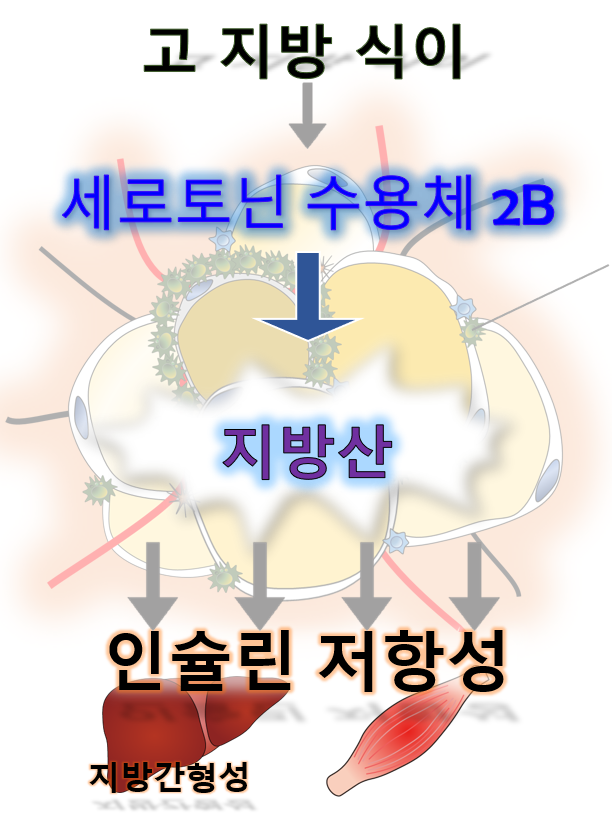
The research team was inspired by the observation that serotonin receptor 2B expression specifically increases in visceral fat under conditions that induce insulin resistance, such as obesity. They confirmed that inhibiting serotonin receptor 2B signaling in adipose tissue regulates the secretion of fatty acids from fat tissue, thereby lowering blood fatty acid levels and improving systemic metabolic indicators and fatty liver.
Unlike its role in the brain, serotonin in peripheral tissues regulates various energy metabolisms in obesity and diabetes conditions. In particular, serotonin signaling in liver tissue is known to promote fat synthesis. It has been confirmed that inhibiting this signal improves the formation of fatty liver.
To verify serotonin's role in visceral fat, the research team inhibited serotonin receptor 2B signaling in fat cells and observed a reduction in inflammatory responses within adipose tissue, suppression of fatty liver, and overall improvement in metabolic indicators such as increased systemic insulin sensitivity. This newly discovered finding shows that serotonin acts directly on adipose tissue rather than through the central nervous system.
Developing treatments targeting serotonin signal inhibition for fatty liver or diabetes holds significant biological and clinical importance. Unlike existing therapies, serotonin signal inhibitors that simultaneously target adipose and liver tissues are expected to achieve remarkable results in the future development of metabolic disease treatments. Although currently at the stage of human fat tissue and animal experiments, successful development of orally administrable drugs could revolutionize diabetes and fatty liver treatment.
This research was published online on the 7th in the international academic journal Journal of Clinical Investigation.
Dr. Choi explained, "Currently, chemical compounds that inhibit serotonin receptor 2B signaling have been discovered, but drugs have not yet been developed, and a startup company has been established to conduct research."
© The Asia Business Daily(www.asiae.co.kr). All rights reserved.
![Clutching a Stolen Dior Bag, Saying "I Hate Being Poor but Real"... The Grotesque Con of a "Human Knockoff" [Slate]](https://cwcontent.asiae.co.kr/asiaresize/183/2026021902243444107_1771435474.jpg)
















