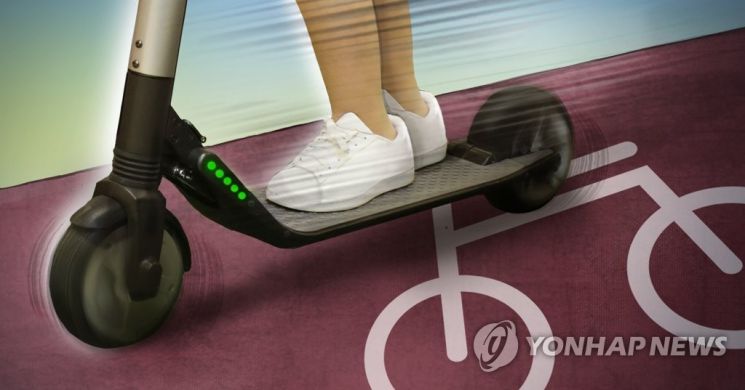
[Asia Economy Reporter Oh Hyung-gil] Traffic accidents involving personal mobility devices (PM), including electric kickboards, have increased by 300% over the past three years. Interest is also growing in how to handle accidents involving kickboards.
According to data on PM traffic accidents submitted by the National Police Agency to Heo Young, a member of the National Assembly Land, Infrastructure and Transport Committee from the Democratic Party, the number of accidents last year increased by 298% compared to 2018.
The total number of accidents over the past three years was 1,569, showing a sharp increase from 225 cases in 2018 to 447 in 2019 and 897 in 2020. Traffic accidents occurring while pedestrians were walking also increased to 83 cases over three years.
The number of injuries and deaths also increased by 276% compared to 2018. A total of 1,606 people were injured in accidents. The number of injured by year was 238 in 2018, 473 in 2019, and 895 in 2020, while the number of deaths was 4 in 2018, 8 in 2019, and 10 in 2020.
As of 2020, the number of accidents by region showed Seoul leading with 387 cases, accounting for 43% of the total. This was followed by Gyeonggi with 223 cases and Daegu with 43 cases.
By type of accident, collisions between personal mobility devices and vehicles accounted for 890 cases, or 56% of the total accidents, making it the most common. This was followed by collisions between mobility devices and pedestrians with 495 cases, and single-vehicle mobility device accidents with 184 cases.
When an accident occurs involving a PM, the fault ratio can be determined by referring to the non-standard fault ratio criteria for PM and automobile traffic accidents disclosed by the General Insurance Association of Korea.
These non-standard criteria are not included in the fault ratio recognition standards reflected in the standard terms and conditions, but they have been organized through expert consultation so that consumers and insurance companies can refer to frequently occurring cases. If their usefulness is proven in the future, they will be included in the fault ratio recognition standards.
The association created the fault ratio criteria by reflecting the traffic law regulations applicable to PMs, such as signal violations, crossing the center line, and riding on sidewalks, as well as the unique operational characteristics of PMs compared to bicycles, such as sudden starts, rapid acceleration, and sharp turns.
If a PM and a car collide while the PM is crossing a crosswalk on a red light, the PM is assigned 100% fault. This is because the serious fault of signal violation is fully recognized, and it is acknowledged that it is difficult for a car to avoid a PM entering the crosswalk. In accidents where an electric kickboard crosses the center line and collides with a vehicle, the kickboard is also assigned 100% fault.
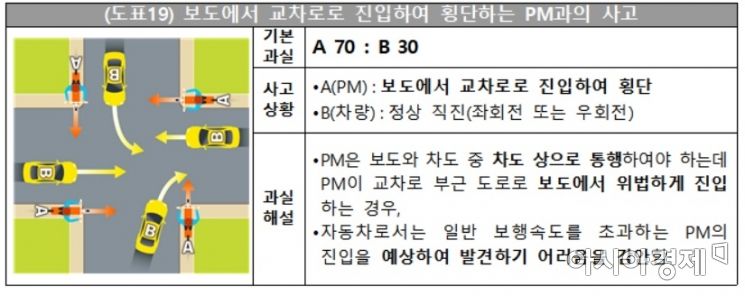
In accidents where a PM enters an intersection from a sidewalk and collides with a car, the PM is assigned 70% fault and the car 30%. Since PMs are supposed to travel on the road, entering the road from the sidewalk is illegal. Moreover, it is considered difficult for cars to anticipate and detect PMs entering at speeds exceeding normal pedestrian speed.
In congested traffic, if a PM enters an intersection on the right side of a vehicle without stopping and collides with a vehicle going straight or turning right, the PM is assigned 70% fault. This takes into account the PM’s violation of safety obligations, but also recognizes that the vehicle driver did not exercise sufficient caution.
Regarding traffic accidents involving signal violations at intersections with traffic lights, the fault ratios are as follows: If a car enters the intersection on a yellow light and a PM enters on a red light, the PM is assigned 60% fault and the car 40%. Conversely, if the car enters on a red light and the PM on a yellow light, the PM is assigned 20% fault and the car 80%.
If both vehicles enter the intersection on a red light, the PM is assigned 30% fault and the car 70%. This reflects that PMs operate at lower speeds than cars, allowing cars to detect and avoid accidents, and that PMs pose less risk of harm to the other vehicle.
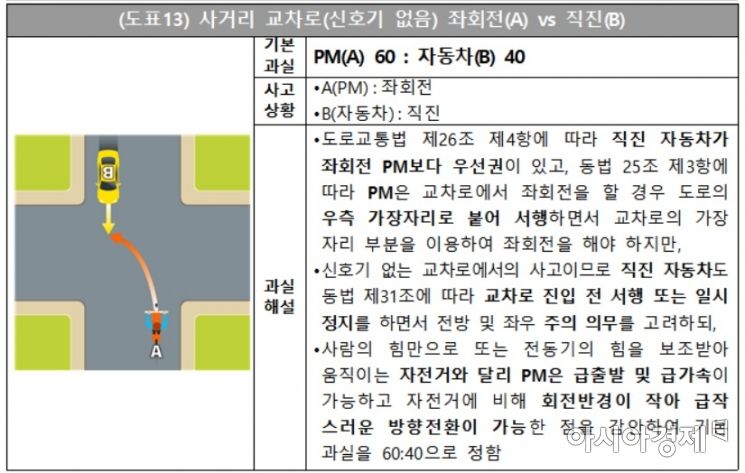
At intersections without traffic lights, if a PM turns left and collides with a car going straight, the PM is assigned 60% fault and the car 40%. Conversely, if a car goes straight and a PM turns left, the PM is assigned 20% fault and the car 80%.
The same fault ratios apply to right-turn accidents. When a PM turns right and collides with a car going straight, the fault ratio is 60% for the PM and 40% for the car; in the opposite case, it is 20% for the PM and 80% for the car.
© The Asia Business Daily(www.asiae.co.kr). All rights reserved.
![Clutching a Stolen Dior Bag, Saying "I Hate Being Poor but Real"... The Grotesque Con of a "Human Knockoff" [Slate]](https://cwcontent.asiae.co.kr/asiaresize/183/2026021902243444107_1771435474.jpg)


















