648 Industrial Accident Deaths Amid Upcoming Serious Accident Punishment Act
Repeated Worker Deaths at Industrial Sites
Experts: "Policy Effectiveness Lacking... Need to Find Ways to Reduce Legal Blind Spots"
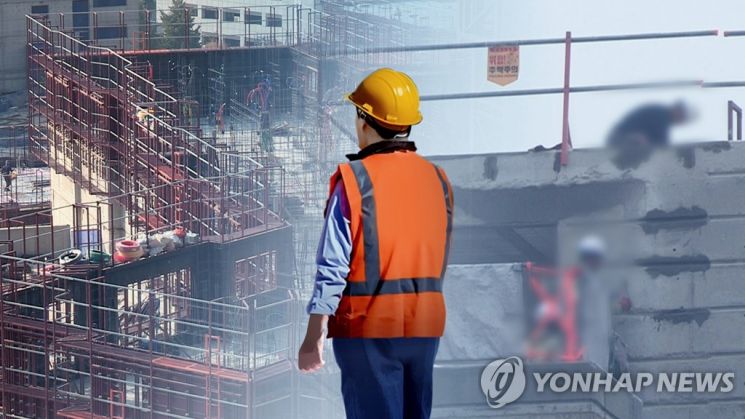 As the Serious Accidents Punishment Act is set to be enforced in January next year, industrial accidents are recurring as workers continue to die one after another at industrial sites.
 [Image source=Yonhap News]
[Asia Economy Reporter Yoon Seul-gi] The Serious Accident Punishment Act, which punishes management officials when workers die from industrial accidents, will be enforced starting January next year, but workers are still dying on site. Experts point out that more fundamental measures are urgently needed alongside the enforcement of the law.
On the 4th, a worker in his 60s died after being crushed by parts of an electric motor at Hyosung Heavy Industries Changwon Plant 3 in Changwon, Gyeongnam. While lifting a 700kg high-voltage electric motor frame to remove foreign substances from underneath, one side of the metal hook connecting the crane and the frame detached, causing the frame, which was 1.2 meters high, to fall.
In response, the Korean Metal Workers' Union held a protest on the morning of the 6th in front of the Changwon branch of the Ministry of Employment and Labor, stating, "The employer at Hyosung Heavy Industries was already aware that this was a dangerous task where accidents could happen at any time but did not establish safety measures," and "This serious accident was caused by Hyosung Heavy Industries and appropriate punishment is necessary."
The union pointed out problems such as the absence of a locking device to prevent the product from detaching from the metal hook, the lack of a separate work platform for tasks under the frame, and the failure to specify detailed risk factors and safety measures concretely.
Kim Chang-nam, head of the Labor Safety and Health Department at the Korean Metal Workers' Union, said, "This was a foreseeable accident. The deceased worker was a veteran who had worked here for 30 years, retired, and then worked as a contract worker for the prime contractor for three years. The accident happened while he was working as he had done for 30 years." He added, "The company is asking 'why did you work like that,' but it has never provided conditions for workers to work safely. The deceased worker tried to avoid injury on his own but ultimately suffered this accident."
He continued, "Even with the Serious Accident Punishment Act about to be enforced, nothing has changed on site," and "There is still no communication between the company and workers regarding safety guidelines, and workers still have to avoid accidents on their own." Hyosung Heavy Industries stated, "We will do our best to handle the accident" and "We will cooperate with the investigation and await the results."
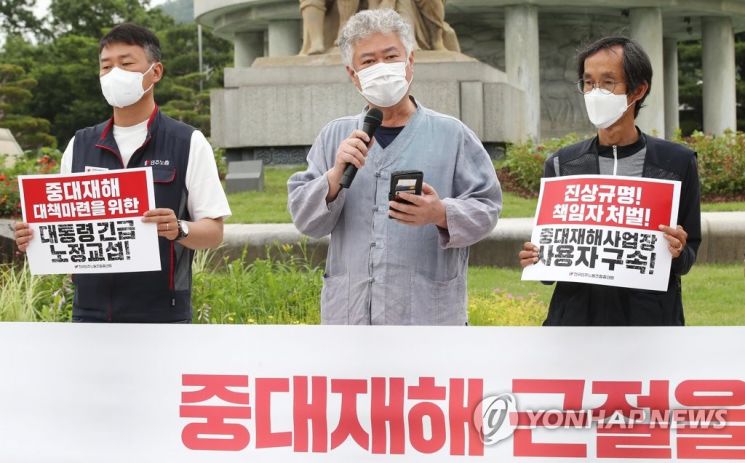 On the morning of June 7, Lee Jae-hoon, the father of the late Lee Seon-ho who died while working at Pyeongtaek Port, is speaking at a press conference held in front of the Blue House fountain, urging urgent emergency measures to eradicate serious accidents.
 [Photo by Yonhap News]
It is not uncommon for workers to die while working in industrial sites. In April, Lee Seon-ho, a worker in his 20s who was working to pay for tuition and living expenses after completing military service, died at a site with poor safety inspections at Pyeongtaek Port, Gyeonggi Province. On April 22, while removing safety pins to fold the wings of an open-type container (FRC) at Pyeongtaek Port, a forklift suddenly folded the left wall, causing the right wall to fold as well, crushing him underneath.
On June 7, the Ministry of Employment and Labor announced interim results of a special inspection, revealing that the prime contractor, Dongbang TS, had not taken various safety measures. The ministry confirmed that no work plan was prepared for the task at the time of the accident and that protective gear was not provided to Lee, pointing out that the accident was caused by poor safety management.
Subsequently, the "Committee for Measures on the Industrial Accident Death of the Late Lee Seon-ho (hereafter Committee)" and Lee's father, Lee Jae-hoon, filed a complaint against Dongbang TS, the company entrusted with container safety inspections and management, to the prosecution in August. The Committee stated, "Corporate responsibility for industrial accident deaths in Korea is too light. The Serious Accident Punishment Act and its enforcement decree are insufficient, leaving too many loopholes for companies to escape," demanding appropriate judicial action against companies that fail to implement safety measures.
In response, the Ministry of Employment and Labor launched the Occupational Safety and Health Headquarters in July to reduce deaths caused by industrial accidents. The Occupational Safety and Health Headquarters serves as a control tower supporting safety-related tasks at workplaces and closely managing sites where accidents frequently occur ahead of the enforcement of the "Serious Accident Punishment Act," which strengthens punishment for management officials who fail to fulfill safety responsibilities, effective from January 2022, aiming to prevent industrial accidents.
However, despite these efforts, the government's pledge to reduce industrial accident deaths below 500 has not been fulfilled. According to the major work progress report submitted by the Ministry of Employment and Labor to the National Assembly's Environment and Labor Committee on the 6th, 648 people died from industrial accidents between January 1 and September 24 this year. While the number of deaths fell below 900 for the first time in 2019 with 855 deaths, the goal to reduce deaths by 20% compared to last year was not achieved.
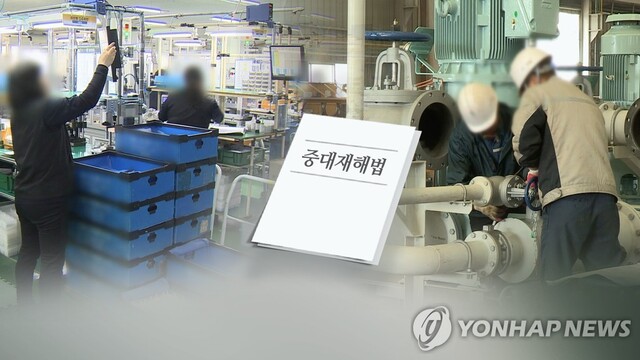
As worker deaths at industrial sites continue unabated, attention is focusing on the Serious Accident Punishment Act. Experts point out that the repeated industrial accidents are ultimately due to the ineffectiveness of previous policies and advise that efforts should be made to minimize legal blind spots in the enforcement of the Serious Accident Punishment Act.
Professor Ahn Hong-seop of the Department of Architectural Engineering at Kunsan National University said, "With the current level of punishment criticized as 'toothless,' it is difficult to induce companies to implement safety measures for workers," adding, "Even after the Serious Accident Punishment Act is enforced, it will take considerable time for companies to establish safety measures, and the effects are expected to take 5 to 10 years. During that time, such safety accidents may continue to occur."
Regarding the Serious Accident Punishment Act, Professor Ahn analyzed, "It seems difficult to fundamentally eliminate risks at industrial sites," and "Companies are not taking the law as a warning to prepare safety measures but are instead seeking legal advice and other ways to respond legally. They are trying to find ways to legally counter the law. The focus is misplaced as they try to avoid management responsibility."
Professor Ahn suggested, "Ultimately, in this situation, measures should be devised to minimize legal blind spots, and actions such as strengthening supplementary provisions should be taken."
© The Asia Business Daily(www.asiae.co.kr). All rights reserved.



















