National Economic Advisory Council and KDI International Conference
[Sejong=Asia Economy Reporter Kim Hyunjung] To enhance the sustainability of welfare states, the creation of quality jobs is urgently needed, and balanced welfare that does not concentrate benefits on specific generations should be pursued, according to advice from global scholars.
These claims were mentioned at an international conference hosted by the National Economic Advisory Council and the Korea Development Institute (KDI) on the 7th at the Four Seasons Hotel in Seoul, under the theme "Virtuous Cycle Economy of Growth, Jobs, and Welfare."
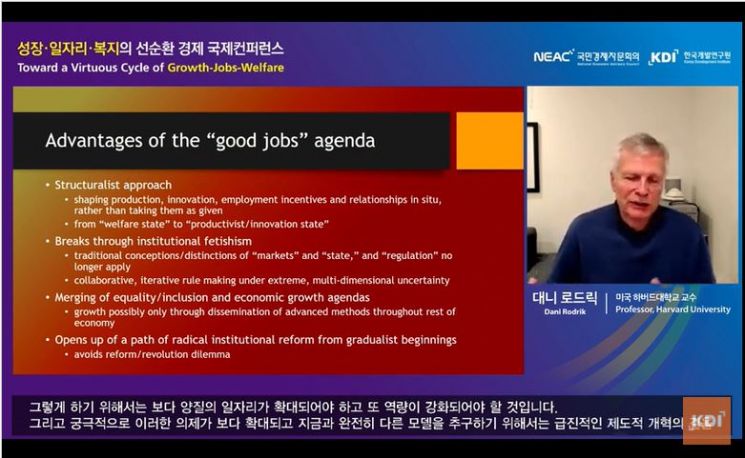
At the event, Dani Rodrik, a professor at Harvard University in the United States, stated, "Technological progress, hyper-globalization, and market fundamentalism cause the collapse of domestic policies, but the traditional welfare state model only alleviates symptoms and cannot be a fundamental solution." He proposed that policies focusing on the pre- and post-production stages such as education and pensions, as well as job policies that directly intervene in the production stage, are necessary. He said, "The creation of quality jobs is possible through companies possessing innovative technologies, but companies do not consider the positive externalities of job creation," adding, "Public inputs required by companies should be provided to induce the creation of quality jobs."
Kenneth Nelson, a professor at Stockholm University in Sweden, focused on generational conflict. In his presentation, Professor Nelson pointed out, "If social rights related to social risks are unevenly distributed by age groups, intergenerational conflicts arise and the possibility of sharing risks and resources within society decreases," and "One of the important reasons why inequality and social problems are worsening in many countries is the intensification of intergenerational conflicts due to aging." He classified types of intergenerational welfare contracts into four categories: balanced (Nordic countries), labor-friendly (Germany and Japan), elderly-friendly (Anglo-American countries), and child-friendly (Korea). Regarding Korea, he diagnosed, "It shows a child-friendly type but has a particularly weak characteristic in protecting the working-age population."
He also said, "A balanced intergenerational welfare contract prevents 'intergenerational conflicting distribution,' which provides social rights favorable to certain age groups while weakening protections for other age groups," and "To enhance the sustainability of the welfare state, just and equitable relationships between generations must be established."
Professor Yang Jaejin of Yonsei University, who attended the conference, argued, "Korea must control the excessive increase in elderly-related expenditures inevitably rising due to super-aging and expand welfare for the working-age population."
In his opening remarks, Lee Geun, Vice Chairman of the National Economic Advisory Council, cited lessons to be learned from Nordic welfare states, emphasizing "properly establishing various social services such as childcare, childbirth, and child-rearing rather than cash welfare" and "a system that appropriately considers welfare targets not only for the elderly but also for the young and middle-aged population directly responsible for production."
In his welcoming remarks, Hong Jangpyo, President of KDI, said, "At this moment, experiencing the greatest crisis since the Great Depression due to the COVID-19 pandemic, resolving polarization and creating quality jobs have emerged as global issues," adding, "There is a demand for a transition from the traditional economic model that emphasizes growth and efficiency to a new economic model that values harmony and balance among various social values such as inclusion, innovation, environment, and fairness, and from the traditional welfare model that emphasizes ex-post selective welfare to a new welfare model aiming for 'good jobs and inclusive welfare.'"
Deputy Prime Minister and Minister of Economy and Finance Hong Namgi said in his congratulatory remarks, "Jobs are the best way for many people to participate in the growth process and also serve as a link for the virtuous cycle of welfare," adding, "To this end, fundamentally, we will continue to improve the quality of jobs by strengthening the private sector's job creation capacity, settling the 52-hour workweek system, and improving working conditions such as converting irregular workers to regular positions."
© The Asia Business Daily(www.asiae.co.kr). All rights reserved.
!["The Woman Who Threw Herself into the Water Clutching a Stolen Dior Bag"...A Grotesque Success Story That Shakes the Korean Psyche [Slate]](https://cwcontent.asiae.co.kr/asiaresize/183/2026021902243444107_1771435474.jpg)
















