Four Former Hyundai Motor Employees Unite to Develop Autonomous Vehicles
Focus on 'Fully Unmanned' Logistics and Shuttle Buses
Project with 200 Billion KRW Investment Including Factory Establishment
Safety Assurance as Top Priority... Emphasis on Corporate-Government Collaboration
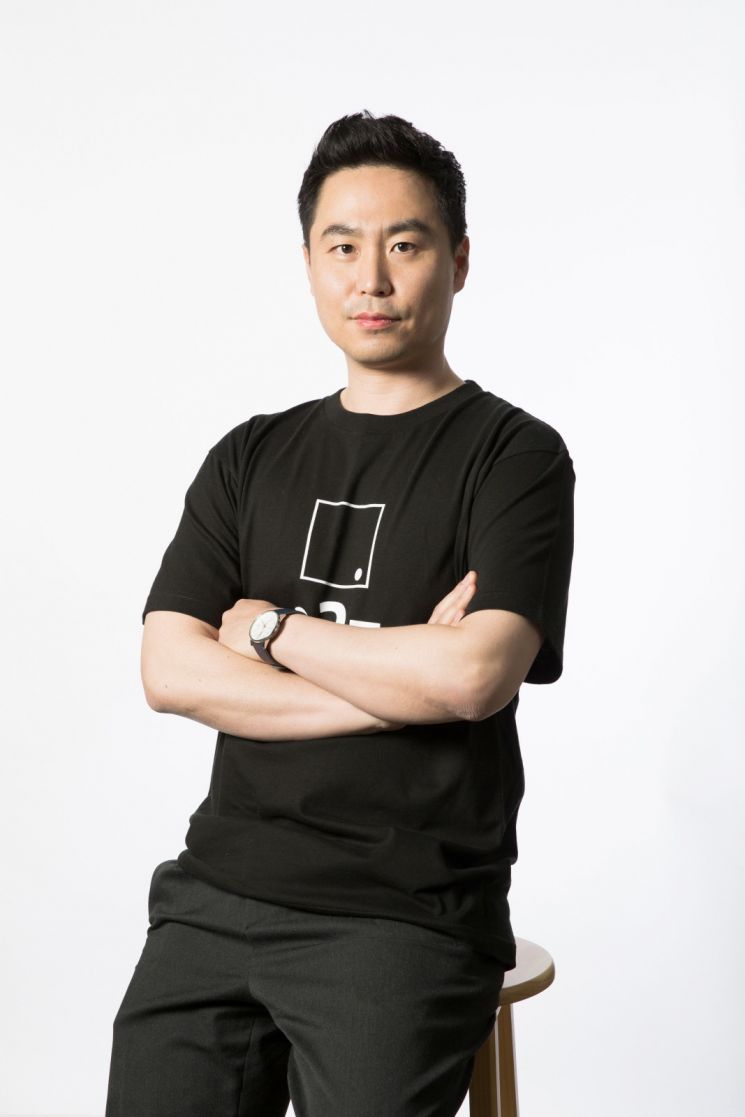
[Asia Economy Reporter Kim Bo-kyung] Autonomous driving startup Autonomous A2Z (a2z), founded by four former Hyundai Motor employees, will begin mass production of autonomous vehicles in 2027. Starting full-scale development next year, this large-scale project will involve an investment of approximately 200 billion KRW for factory establishment. The ultimate goal is to become a global conglomerate encompassing both software and hardware in the autonomous driving sector.
◆Leaving a conglomerate to start a business...160 billion KRW investment secured= Han Ji-hyung, CEO of Autonomous A2Z (pictured), left Hyundai Motor, where he worked for 11 years, and established the company in July 2018. The company name signifies the development of all technologies from a to z necessary for autonomous driving, including perception, judgment, and control, aiming to become an autonomous driving platform company. Four members, including him, who were responsible for autonomous driving development at Hyundai Motor, came together to start the business.
They were appointed as industry professors at Kyungil University in Gyeongsan, Gyeongbuk Province, and received support from the university's startup program, allowing them to operate the company under relatively stable conditions. For this reason, the headquarters is located within Kyungil University.
Thanks to their outstanding technology and know-how, the company generated revenue from the early stages through government research and development (R&D) projects and technical services. Meeting CEO Han at the central research center in Anyang, Gyeonggi Province, he said, "We possess an autonomous driving solution that functions as the brain of the vehicle, enabling us to develop an autonomous vehicle in a short period and obtain certification from the Ministry of Land, Infrastructure and Transport. Rumors spread that an autonomous vehicle was developed at a lesser-known regional university, which brought us into the spotlight."
Last month, the company successfully secured 16 billion KRW in Series A investment. In the early stages, they declined investment proposals while building performance and technology. CEO Han stated, "I have seen many cases where receiving investment early on creates pressure to deliver results within one or two years, leading to reckless business advancement. We chose investors who can provide continuous support after sufficiently growing and stabilizing the company." Several investors, including KB Investment, Korea Investment Partners, KN Investment Partners, Inlight Ventures, Kakao Mobility, and Kakao Investment, have taken an interest in Autonomous A2Z.
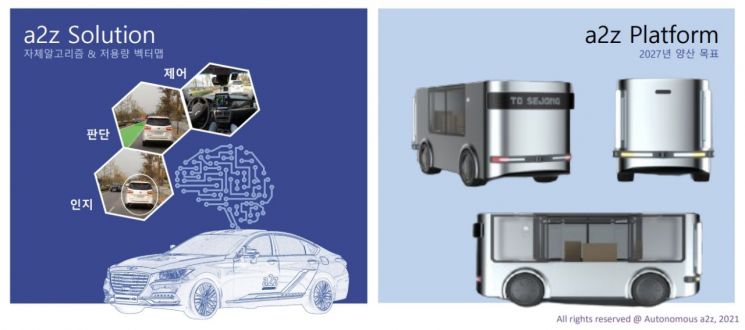
◆Targeting the unmanned special-purpose vehicle market= The company expects its sales this year to reach 5 billion KRW, more than tripling last year's 1.4 billion KRW. They have already achieved 3 billion KRW in sales in the first half of the year. CEO Han said, "Thanks to active smart city and autonomous driving demonstration projects by local governments, we expect to turn a profit this year." Autonomous vehicle demonstration projects are currently underway in Sejong, Ulsan, and Gwangju. Through fundraising, the company plans to invest 200 billion KRW over five years starting next year in a project covering everything from planning and design to mass production of autonomous vehicles. This aligns with the government's innovation project aimed at accelerating the commercialization of Level 4 or higher autonomous vehicles by 2027.
The company's revenue comes from business-to-business (B2B) or business-to-government (B2G) transactions. Therefore, they focus on developing unmanned and autonomous special-purpose vehicles such as shuttle buses, village buses, logistics, and cleaning vehicles operating within limited areas. The goal is to introduce autonomous vehicles in sectors where people are reluctant to work or for public transportation needs. CEO Han said, "We can operate unmanned autonomous village buses in local governments experiencing population decline without infringing on private business areas or taking away jobs." The goal is a fully unmanned vehicle without a steering wheel, with safety as the top priority.
CEO Han emphasized the importance of collaboration with companies and the government. He said it is impossible for a single company to develop autonomous vehicles, which integrate various technologies and hardware. "Korea has sufficient technological capabilities to produce global conglomerates like Tesla and Apple," he said. "If the government, companies, and affiliated organizations collaborate and laws and systems support them, it is achievable." He added, "We will target the special-purpose vehicle market, including unmanned shuttle buses and unmanned cleaning vehicles operating within limited areas, and aim for overseas expansion using autonomous driving technology."
© The Asia Business Daily(www.asiae.co.kr). All rights reserved.
!["I'd Rather Live as a Glamorous Fake Than as a Poor Real Me"...A Grotesque Success Story Shaking the Korean Psyche [Slate]](https://cwcontent.asiae.co.kr/asiaresize/183/2026021902243444107_1771435474.jpg)

















