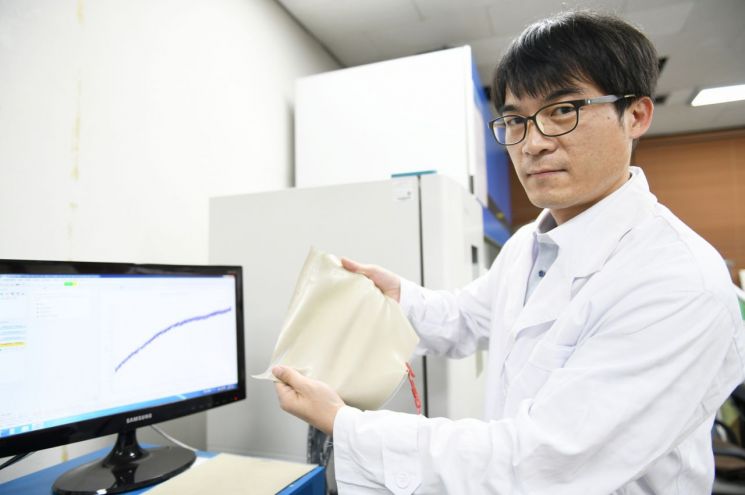
 Korea Electrotechnology Research Institute (KERI) has developed a 'self-charging power supply device' for fully stretchable wearable electronic devices. Photo by KERI
[Asia Economy Reporter Kim Bong-su] A material that generates and stores electricity through friction to supply wearable electronic devices has been developed by domestic researchers. While there have been cases of friction-based generator development, this is the first integrated material that performs storage and supply together.
The Korea Electrotechnology Research Institute (KERI) announced on the 7th that the research team led by Principal Researcher Park Jong-han and Researcher Yang Hye-jin at the Nano Convergence Research Center developed a technology integrating a ‘nanogenerator’ (self-charging) that generates electricity by utilizing friction generated from clothes and other sources, and a ‘micro supercapacitor’ (power supply) that stores and supplies electricity to wearable devices.
Previous studies have developed ‘triboelectric nanogenerators’ in fiber forms that stretch and contract. However, the research team is the first to develop an integrated stretchable material that also performs the function of a ‘micro supercapacitor’ to stably store and deliver electricity for power supply.
Self-charging wearable devices require not only excellent stretch durability but also multiple conditions such as superior electrical properties, lightweight, and biocompatibility. To address this, many researchers have used wrinkled substrates or introduced partial stretchable electrodes, but these approaches had limited stretch directions, lower durability, and higher manufacturing costs.
Based on over ten years of accumulated nano-convergence technology, the research team utilized a method of effectively mixing ‘single-walled carbon nanotubes’ with excellent electrical conductivity and physical properties with a stretchable ‘polymer.’ Through this, they developed a device that simultaneously performs the roles of a ‘current collector’ that transmits current and an ‘electrode’ that stores energy. This device is stretchable in all directions and, according to the researchers’ own performance tests, has excellent durability, withstanding over 10,000 uses.
The developed technology is expected to be used as an important power source in fields such as defense and leisure. Especially in future battlefields where the use of various electrical and electronic equipment is essential, technologies that can directly produce and utilize electricity on-site for survival in extreme environments, along with ultra-lightweight portable batteries for military use, are necessary. Applying KERI’s technology allows electricity generation from friction occurring in military uniforms, boots, hats, and combat backpacks. In the leisure sector, applying self-charging power supply devices to hiking clothes can be very useful as a power source for flashlights or smartphone charging in emergencies.
Principal Researcher Park stated, “This is the world’s first achievement of a fully stretchable device that integrally performs electricity generation from friction, storage, and supply.” He added, “We will continue research to further improve the device’s efficiency and performance to greatly contribute to the lightweight and portability enhancement of next-generation wearable electronic devices.”
The research results were published in the international journal ‘Nano Energy’ (IF = 17.881), which is in the top 4.6% of journals in the materials field according to the Journal Citation Reports (JCR).
© The Asia Business Daily(www.asiae.co.kr). All rights reserved.

















