Reforming Development Charges Triggered by Hwacheon Daeyu Scandal
Minister Noh Hyung-wook: "Will Review System Improvements"
Patchy System Overhaul... Expectation of Increased Burden Rates
However, Excessive Restrictions May Increase Project Rigidity
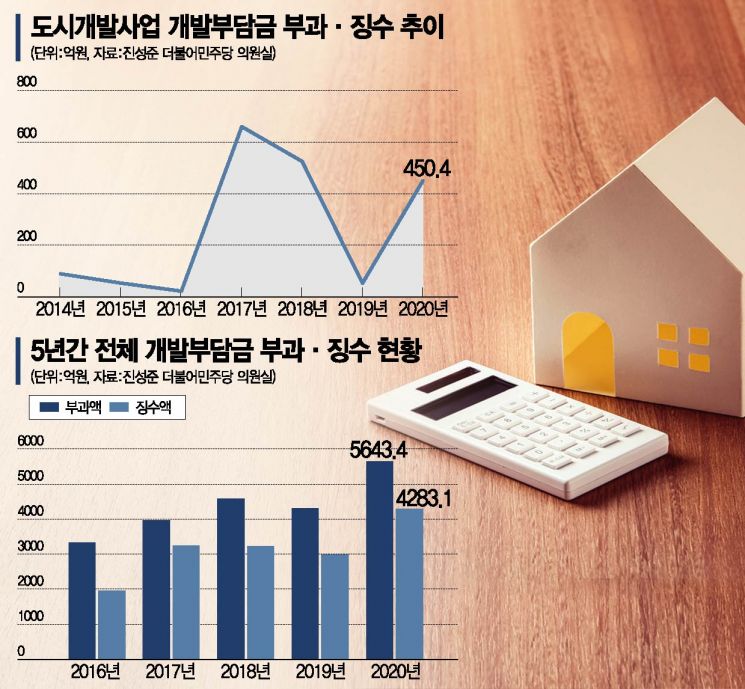
Amid criticism that the current development profit recovery system is inadequate following the Pangyo Daejang-dong project in Gyeonggi Province, the government has begun full-scale efforts to improve the system. To weaken the structure that allows the private sector to reap excessive profits from development projects, it is widely analyzed that the system will likely be revised to significantly increase the development charge rate and reduce various exemption and reduction measures. However, there are also opinions that a balanced approach is necessary, as excessive regulation could increase project rigidity and lead to inefficiency.
According to the government and the National Assembly on the 6th, during the National Assembly Land, Infrastructure and Transport Committee's audit of the Ministry of Land, Infrastructure and Transport held the previous day, ruling and opposition members continued to condemn the Daejang-dong project controversy. Regardless of party affiliation, most committee members pointed out that Hwacheon Daeyu, a private company, monopolized enormous profits through the Daejang-dong urban development project under unprecedented regulations. In particular, Democratic Party members demanded institutional improvements, arguing that the current situation arose because the previous administration introduced special exemptions for development charges.
The government plans to review comprehensive improvement measures for the development profit recovery system in relation to the Daejang-dong project controversy. Minister of Land, Infrastructure and Transport Noh Hyung-wook said, "Under the current Urban Development Act, when the local government head is the authority designating urban development projects, the government has no grounds to intervene," but added, "We will look into whether institutional improvements such as central government management and supervision are necessary." Deputy Prime Minister and Minister of Economy and Finance Hong Nam-ki also stated, "It is necessary for the government to recover a certain portion of public development profits," and "We will consult to ensure that public recovery is properly implemented through institutional mechanisms."
The Patchwork Development Profit Recovery System
The development profit recovery system is designed to recover profits generated from land development to prevent land speculation and promote efficient land use. It was introduced in January 1990 under the 'Act on the Recovery of Development Profits' enacted in 1989. Initially, the charge rate was 50% of development profits, but it was temporarily exempted from September 1998 to December 1999 due to the foreign exchange crisis, and the rate was adjusted to 25% for one year starting January 2000. Subsequently, to stimulate the economy, exemptions were granted from 2002 to 2005, and currently, a charge rate of 20% applies to planned sites and 25% to individual sites.
Due to significant volatility in the charge rate depending on external factors such as economic conditions, and repeated exemptions and special provisions, there are criticisms that the development profit recovery law has become a patchwork. Experts explain that reforms are needed, such as raising the charge rate to adjust the profits taken by the private sector. Lee Kang-hoon, an executive committee member of the People's Livelihood Hope Headquarters at the People's Solidarity for Participatory Democracy, said, "The current charge rate is 25%, but it should be raised to 45-50%, and standards, procedures, and means related to prior agreements should be specified in the law," adding, "Currently, much discretion is left to local governments, so it tends to depend heavily on their experience and judgment."
Concerns Over Side Effects of Private Development Contraction
Currently, charges are imposed on the portion exceeding the normal land price increase, but there are calls to also reflect the increase in land value after building construction, such as apartments, when calculating charges. Despite the large difference in land prices before and after development, this aspect is not considered, limiting the recovery of development profits. Democratic Party lawmaker Kang Jun-hyun said, "The current law requires charges to be imposed within five months after project completion, but in long-term projects, there are many variables such as changes in currency value," and added, "It needs to be effectively revised."
However, there are concerns that excessive regulation on the private sector and local governments could worsen private profit rates, undermine local government autonomy, increase project rigidity, and cause side effects of public-led development. An industry official said, "In local government projects, some degree of autonomy should be guaranteed," and "It is necessary to establish standards in the law so that local governments can have authority and act responsibly."
Real estate specialist lawyer Um Jeong-sook said, "Land is a limited resource and has a strong public concept, so restrictions are necessary to prevent specific private companies from taking too much development profit," but also noted, "Since the previous land ownership limit system was ruled unconstitutional, social consensus is needed on the appropriate charge rate."
© The Asia Business Daily(www.asiae.co.kr). All rights reserved.

















