Risk Asset Aversion Psychology at Work
924.1 Billion KRW Net Selling Over 2 Trading Days
Amid Selling-Dominant Atmosphere
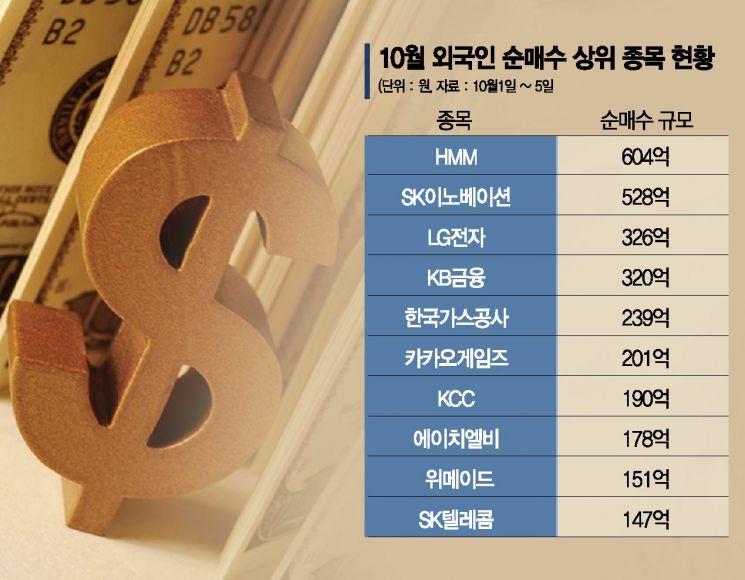
HMM Leads with 60.4 Billion KRW Net Buying
Low-Price Buying Opportunity Due to China's Power Shortage
SK Inno Also Net Buys 52.8 Billion KRW
Reflecting Expectations of Strong Performance in Secondary Batteries
[Asia Economy Reporter Park Ji-hwan] Foreign investors have sold nearly 1 trillion won worth of stocks in the KOSPI over two trading days this month, while opening their wallets wide for certain stocks such as HMM, SK Innovation, and LG Electronics. Analysts suggest that foreigners are investing in stocks expected to benefit from favorable industry conditions and those with significant price adjustments relative to earnings.
According to the Korea Exchange on the 6th, foreigners net sold 924.1 billion won over two trading days on the 1st and 5th of this month. The early session on the day also showed a selling-dominant trend.
The background behind foreigners withdrawing investment funds from the domestic stock market is largely attributed to risk-averse sentiment in preparation for uncertainties. Lee Hyo-seok, head of asset strategy at SK Securities, said, "The recent selling trend by foreigners appears to be primarily driven by avoidance of uncertainties such as inflation concerns," adding, "In particular, factors increasing market volatility, such as the U.S. federal government debt ceiling and the possibility of renewed U.S.-China trade disputes, are being reflected."
Despite the overall selling trend, foreigners were the largest net buyers of HMM in the KOSPI, purchasing 60.4 billion won worth. This is interpreted as a bargain hunting move after the stock price sharply dropped due to concerns over a slowdown in container shipping caused by China's power shortages reducing cargo volumes. On the 30th of last month, the Shanghai Containerized Freight Index (SCFI) turned downward for the first time in 21 weeks, falling 0.6% from the previous week to 4614.1, which led to a sharp decline in HMM's stock price. HMM's stock price fell for five consecutive trading days from the 28th of last month through the previous day, dropping more than 20%. Yang Ji-hwan, a researcher at Daishin Securities, said, "We believe the stock price decline was triggered by China's power shortages and intensified global inflation concerns," adding, "Since the power shortages and inflationary pressures in China are unlikely to persist for more than one or two quarters, the current stock price level is considered extremely undervalued."
Foreigners also net bought SK Innovation worth 52.8 billion won. This is interpreted as reflecting expectations for continued strong performance in the second half of the year due to expansion in the secondary battery market and improved refining margins, which are the company's two main businesses. The International Energy Agency (IEA) forecasts that the global electric vehicle fleet will reach at least 145 million units by 2030. SK Innovation is making aggressive investments in preparation for market expansion. Last month, together with Ford, it decided to invest a total of 13.5 trillion won to build a joint electric vehicle battery factory. The recent improvement in refining margins, which account for a significant portion of sales in the petrochemical sector, is also cited as a reason for selection. In the third week of last month, refining margins surpassed $6 for the first time in about two years since the first week of October 2019. The industry generally considers the breakeven point for refining margins to be between $4 and $5.
Foreigners also concentrated net purchases worth 32.6 billion won on LG Electronics, whose stock price has recently undergone significant adjustments despite expected strong performance. Since September, LG Electronics' stock price has fallen 13%, dropping from the 140,000 won range to the 120,000 won range. Kim Rok-ho, a researcher at Hana Financial Investment, said, "The recent decline in LG Electronics' stock price is interpreted as concerns over 2022 earnings rather than short-term performance," adding, "However, LG Electronics has demonstrated better sales growth rates than global home appliance companies even before the surge in stay-at-home demand, and the current stock price level does not carry valuation burdens compared to global home appliance companies."
KB Financial, ranked fourth in foreign net purchases with 32 billion won, has benefited as U.S. Treasury yields have surged sharply since mid-last month. The U.S. 10-year Treasury yield fluctuated around 1.3% on the 20th of last month (local time) and recently has been oscillating in the 1.5% range, with the market judging that a full-fledged rate hike phase has begun.
Foreigners also net bought 23.9 billion won worth of Korea Gas Corporation, which announced electricity rate hikes by Korea Electric Power Corporation along with a sharp rise in natural gas prices and news of hydrogen business promotion. Additionally, foreigners net purchased Kakao Games (20.1 billion won), KCC (19 billion won), HL Biopharma (17.8 billion won), Wemade (15.1 billion won), and SK Telecom (14.7 billion won).
© The Asia Business Daily(www.asiae.co.kr). All rights reserved.

















