Recognized for Laying the Foundation of Climate Change Research
Faithfully Evaluated as the 'Most Important Discovery' in Accordance with the Era's Context
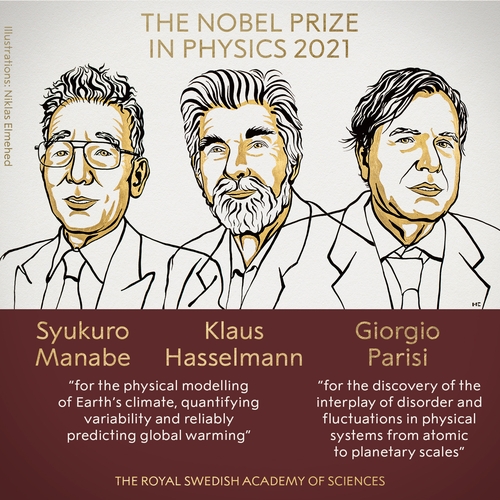
[Asia Economy Reporter Kim Bong-su] "He faithfully followed Nobel's will to award the person who made the most important discovery."
This is an evaluation of this year's Nobel Prize in Physics, which for the first time selected meteorologists, considered 'marginal' in the physics community, as recipients. It was an appropriate choice given the urgent contemporary issue of 'addressing climate change.'
On the afternoon of the 5th (local time), the Royal Swedish Academy of Sciences announced that this year's Nobel Prize in Physics was awarded to Shukuro Manabe, a professor at Princeton University in the United States who pioneered climate change research; Klaus Hasselmann, a researcher at the Max Planck Institute in Germany; and Giorgio Parisi, a basic physicist at Sapienza University of Italy who analyzed the properties of matter at the molecular level.
Manabe and Hasselmann received the Nobel Prize in Physics for the first time as meteorologists, in recognition of their foundational contributions to climate change research. In the 1960s, when there were no satellites or supercomputers, Professor Manabe developed a three-dimensional climate model based on mathematical calculations and the physical properties of the atmosphere that could predict temperature changes due to increased carbon dioxide. Researcher Hasselmann, an ocean climatologist, theoretically explained that increased human industrial activity is the cause of global temperature rise and climate extremes. He also published research showing that atmospheric variability can cause long-term ocean variability.
Professor Son Seok-woo of the Department of Earth and Environmental Sciences at Seoul National University explained, "The Intergovernmental Panel on Climate Change (IPCC) under the United Nations (UN) issued its 6th report warning that the time left until the global average temperature rise since industrialization reaches the limit tolerable by humans and nature (1.5 degrees Celsius) is only about 10 years," adding, "This is recognition of meteorologists' research results by the physics community."
Professor Parisi was awarded for elucidating the principles of how matter moves at the molecular level. In 1979, he proposed the 'spin glass' theory, analyzing the behavior of seemingly irregular molecular states of matter through mathematical models. Notably, this theory has recently been found applicable as a framework for analyzing human behavior and social relationships, and is being utilized in big data and artificial intelligence (AI) research.
© The Asia Business Daily(www.asiae.co.kr). All rights reserved.
![Clutching a Stolen Dior Bag, Saying "I Hate Being Poor but Real"... The Grotesque Con of a "Human Knockoff" [Slate]](https://cwcontent.asiae.co.kr/asiaresize/183/2026021902243444107_1771435474.jpg)











