Domestic Pharmaceutical Stocks Collectively Slump... Pharmaceutical Sector Index Falls 7.99%
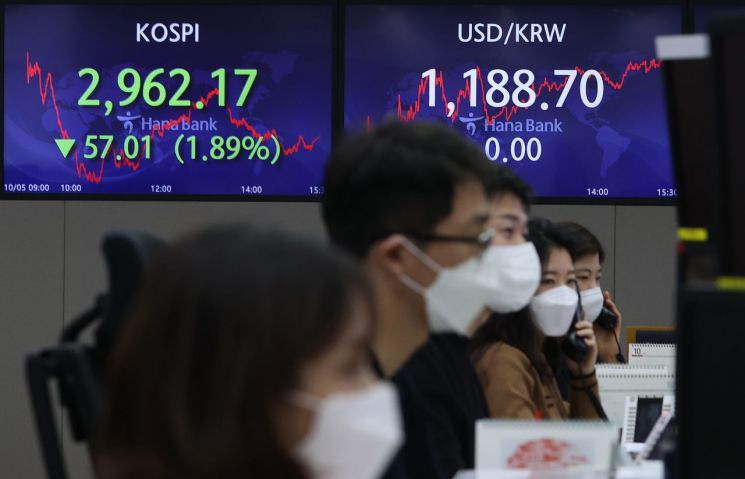
[Asia Economy Reporter Gong Byung-sun] A series of adverse events in the United States and China led to sluggishness in the domestic stock market. The KOSPI closed below the 3000 mark for the first time in about six months.
On the 5th, the KOSPI closed at 2962.17, down 1.89% (57.01 points) from the previous day. This is the first time the KOSPI has fallen below 3000 since March 25. It even dropped to 2940.59 at 10:34 a.m. that day.
The negative developments in the US and China are interpreted as having weakened investor sentiment. On the 4th (local time), Katherine Tai, US Trade Representative, revealed the US trade strategy toward China, emphasizing compliance with the US-China Phase One trade agreement, during a speech at the US think tank, the Center for Strategic and International Studies. The Phase One trade agreement, signed last year, requires China to purchase an additional $200 billion (approximately 237.6 trillion KRW) worth of US goods and services in 2020-2021 compared to 2017. This indicates that the Biden administration is continuing the Trump administration's tough stance on China.
The Biden administration's infrastructure investment bill, which had been a positive factor for global stock markets, is also stalled. The vote on the $1.2 trillion (approximately 1421.52 trillion KRW) infrastructure investment bill has been postponed to October 31 due to congressional conflicts. Park Kwang-nam, a researcher at Mirae Asset Securities, analyzed, "Persistent macroeconomic risks such as US-China trade friction and US debt ceiling negotiations are acting as burdens on investment."
Foreigners showed strong selling pressure, with net sales of 621.1 billion KRW. Individuals and foreigners were net buyers of 358 billion KRW and 232.5 billion KRW, respectively.
Most sectors declined. Pharmaceuticals had the largest drop at 7.99%. The announcement by US pharmaceutical company Merck verifying the efficacy of an oral COVID-19 treatment led to a sharp decline in domestic biotech stocks. This was followed by banks (-6.51%), paper and wood (-3.29%), services (-2.76%), and manufacturing (-2.00%). Sectors that rose included textiles and apparel (1.43%), distribution (0.69%), electricity and gas (0.32%), food and beverages (0.23%), and insurance (0.08%).
All of the top 10 stocks by market capitalization except Hyundai Motor fell. Celltrion had the largest drop at 12.10%, followed by Samsung Biologics (-7.20%), Kakao (-4.72%), Samsung SDI (-3.82%), NAVER (-3.01%), LG Chem (-2.99%), SK Hynix (-2.10%), Samsung Electronics (-1.37%), and Kia (-0.64%). Hyundai Motor remained flat.
The KOSDAQ closed at 955.37, down 2.83% (27.83 points) from the previous day. At 10:32 a.m., the KOSDAQ had fallen to 950.09.
Individuals' selling pressure led to the index decline, with net sales of 233.1 billion KRW. Foreigners and institutions were net buyers of 109.2 billion KRW and 137.4 billion KRW, respectively.
Almost all sectors declined. Distribution had the largest drop at 7.61%, followed by pharmaceuticals (-5.88%), publishing and media replication (-3.98%), telecommunications services (-3.90%), and information devices (-3.76%). Sectors that rose included entertainment and culture (2.31%), digital content (1.99%), broadcasting services (0.29%), and paper and wood (0.07%).
Many of the top 10 stocks by market capitalization showed weakness. Celltrion Healthcare had the largest drop at 12.84%, followed by Celltrion Pharm (-10.21%), HL Biotech (-5.41%), EcoPro BM (-2.66%), Kakao Games (-2.31%), and Alteogen (-1.82%). CJ ENM (2.47%), Pearl Abyss (0.70%), SK Materials (0.42%), and L&F (0.33%) rose.
© The Asia Business Daily(www.asiae.co.kr). All rights reserved.

















