Estimating the Political Characteristics of Gaya Inland through Distribution Range
Various Pottery Discovered... Indicating Changes in Gaya Culture
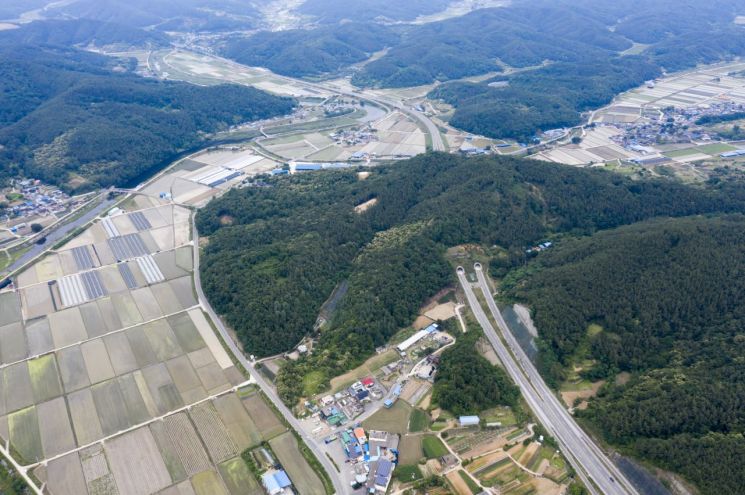
The Hapcheon Samga Burial Mounds consist of over 330 tumuli and represent a cluster of tombs in the inland region of Gaya. They include pit graves, stone-lined pit graves, stone chamber graves, and stone cist graves dating from the 1st to the 7th century, allowing us to trace the evolution of Gaya burial practices. Changes in the mound shapes and the types of grave goods also reveal the political dynamics of Gaya, making this site highly valuable historically and academically.
On the 5th, the Cultural Heritage Administration announced the advance notice of designation of this cultural heritage, which indicates the changes in Gaya, as a nationally designated historic site. Opinions from various sectors will be collected for a month, and the Cultural Heritage Committee will review and finalize the designation. Based on the location of the burial mounds, the size of the tumuli, the number of burial facilities for the deceased, and the types of grave goods, it is estimated that a powerful political entity constructed the Hapcheon Samga Burial Mounds. The Cultural Heritage Administration stated, "Through the distribution range of the so-called 'Samga-style tombs,' which were built from the mid-5th century to the mid-6th century, we can infer the scale and existence patterns of the inland Gaya political entity."
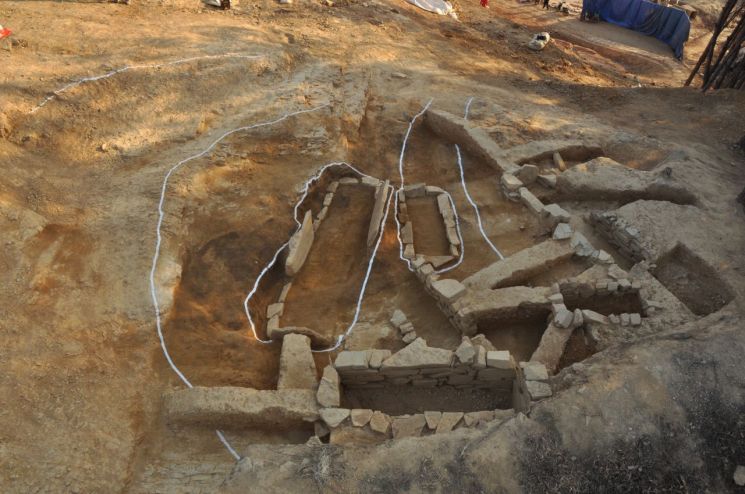
Samga-style tombs are characterized by having multiple burial facilities within a single mound. For example, when adding stone-lined pit graves, instead of building separate mounds, parts of the existing mound were excavated and combined. The Cultural Heritage Administration explained, "The mounds were mainly expanded toward the ridge tops," adding, "Through repeated burial activities like this, many tombs with mounds about 5 meters in size overlapped and expanded within a short time interval." Tombs of this type are also found in the Yeongsan River basin. However, unlike the Hapcheon Samga Burial Mounds, their structure, scale, and grave goods vary depending on the construction period.
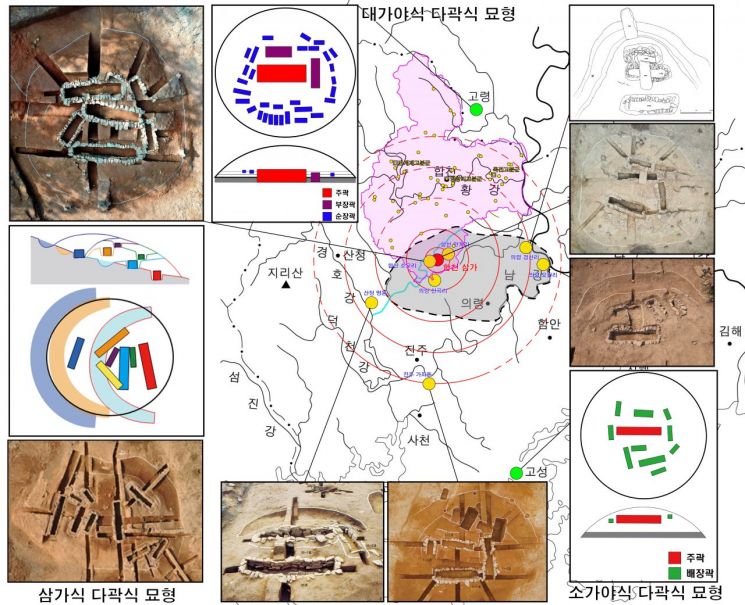
Various pottery types have been excavated from the Samga Burial Mounds. These include ancient style earthenware, new style earthenware, ancient style glazed pottery, Sogaya-style pottery, and Daegaya-style pottery. Each carries characteristics of its respective era, indicating changes in Gaya culture. Earthenware is a somewhat soft pottery with a color similar to roof tiles. The ancient style was made in the 1st century BCE, and the new style in the 2nd century CE. Ancient style glazed pottery was frequently excavated from sites in the Yeongnam region around the 4th century. Representative types include cylindrical footed plates, brazier-shaped pot stands, and handled cups. Sogaya-style pottery is mainly found in the western Gyeongnam areas such as Goseong and Jinju. Daegaya-style pottery is commonly found in the Goryeong and Hapcheon regions.
© The Asia Business Daily(www.asiae.co.kr). All rights reserved.



















