No Detailed Technology Development Roadmap and No Assessment of Required Critical Mineral Quantities
Surge in Foreign Market Share of Wind Power Equipment Causes Vicious Cycle of Domestic Ecosystem Contraction
Wind Power Speed Control Debate... "Analysis of Nuclear Power Role Must Also Be Conducted"
[Sejong=Asia Economy Reporter Kwon Haeyoung] As the localization rate of key components for wind power generation declines, concerns are growing that the government-driven offshore wind power market, worth 100 trillion won, will be flooded with imported equipment. While the government agrees on the need to develop key wind power technologies, it has neither prepared a detailed technology roadmap nor identified the essential mineral quantities required for turbine production. Amid fears that the mega offshore wind power projects could become a 'second solar power' benefiting only foreign companies, there are calls for 'speed control' in the expansion of wind power deployment.
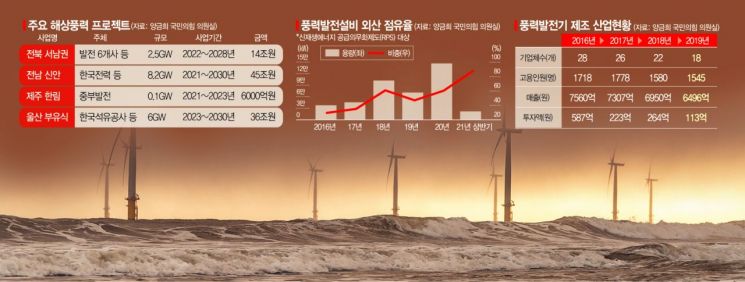
◆Threefold Increase in Foreign Share of Wind Power Equipment=According to data submitted by the Korea Energy Agency to Rep. Yang Geum-hee of the People Power Party on the 5th, the influence of foreign companies in the domestic wind power market is rapidly expanding. In the wind power equipment market subject to the Renewable Portfolio Standard (RPS), which requires power producers above a certain scale to supply a portion of their output from renewable sources such as solar, wind, and hydrogen, the share of imported equipment surged nearly threefold from 29.6% (37,800 kW) in 2016 to 87.8% (146,550 kW) in the first half of 2021. Meanwhile, the domestic share shrank from 70.4% (89,800 kW) to 12.2% (3,000 kW) during the same period. This structure means that the more wind power is deployed, the more foreign companies benefit.
The increase in foreign market share in wind power is also leading to a contraction of the domestic wind ecosystem. According to 2019 renewable energy industry statistics, the number of domestic wind manufacturing companies decreased from 28 in 2016 to 18 in 2019, and employment dropped from 1,718 to 1,545 during the same period. Sales fell from 756 billion won to 649.6 billion won, and investment plunged sharply from 58.7 billion won to 11.3 billion won. While 60% of domestic solar power equipment owned by eight public enterprises including Korea Electric Power Corporation uses imported solar cells, there are concerns that wind power may follow the same path. This underscores the need not only to expand offshore wind power but also to establish a roadmap for technology internalization, including support for key technology R&D and securing mineral resources for domestic production.
◆No Supply Plan for Essential Minerals for 'Turbine' Production=According to the Korea Mine Reclamation Corporation, a public enterprise under the Ministry of Trade, Industry and Energy, the corporation has not identified the domestic usage and supply quantities of minerals required to manufacture one wind turbine. The Korea Mine Reclamation Corporation was established through the merger of the Korea Mineral Resources Corporation, the only mineral resource development specialist in Korea, and the Korea Mine Reclamation Agency.
Analysis by the Korea International Trade Association shows that permanent magnets and neodymium are used in wind turbine production, requiring up to 1,200 kg and 420 kg per megawatt (MW), respectively. According to the Ministry of Trade, Industry and Energy’s offshore wind power plan for 2030, which targets 16.8 gigawatts (GW), domestic turbine production would require 20,160 tons of permanent magnets and 7,056 tons of neodymium. At current prices, this would cost a total of 810 billion won. However, due to rising mineral prices from increased global demand and instability in rare earth supply chains, there is a risk of supply difficulties. Despite unveiling a 2030 offshore wind power blueprint equivalent to 17 nuclear reactors, the government is criticized for neglecting key technology internalization and domestic ecosystem establishment.
Rep. Yang said, "Not only is wind power technology and price competitiveness lagging, but the supply rate of raw materials is also unknown," adding, "If the government focuses only on achieving wind power targets, it will be no different from imported electricity."
◆Nuclear Power with World-Class Technology is 'Neglected'=Renewable energy technology is often compared to nuclear power. Although domestic nuclear technology is world-class, the government’s decision to expand solar and offshore wind power deployment has led to a rapid collapse of the nuclear ecosystem. With the current administration’s 'nuclear phase-out' policy, including the cancellation of new nuclear plants such as Shin Hanul Units 3 and 4, orders received by Doosan Heavy Industries, a leading domestic nuclear company, from Korea Hydro & Nuclear Power decreased by 55.6%, from 397.8 billion won in 2016 to 176.6 billion won in 2020. Nuclear companies in the Gyeongnam region saw their orders from KHNP drop by 62.4%, from 546.5 billion won to 205.1 billion won during the same period.
Jobs are also disappearing rapidly. Doosan Heavy Industries’ nuclear-related workforce shrank from 1,857 in 2016 to 1,468 in 2020, and further down to 1,193 as of February this year.
Experts advise that the pace of wind power deployment should be moderated until domestic wind power technology reaches an advanced level. Professor Jung Dong-wook of the Department of Energy Systems Engineering at Chung-Ang University pointed out, "Scaling up is essential for wind power technology, but the current technology level of domestic companies is significantly lower than that of overseas firms." He added, "It is advisable to first promote offshore wind pilot projects mainly in island regions to support technology development, and then expand offshore wind power deployment after securing economic feasibility." He emphasized, "To achieve carbon neutrality, a precise analysis of the role of nuclear power, which Korean companies possess with world-class technology, must be conducted concurrently."
© The Asia Business Daily(www.asiae.co.kr). All rights reserved.

















