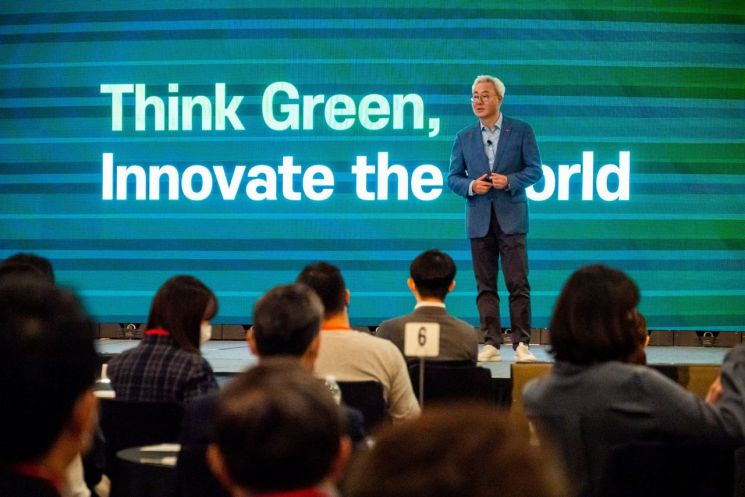
 Kim Jun, President of SK Innovation, is speaking at a recent recruitment event held in the United States.
 [Asia Economy Reporter Choi Dae-yeol] SK On's management has revealed that they are considering developing lithium iron phosphate (LFP) batteries. LFP is known for having lower energy density but being cheaper and less prone to fire risks, a method mainly adopted by Chinese companies so far. This company, a newly established battery subsidiary of SK Innovation, currently manufactures nickel-cobalt-manganese (NCM) series electric vehicle batteries.
Kim Jun, President of SK Innovation, and Ji Dong-seop, CEO of SK On, stated in a foreign media interview released on the 5th that they are reviewing the development of LFP batteries. CEO Ji said, "Automakers, who are the battery customers, are interested in LFP technology," and mentioned that they are considering developing LFP batteries for specific uses such as low-cost vehicles.
LFP batteries are developed and supplied mainly by Chinese companies, including CATL, the world's largest battery company. Tesla, which has the highest electric vehicle sales, also uses LFP batteries in some models. Domestic companies like LG Energy Solution have produced some small products using LFP, but for medium and large electric vehicle batteries, they have supplied NCM series batteries. It is also reported that LG Energy Solution has started reviewing the development of LFP batteries for electric vehicles.
NCM batteries are praised for their high energy density, which is advantageous for improving electric vehicle performance such as driving range and charging time. However, the main materials are expensive, and supply issues may arise at any time. There is also a structural disadvantage in terms of safety. As fire issues in vehicles using NCM batteries have been highlighted, and some automakers like Volkswagen and Ford are moving to expand LFP use, the demand for LFP batteries is steadily expected to increase.
Until now, production and supply were limited to China due to patent issues, but patents will expire by the end of next year. However, since LFP has lower density, some opinions suggest that the cost difference between LFP and NCM is not significant when considering actual vehicle performance.
SK management forecasts that battery supply will be insufficient for a while in the United States, where electric vehicle adoption is increasing. SK recently decided to build a joint factory with Ford with an annual production capacity of 129 GWh, more than double the originally planned scale. Mass production is targeted around 2025.
© The Asia Business Daily(www.asiae.co.kr). All rights reserved.

















