Global Stock Markets Fall Sharply Amid Tightening Concerns and Chinese Regulations
KODEX Leverage Sees Largest Purchase of 250 Billion KRW Over 20 Trading Days
Institutions Buy Inverse ETFs, Foreigners Invest in Secondary Battery Stocks
[Asia Economy Reporter Minji Lee] Since last month, individual investors have been expanding their net purchases of ETFs that bet on index rises. Despite the global stock market's sharp decline due to tightening concerns from rising inflation and regulatory policies by the Chinese government, individual investors seem to have judged that the index has fallen excessively.
◆ Excessive Index Decline... Individual Investors Betting on Rise
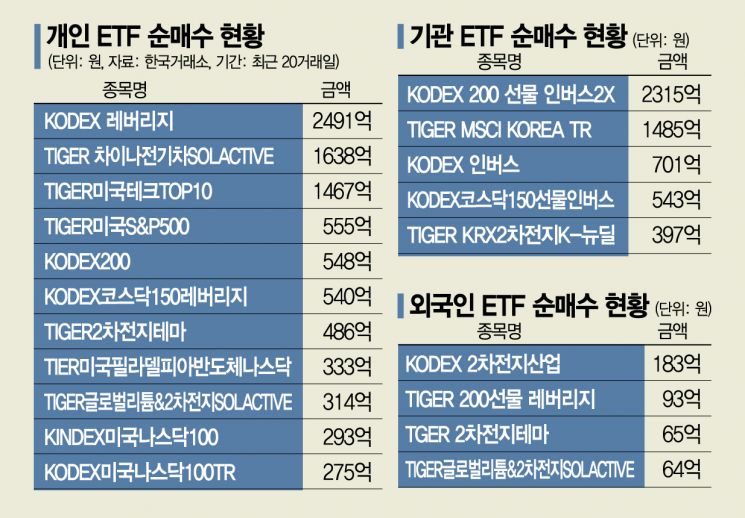
According to the Korea Exchange on the 5th, the ETF most purchased by individual investors over the past 20 trading days was KODEX Leverage (249.1 billion KRW). This ETF seeks to achieve twice the rate of change of the KOSPI 200 index, meaning that if the KOSPI 200 index rises, investors can gain twice the profit of the increase. Individual investors also bought KODEX 200 (54.8 billion KRW) and KODEX KOSDAQ 150 Leverage (54 billion KRW), continuing to bet on the expectation that the domestic stock market could rise.
During the same period, individual investors also significantly increased their investments in the Nasdaq index. As concerns over rising government bond yields due to inflation expansion caused major tech stocks to experience larger price declines, domestic investors strengthened their outlook for a rise in the Nasdaq index, which includes these stocks. Among the top net purchase ETFs, many were those investing in the Nasdaq index, including TIGER US Tech TOP10 (146.7 billion KRW), TIGER US Nasdaq 100 (71.7 billion KRW), TIGER US S&P 500 (55.5 billion KRW), TIGER US Philadelphia Semiconductor Nasdaq (33.3 billion KRW), KINDEX US Nasdaq 100 (29.3 billion KRW), and KODEX US Nasdaq 100 TR (27.3 billion KRW).
The reason individuals bought these ETFs is analyzed to be due to the rapid increase in the global stock market's decline since last month. With domestic uncertainties such as semiconductor industry instability and internet regulation risks still present, external uncertainties increased due to the side effects of China's regulatory risks, the Evergrande Group default crisis, and rising interest rate pressures. As a result, the Nasdaq index fell about 6% and the KOSPI about 4.3% in one month. In particular, the KOSPI continued its decline for three consecutive months, marking the largest drop in 18 months since March last year (-11%) when it was hit hard by the spread of COVID-19.
Securities experts expect that, given the significant index decline over the past three months, a technical rebound may occur this month, but it may take more time for a trend reversal to an upward movement. Lee Kyung-min, a researcher at Daishin Securities, analyzed, "After three consecutive months of decline, short-term price and valuation attractiveness increase, so a rebound is expected, but the fundamental issues such as economic instability, inflationary pressures, and global supply chain uncertainties must be resolved for the current situation to change."
◆ Institutions Bet on Inverse ETFs, Foreigners on Secondary Battery ETFs
Meanwhile, institutional investors showed opposite investment sentiment to individual investors by betting on index declines. Institutional investors made the largest net purchases of KODEX 200 Futures Inverse 2X, buying 231.5 billion KRW worth. They also bought 70.1 billion KRW worth of KODEX Inverse, anticipating that the KOSPI will continue to decline for the time being. They also continued to bet downward on the KOSDAQ index, purchasing 54.3 billion KRW worth of KODEX KOSDAQ 150 Futures Inverse.
Foreign investors mainly accumulated ETFs related to secondary batteries in the ETF market. Among the top five net purchased ETFs, four were invested in secondary battery-related stocks. They bought the most of KODEX Secondary Battery Industry with 18.3 billion KRW, followed by TIGER 200 Futures Leverage (9.3 billion KRW), TIGER Secondary Battery Theme (6.5 billion KRW), TIGER Global Lithium & Secondary Battery SOLACTIVE (6.4 billion KRW), and TIGER KRX Secondary Battery K-New Deal (6.3 billion KRW). KB Securities researcher Ha In-hwan analyzed, "Among eco-friendly related stocks, secondary batteries have lower price attractiveness compared to other solar, hydrogen, and wind stocks, but expectations will expand as policy momentum in the US and Korea fully materializes in the fourth quarter."
© The Asia Business Daily(www.asiae.co.kr). All rights reserved.


















