Korea Research Institute of Standards and Science Quantum Technology Research Center Quantum Spin Team
Development of Core Technologies for Skyrmion-Based Electronic Devices
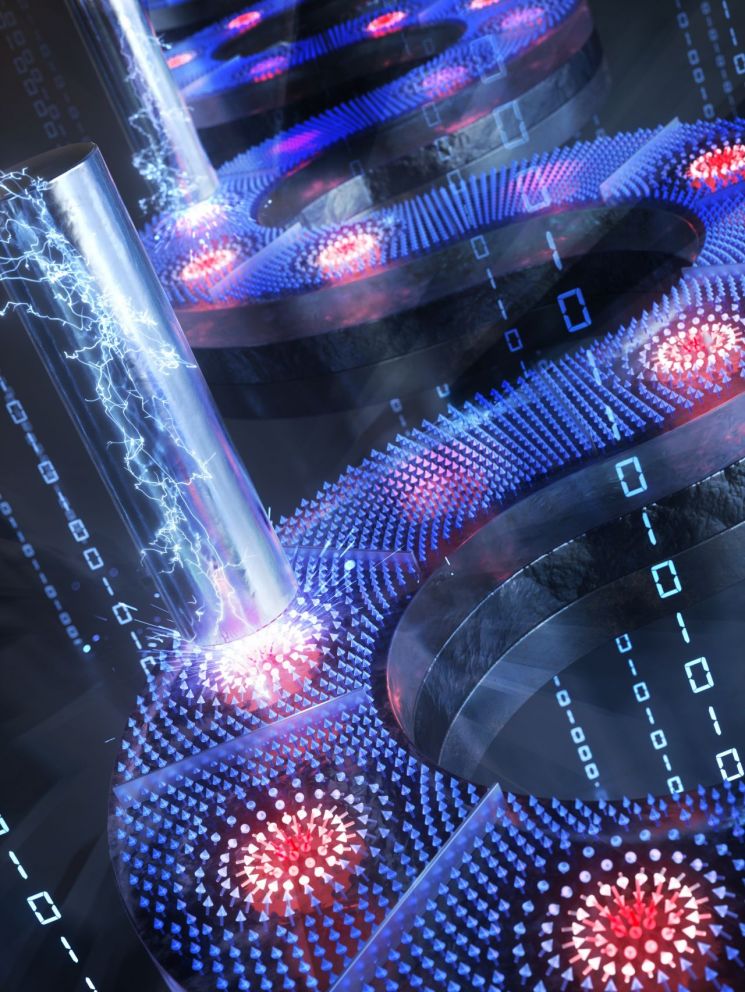
[Asia Economy Reporter Kim Bong-su] A skyrmion-based electronic device, a core technology for developing next-generation semiconductors such as neuromorphic devices and logic devices, has been developed by a domestic research team. Unlike conventional semiconductors that consume enormous electricity and generate a lot of heat, this device can process large volumes of data with low power consumption, making it revolutionary.
The Korea Research Institute of Standards and Science (KRISS) announced on the 5th that the Quantum Spin Team at the Quantum Technology Research Center succeeded in developing the core technology to implement skyrmion-based electronic devices.
Artificial intelligence and supercomputers are often called "electricity guzzlers" due to their high power consumption. In 2016, the power consumed by AlphaGo to play one game of Go was about 1 megawatt, which is comparable to the daily electricity usage of 100 average households. Consequently, there is growing interest in ultra-low-power electronic devices capable of processing large volumes of data with low power consumption.
Skyrmions are spin structures arranged in a vortex shape, which can be reduced to sizes of a few nanometers and can move with very low power, making them representative candidates for ultra-low-power devices. Electronic devices using skyrmions consume about 1/100th of the power compared to conventional electronic devices that record 1s and 0s using magnetic north and south poles, making them economical.
To develop skyrmions into electronic devices, four integrated technologies are required within a single device: creation, deletion, movement, and detection of individual skyrmions. Over the past decade, researchers have succeeded in experimentally implementing some combinations of these four technologies, but due to the inability to precisely identify the cause of creation, no experiment has simultaneously demonstrated all four.
Until now, most research on electronic devices applying skyrmions has been based on computer simulations. To commercialize skyrmion-based electronic devices, experimental proof is necessary, which has limited the development of devices with high application potential.
The research team succeeded in experimentally implementing a new method for creating and deleting skyrmions based on a three-dimensional vertical electrode structure, surpassing the conventional method limited to two-dimensional planar states that generate and delete skyrmions using strong external stimuli such as light, current, magnetic fields, and electric fields. By utilizing the formation of filaments acting as three-dimensional vertical electrodes inside the oxide layer, they injected current into specific locations of the magnetic material and discovered that skyrmions were easily created and deleted. By combining this with existing skyrmion movement technology, they simultaneously realized free creation, deletion, and movement of skyrmions within a single device.
This technology can be easily applied to the "MRAM" technology being developed by domestic large corporations. MRAM, known as magnetic semiconductor, processes and stores data by utilizing the push-pull phenomenon of magnetic fields. Theoretically, semiconductor manufacturing with integration density over 1000 times higher than DRAM is possible. This achievement is even more significant as it is the world's first experimental realization of the skyrmion device (Skyrmion racetrack memory) theoretically proposed by Albert Fert, the 2013 Nobel Prize in Physics laureate.
Senior Researcher Hwang Chan-yong said, "This achievement can play a key role in developing next-generation semiconductor technology," and added, "We plan to pursue applied research such as synapse devices utilizing skyrmion number control and attempt research in the quantum skyrmion field, which has been nearly impossible to experiment with until now."
The research results were published online on the 27th of last month in the international academic journal Advanced Materials (IF: 30.849).
Below are explanations of key terms.
▲Skyrmion
Skyrmions are unique spin structures in the form of particles arranged in a spiral vortex shape (spindle). Skyrmions have the property of maintaining their shape and structure despite external environmental changes, can be created at sizes of a few nanometers, and their number can be electrically controlled. These characteristics make them very useful for next-generation electronic devices such as memory, logic devices, and communication devices. To utilize skyrmions in memory devices, each skyrmion, which is the basic unit (bit) of information storage, must be created and annihilated at desired positions, and the created skyrmions must be moved with very high efficiency.
▲Neuromorphic
Neuromorphic refers to hardware such as semiconductor chips designed to mimic the human brain. It uses a method that efficiently processes data by imitating the signal transmission between neurons in the brain. It has the advantage of consuming only 20 watts (W) of power, enabling artificial intelligence (AI) functions to operate with ultra-low power consumption.
© The Asia Business Daily(www.asiae.co.kr). All rights reserved.

















