Biden Administration's First Public Disclosure of China Trade Policy
"Frank Discussion on Phase 1 Trade Talks... Raising Concerns Over China's Trade Practices"
No Criticism of China's Unfulfilled Promises
Dialogue Initiated but China's Response Uncertain
[Asia Economy New York=Correspondent Baek Jong-min] Contrary to expectations, the United States moderated its level of trade pressure on China and emphasized change through dialogue. While the US-China conflict was avoided from spreading into the trade sector, it remains uncertain whether China will accept what the US desires.
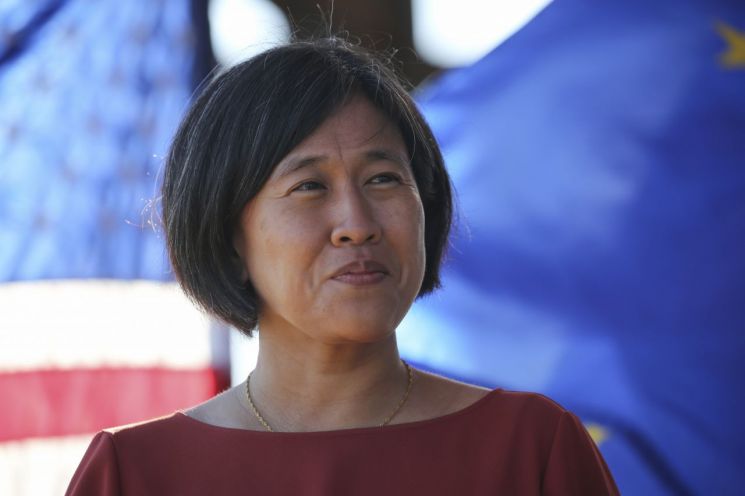
Catherine Tai, United States Trade Representative (USTR), delivered a speech on the 4th (local time) at the think tank Center for Strategic and International Studies (CSIS), stating that she would sincerely discuss the outcomes of the US-China Phase One trade agreement signed in January 2020 with China, and raise serious concerns about China’s state-centric and non-market trade practices that were not addressed in Phase One.
Through this statement, the Biden administration publicly revealed its trade policy direction toward China for the first time.
Representative Tai said, "We will use all available tools and develop new tools as necessary," leaving open the possibility of invoking ‘Section 301 of the Trade Act.’ She also stated that there are no plans to pursue a Phase Two trade agreement, which was originally scheduled to follow Phase One.
US media had expected Representative Tai to take a hardline stance against China, but her remarks instead emphasized dialogue with China. When asked if she had seen analysis data showing that China had only achieved about 60% of the Phase One trade agreement, she replied, "I have not seen it," avoiding specific comments and emphasizing responses through cooperation with allies.
According to the Phase One trade agreement, China was supposed to purchase an additional $200 billion (approximately 237 trillion won) of US goods and services in 2020?2021 compared to 2017. However, with the agreement’s implementation period ending in three months, China has not purchased the planned amount of US products.
Representative Tai repeatedly stressed the necessity of dialogue, saying, "There is no way to solve the problem without direct dialogue with China."
US companies felt relieved that the Biden administration is not escalating trade conflicts with China. Myron Brilliant, head of international affairs at the US Chamber of Commerce, welcomed Representative Tai’s remarks, saying, "While exchanges with allies are important, direct engagement with China is necessary."
The Wall Street Journal (WSJ) reported that while China responded cautiously yet with relief to Representative Tai’s remarks, it remains uncertain whether the Biden administration will receive the concessions it desires. An advisor to China’s Ministry of Commerce told WSJ, "China welcomes discussions but will not rush anything."
© The Asia Business Daily(www.asiae.co.kr). All rights reserved.

















