FKCCI Urges Resolution of Korea-Japan Economic Conflicts Following New Japanese Administration Inauguration
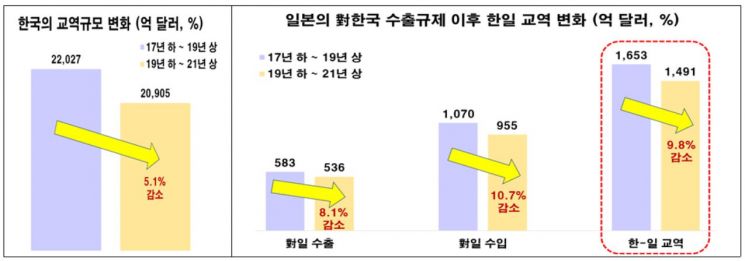
[Asia Economy Reporter Kim Hyewon] Over the past two years since Japan imposed export restrictions on South Korea, the trade volume between the two countries has decreased by 9.8%. As Japanese companies' investment sentiment has frozen, direct investment in South Korea also dropped by 28.5%. Economic damage is increasing in areas such as trade, direct investment, and human exchange between the two countries, leading to calls for resolving the economic conflict between Korea and Japan with the launch of Japan's new administration under Fumio Kishida.
The Federation of Korean Industries (FKI) analyzed changes in economic relations between the two countries during the period of Japan's export restrictions (second half of 2019 to first half of 2021) on the 5th and urged the prompt abolition of the mutually ineffective export restrictions.
During this period, trade between the two countries decreased by nearly 10%, a result compounded by overall distrust due to mutual export restrictions. The total amount of parts and materials imported by South Korea from all countries worldwide increased by 0.23%, but the total amount imported from Japan decreased by 4.1%. Additionally, Japan's direct investment in South Korea fell by 28.5%, from $2.19 billion to $1.57 billion.
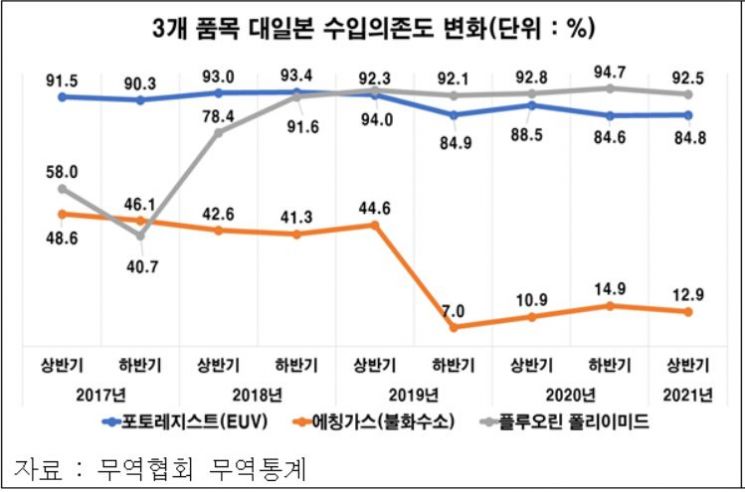
The total imports from Japan of the three materials subject to export restrictions related to the semiconductor and display industries (photoresist, hydrogen fluoride, and fluorinated polyimide) decreased by 0.67%, showing little change before and after the export restrictions. The dependency on imports of these three materials from Japan decreased by 1.3 percentage points, from 75.9% before the restrictions to 74.6% after. The FKI analyzed that this was because the government and companies responded quickly to Japan's import restrictions, and the Japanese government also eased restrictions by approving photoresist exports twice in August 2019. However, in the case of hydrogen fluoride, import sources were replaced by Taiwan and China after Japan's export restrictions, resulting in a 31.7 percentage point decrease in dependency on imports from Japan as of the first half of this year compared to the first half of 2019.
Sales of Japanese companies operating domestically decreased by 9.4% in 2019, the year export restrictions began, compared to the previous year, and the number of companies decreased by 2.4%. Sales of Korean companies investing in Japan also dropped by 10.2%, and the number of companies decreased by 11.3%. Tomoyuki Moriyama, director of the Seoul Japan Club, stated at an FKI-hosted seminar in April, "We want to continue business in a win-win relationship with Korean partners, but there are concerns about emotional reactions such as the boycott of Japanese products," adding, "Only 27% of companies are considering future business expansion, indicating increasing management difficulties."
Kim Bongman, head of international cooperation at FKI, pointed out, "The unprecedented Korea-Japan economic conflict over about two years since July 2019 has caused minimal reduction in imports of the three major export-restricted items from Japan, but negative effects such as anti-Japanese and anti-Korean sentiments have reduced trade, direct investment, and human exchanges between the two countries, increasing economic damage." He added, "With the launch of Japan's new administration, the mutually ineffective Korea-Japan export restrictions should be promptly ended through official negotiations between the two countries' trade authorities, separate from diplomatic issues," and suggested, "An unconditional summit meeting between the two countries' leaders should be pursued."
© The Asia Business Daily(www.asiae.co.kr). All rights reserved.
![Clutching a Stolen Dior Bag, Saying "I Hate Being Poor but Real"... The Grotesque Con of a "Human Knockoff" [Slate]](https://cwcontent.asiae.co.kr/asiaresize/183/2026021902243444107_1771435474.jpg)












