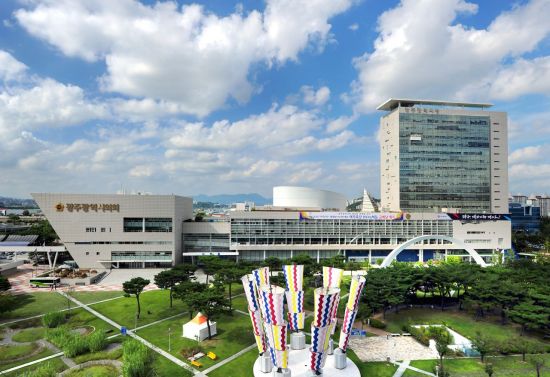
[Asia Economy Honam Reporting Headquarters, Reporter Yoon Jamin] Gwangju Metropolitan City announced on the 4th that it will proceed with the development of new medical technology and the advancement of the industrial base to foster the medical healthcare industry, which is rapidly emerging as a promising future industry, as a next-generation strategic industry.
Since 2002, starting with the Titanium Special Alloy Center at Gwangju Technopark, the city has steadily nurtured the medical healthcare industry, significantly expanding the medical industry base to include dentistry, bio, optical medical, orthopedics, cosmedi-care, ophthalmology, dementia, and micro medical robots.
In particular, centered around the second complex of Gwangju Technopark, a bio-health industry cluster has naturally formed, including the dental and orthopedic biomedical materials and parts center, contributing greatly to the regional economy with an average annual growth rate of 18.4% over the past three years.
In fact, related companies, which numbered only two with sales of 200 million KRW and 22 employees in 2002, recorded explosive growth by 2020 with sales of 1.0828 trillion KRW, 4,525 employees, and 519 businesses.
Moreover, a virtuous cycle structure has been established, leading to the attraction of external companies, job creation, and increased exports, positioning the medical industry as a next-generation knowledge-based industry that induces employment.
The city is accelerating the development of new medical technologies and the advancement of the industrial base to make the medical healthcare industry a future strategic industry.
Since 2014, biomedical materials and parts have been selected and nurtured as a regional core industry, expanding support from metal materials centered on implants to materials such as polymers, ceramics, and silicone. The scope has broadened to include dental, orthopedic, ophthalmic optical medical devices, bioabsorbable materials, high-functionality cosmetics industry, and AI-based digital biohealth industry. Networks have been established among universities, hospitals, research institutes, and companies to implement full-cycle corporate support projects from product development to clinical application.
The company cluster formed around biomedical materials and parts that are harmless and easily adaptable to the human body, including materials and parts for artificial joints or implants for orthopedic and dental tissue recovery, as well as ophthalmic and optical medical devices, is evaluated as the best nationwide.
Projects underway include hospital-centered open laboratories supporting startups and technology commercialization, dental hard tissue biointerface research centers, development of technology to overcome intractable chronic pain, establishment of a leading research center for next-generation precision medical technology tailored for cardiovascular patients, fostering the world’s top-level micro medical robot industry performing human diagnosis, treatment, and drug delivery with active ultra-small medical devices in the advanced innovative medical device field, and clinical data-based musculoskeletal human simulation convergence technology support projects.
Especially, since 2022, to focus on the biohealth industry, Chonnam National University Hospital is leading the establishment of an AI-based smart medical device development and commercialization platform where doctors and companies collaborate throughout the entire cycle from idea discovery to product development, clinical trials, and usability evaluation.
Additionally, plans are underway to build a large-scale high-purity peptide production cluster for mass production of high-purity peptides, which are used as raw materials for incurable diseases such as cancer, diabetes, osteoporosis, infectious disease vaccines, functional cosmetics, and health functional foods. These peptides are globally recognized as key raw materials for the future bio-pharmaceutical industry but have a weak domestic production base and are mainly imported.
In the dementia and elderly-friendly sectors, projects include developing dementia prediction technology based on brain research, establishing a dementia cohort multimodal data application verification base, and operating an elderly-friendly industry support center that supports exhibition, experience, usability evaluation, product development, and startups for senior products.
In the cosmetics field, to develop Gwangju as the Honam region’s hub for the cosmetics industry, a new concept cosmedi-care industry demonstration center combining dermatological medicine is being constructed. This center covers everything from cosmetics development to efficacy evaluation, clinical trials, usability verification, and small-lot multi-product customized production facilities (CGMP).
Through these efforts, the city plans to achieve its goal of nurturing medical industry sales of 2.3 trillion KRW, employment of 9,000 people, and 2,000 companies by 2030, aiming to leap forward as a global MediCity.
Son Kyungjong, Director of the City’s AI Industry Bureau, said, “We are focusing on nurturing the medical healthcare industry as Gwangju’s future growth engine industry,” adding, “We will do our best to support the medical industry, which is emerging as a high value-added industry in the aging era and a future growth new industry, so that it can become a major pillar of our regional economy.”
© The Asia Business Daily(www.asiae.co.kr). All rights reserved.
![Clutching a Stolen Dior Bag, Saying "I Hate Being Poor but Real"... The Grotesque Con of a "Human Knockoff" [Slate]](https://cwcontent.asiae.co.kr/asiaresize/183/2026021902243444107_1771435474.jpg)











