Promoting Business Diversification Based on Innovation-Recognized Business Model
Notable Success Stories of Value-Up Following Scale-Up
 Amid the second venture boom, with entrepreneurial enthusiasm hotter than ever, attention is focused on the secrets to success of companies that overcome the five-year crisis and scale up through innovation competitiveness. Photo by Gettyimage
[Asia Economy Reporter Kim Heeyoon] Amid the second venture boom, with entrepreneurial enthusiasm hotter than ever, attention is focusing on the secrets to success of companies that overcome the five-year crisis and scale up with innovative competitiveness.
According to industry sources on the 3rd, entrepreneurs continue to ponder the qualitative growth of companies centered on the startup ecosystem. This is because the number of companies failing to overcome the so-called ‘Death Valley’?facing difficulties in market entry due to obstacles such as funding challenges despite successful startups with excellent technology and entrepreneurial spirit?is increasing.
According to the 'Analysis of Changes in the Korean Startup Ecosystem' announced by the Ministry of SMEs and Startups in April, the one-year survival rate of companies was 59.8% in 2012, slightly rising to 63.7% in 2018. The five-year survival rate remained similar, at 30.9% in 2012 and 31.2% in 2018. Although the number of 'big hit' startups that have grown into unicorn companies or gained global recognition has increased over the past decade, this still reflects the reality that 7 out of 10 startups disappear within five years.
Accordingly, interest is growing in startups that successfully scale up across various fields by overcoming the Death Valley despite numerous challenges. These innovative companies are particularly noteworthy for converting market penalties into consumer loyalty. They are recording strong performances in each sector through a ‘Purple Ocean’ strategy that creates new value by shifting perspectives in fiercely competitive markets. Furthermore, by diversifying their business portfolios, they are achieving not only quantitative scale-up but also growth in corporate value.
Nudge Healthcare: Six Years of Growth Curve through Health Management App ‘Cashwalk’ and Comprehensive Healthcare Service Expansion
Health tech platform Nudge Healthcare is expanding its health-related business areas based on the growth momentum of Cashwalk. CEO Na Seungkyun, a preventive medicine specialist at Seoul Asan Hospital, and CEO Park Jeongsin, a former developer at Samsung Electronics SW Center, founded the company based on their expertise and concerns about motivating consistent practice of walking exercises for health management. Launched in 2016, ‘Cashwalk’ introduced a pedometer function on the phone lock screen, gaining significant attention by implementing two motivational tools: monetary rewards in the form of cash and a ‘facilitation network’ encouraging interaction among users. As of July this year, in its fifth year since launch, Cashwalk recorded 3 million daily active users (DAU) and 15 million cumulative downloads.
This year, Nudge Healthcare plans to evolve the app to manage both physical and mental health by releasing Catchwatch 2, which can be linked with Cashwalk. Additionally, through its diet division ‘Genieat,’ it operates the ketogenic specialty brand ‘Keto Seonsaeng’ and diet specialty mall ‘CCang Market,’ expanding its scale as a total healthcare company supporting exercise and dietary habit management. Based on the performance of its core business Cashwalk, Nudge Healthcare achieved annual sales of 32.8 billion KRW in 2020 and established a stable business model by diversifying revenue streams through the diet food business, reaching 24.3 billion KRW in sales in the first half of this year.
Na Seungkyun, CEO of Nudge Healthcare, said, “It is very rare in the digital healthcare industry for a company to maintain a steady sales growth curve without deficits since its founding. As a market leader, we will continue to faithfully pursue our core business while investing in new businesses that can create synergy.”

Brandi Evolves into a Fashion-Specialized App through AI-Based Algorithm Development and Versatility
Founded in 2014, Brandi is advancing as a target-specialized vertical commerce aiming to globalize Dongdaemun fashion. Targeting female consumers, the app ‘Brandi,’ launched in 2016, currently hosts about 12,000 sellers and records up to 530,000 daily visitors. Additionally, based on accumulated visit and sales data from the app, Brandi developed an AI-based demand forecasting algorithm and launched an integrated Dongdaemun fulfillment management system, differentiating its business model. This driving force stems from CEO Seo Jeongmin’s background in e-commerce, focusing on connecting Dongdaemun fashion and IT from the early stages of the startup.
Subsequently, Brandi applied this advanced system to launch ‘Hyber’ (2018) for male consumers and the comprehensive childcare shopping app ‘Mami’ (2021), building a vertical portfolio satisfying all age groups. As of last year, Brandi’s sales amounted to 85.8 billion KRW, with a transaction volume of 300 billion KRW. Moving forward, Brandi plans to focus on developing a global version of the app and aims to become a leading fashion and apparel app contributing to enhancing accessibility to the Dongdaemun cluster in the overseas logistics industry.
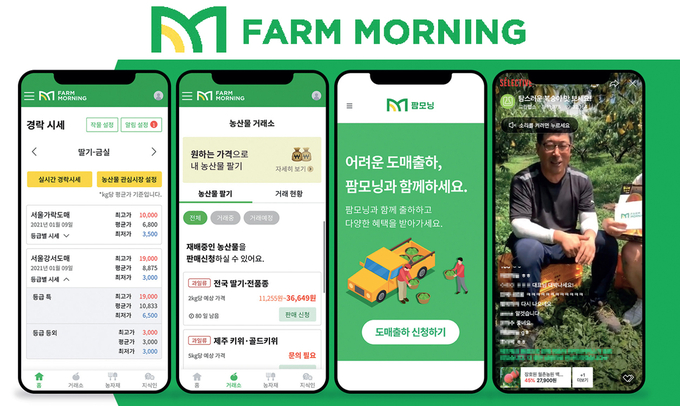
Greenlabs Leads High-Value Agriculture Development with Comprehensive Agricultural Platform ‘Farm Morning’
The evolution into a super app that helps improve users’ living environments can also be seen in the growth of agtech startup Greenlabs, which launched the data agriculture platform Farm Morning. CEO Shin Sanghoon, with generalist experience integrating IT technology across various industries such as Ridibooks, Amanda, and Koocha, has focused on the smart farm sector since the company’s founding in 2017 and expanded the business by developing the cloud-based ‘Farm Morning Smart Farm.’ In 2020, Greenlabs launched the comprehensive agricultural platform ‘Farm Morning,’ combining smart farm environments with mobile technology, aiming to ‘transform agricultural workers into knowledge workers’ and leading agricultural environment improvements.
One of the biggest challenges in agricultural innovation is the high proportion of agricultural workers aged 65 and older. Greenlabs targets consumers under 65 but also develops user interfaces that are easy for those over 65 to access and provides consulting for farmers accustomed to traditional agriculture, enabling rapid growth in the smart farm sector.
Farm Morning surpassed 300,000 member farms within a year of its launch and aims to reach 500,000 by the end of the year. Greenlabs plans to consolidate all agricultural data necessary for production, distribution, and sales into the Farm Morning app to bridge information gaps and maintain efficient farm management. Based on the innovation and performance of combining data and agriculture, Greenlabs received investment interest domestically and internationally, and in June, the venture investment industry recognized its corporate value at 450 to 500 billion KRW.
© The Asia Business Daily(www.asiae.co.kr). All rights reserved.



















