Assemblyman Yoon Kwan-seok: "Banks, eager to boost performance using loans as bait... Need for system improvement"
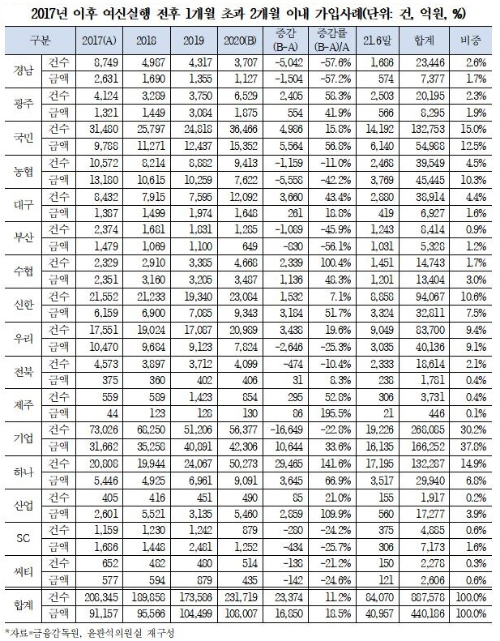
[Asia Economy Reporter Kwangho Lee] Over the past four and a half years, suspected "kkyeokgi" transactions in the banking sector have amounted to approximately 44 trillion KRW across 890,000 cases.
According to data submitted by the Financial Supervisory Service to Yoon Kwan-seok, a member of the National Assembly's Political Affairs Committee from the Democratic Party of Korea, suspected "kkyeokgi" transactions?where banks require customers to subscribe to financial products such as deposits, insurance, or funds as a condition for loans?increased by 18.5% (1.685 trillion KRW) over four years, from 9.1157 trillion KRW in 2017 to 10.8007 trillion KRW in 2020.
In terms of the number of cases, the figures appeared to decrease from 208,345 in 2017 to 172,586 in 2019, but then rose to 231,719 in 2020, marking an 11.2% (23,374 cases) increase over four years.
Under Article 20 of the Financial Consumer Protection Act, banks are prohibited from coercing consumers into purchasing other financial products against their will within one month before or after a loan product sale. However, it has been pointed out that suspected "kkyeokgi" transactions still occur by circumventing this rule, selling financial products between 30 to 60 days before or after the loan contract.
From 2017 to the first half of this year, the bank with the largest share of suspected "kkyeokgi" transactions was the policy bank IBK Industrial Bank of Korea. It accounted for 37.8% (16.6252 trillion KRW) by amount and 30.2% (268,085 cases) by number of cases. While the number of cases decreased by 22.8% over the past four years, the amount increased by 33.6%.
Following IBK were KB Kookmin Bank with 5.4988 trillion KRW (132,753 cases), NH Nonghyup Bank with 4.5445 trillion KRW (39,549 cases), Woori Bank with 4.0136 trillion KRW (83,700 cases), Shinhan Bank with 3.2811 trillion KRW (94,067 cases), and Hana Bank with 2.994 trillion KRW (132,287 cases).
Assemblyman Yoon stated, "Despite the difficulties caused by COVID-19 since last year, suspected cases of 'kkyeokgi'?where banks, eager to boost performance, impose burdens on vulnerable groups and small businesses by using loans as bait?have continued to increase." He emphasized, "Financial authorities need to prepare measures to improve the system."
© The Asia Business Daily(www.asiae.co.kr). All rights reserved.

















