Increase in Insurance Premiums as Payouts Rise
Introduction of Fault-Based Liability for Treatment Costs of Minor Injuries
[Asia Economy Reporter Oh Hyung-gil] Last year, the insurance payouts for automobile insurance reached 14 trillion won, marking a 31% increase over six years.
Accordingly, from 2023, the government will improve the system so that for minor injuries in car accidents, the portion of fault attributable to the insured will be handled by their own insurance. When claiming insurance for long-term treatment exceeding four weeks, submission of a medical certificate will also be mandatory, which is expected to reduce so-called "nai-ron patients" (patients who feign illness).
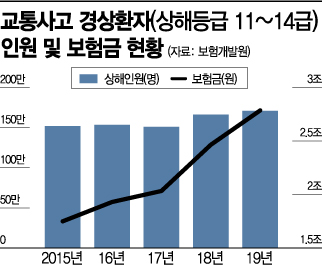
According to the automobile insurance system improvement plan released by the Ministry of Land, Infrastructure and Transport, the Financial Services Commission, the Financial Supervisory Service, the Health Insurance Review & Assessment Service, and the Insurance Development Institute, the rapid increase in automobile insurance payouts has raised the insurance premium burden on policyholders.
Insurance payouts, which were around 11 trillion won in 2014, increased by about 31% to 14.4 trillion won last year over six years. During the same period, the average insurance premium also rose by 20%, from 640,000 won to 750,000 won.
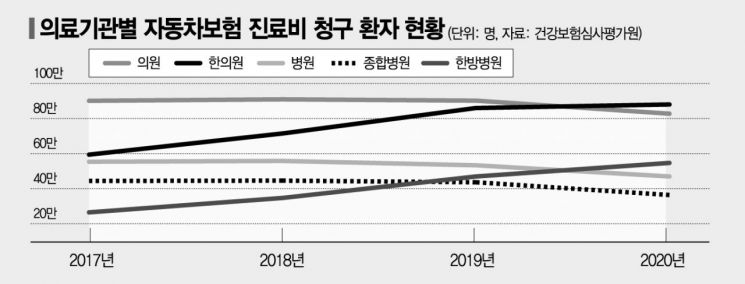
The increase in insurance payouts has been mainly attributed to excessive treatment of minor injury patients and the lack of objective insurance payout standards (such as fees for superior hospital rooms and Korean traditional medicine treatments).
The government has decided to introduce a fault liability principle for treatment costs of minor injury patients in car accidents. Currently, regardless of the degree of fault in a car accident, the opposing party’s insurer pays the full treatment cost, resulting in no out-of-pocket expense for the patient and thus encouraging excessive treatment.
Under the fault liability principle, the portion of treatment costs for minor injury patients (grades 12 to 14) attributable to the insured’s fault must be covered by their own insurance. This differs from the current method where treatment costs are paid in full upfront and then the portion attributable to the insured’s fault is recovered later.
The government expects that this will reduce excessive treatment costs by 540 billion won annually, lowering automobile insurance premiums by approximately 20,000 to 30,000 won.
The improvement plan also includes a requirement for minor injury patients to submit medical certificates when undergoing long-term treatment. Currently, patients can receive treatment and claim insurance without submitting proof such as medical certificates, with no time limit. This has led to many cases of unnecessarily prolonged hospital treatment and excessive settlement demands to insurers.
Therefore, for cases requiring long-term treatment, insurance payouts will be made based on medical certificates from healthcare institutions to objectively determine the treatment period. This applies only to minor injury patients (excluding moderate to severe injury patients graded 1 to 11), and insurance benefits will be paid according to the treatment period stated in the medical certificate if treatment exceeds four weeks.
The standards for superior hospital room admission fees and Korean traditional medicine treatment fees will also be improved.
Currently, unlike health insurance, automobile insurance pays the full hospitalization fee regardless of the hospital room grade. The government plans to review possible alternatives, such as setting an upper limit on superior hospital room fees, and apply them starting next year.
Herbal medicine and acupuncture treatments, which are not covered by health insurance, have unclear fee standards under automobile insurance, creating incentives for excessive treatment. The government plans to analyze the current status of major Korean traditional medicine treatment items through research projects and prepare improvement plans for treatment fee standards.
© The Asia Business Daily(www.asiae.co.kr). All rights reserved.
![Clutching a Stolen Dior Bag, Saying "I Hate Being Poor but Real"... The Grotesque Con of a "Human Knockoff" [Slate]](https://cwcontent.asiae.co.kr/asiaresize/183/2026021902243444107_1771435474.jpg)

















