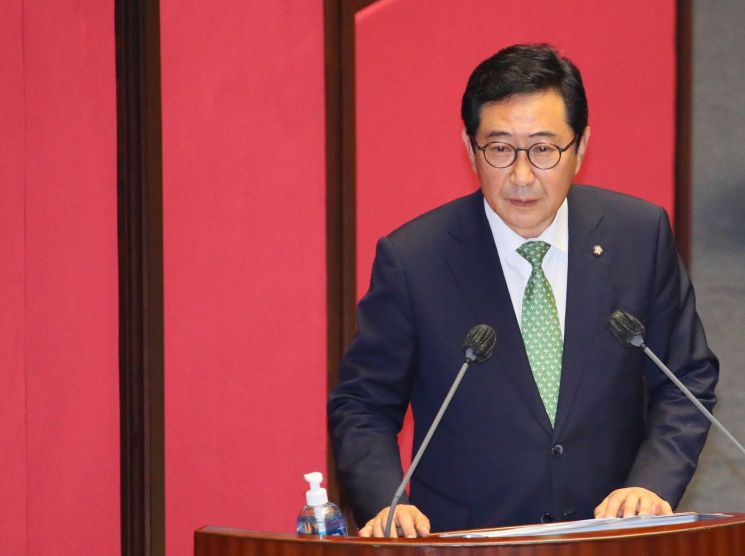
[Asia Economy Reporter Koo Chae-eun] On the 1st, Kim Han-jung, a member of the National Assembly's Political Affairs Committee from the Democratic Party of Korea, stated that the voice phishing reporting channels, which are currently scattered across various institutions, should be unified. This is to ensure that victim relief is carried out promptly.
Currently, voice phishing and smishing reports are handled by the Cyber Investigation Unit of the National Police Agency, the Financial Supervisory Service's Personal Information Exposure Accident Prevention System, the Korea Internet & Security Agency (KISA)'s Internet Incident Response Support Center, the Korea Association of Information & Telecommunication (KAIT)'s m-safer (identity theft prevention service), and the customer centers of each financial institution.
Victims must report smishing incidents to the call center operated by KISA even after reporting to the police, the Financial Supervisory Service, or financial institutions' customer centers. Additionally, to prevent new internet and budget phone subscriptions used for small payments and non-face-to-face account openings, the identity theft prevention service operated by KAIT must be utilized.
Rep. Kim said, “With the activation of open banking, speed has become the most important factor in responding to financial fraud, but the current victim response methods remain outdated, which is exacerbating the damage.”
According to Rep. Kim, even if victims report voice phishing to the police or the Financial Supervisory Service, they cannot prevent damage unless they directly call each financial institution's customer center to take action. Through open banking services, fraudsters quickly withdraw victims' deposits by moving across accounts of different financial institutions, but victims must call each financial institution individually to report, which inevitably increases the scale of the damage.
In fact, after the open banking service started in December 2019, the amount of voice phishing damage in 2020 exceeded 700 billion KRW, an increase compared to 404 billion KRW in 2018 and 639.8 billion KRW in 2019.
Rep. Kim emphasized, “In Taiwan, which was notorious for voice phishing, the government has operated an integrated call center called the ‘165 Fraud Call Reporting Center’ since 2004, which immediately freezes accounts and conducts tracking investigations upon receiving reports,” and added, “A unified reporting center involving all related agencies should be established to minimize financial fraud damage.”
© The Asia Business Daily(www.asiae.co.kr). All rights reserved.

















