Voice Phishing Damage Exceeds 700 Billion Won
How to Quickly Assist Victims?
[Asia Economy Reporter Park Sun-mi] Last year, the amount of damage caused by voice phishing exceeded a record high of 700 billion won, and there is advice that the reporting channels should be unified for faster victim relief.
On the 2nd, Kim Han-jung, a member of the National Assembly's Political Affairs Committee and Special Committee on Budget and Accounts from the Democratic Party of Korea, argued that the scattered voice phishing reporting channels should be unified so that victim relief can be carried out promptly. Although it is perceived that reporting voice phishing to the police or the Financial Supervisory Service will result in measures such as account freezing and transaction cancellation, in reality, victims must directly call each financial institution's customer center to take action, otherwise the damage cannot be prevented.
Kim said, "With the open banking service, financial scammers quickly withdraw victims' deposits by moving across accounts of different financial institutions, but victims have to call each financial institution one by one to report, which increases the scale of damage," adding, "A unified reporting center involving all related agencies should be established to minimize financial scam damage.”
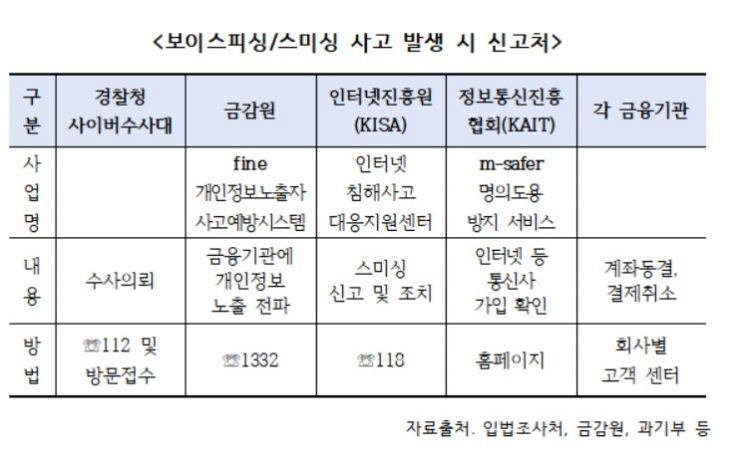
In 2020, the year following the launch of the open banking service in December 2019, the amount of damage from voice phishing exceeded a record high of 700 billion won. Currently, voice phishing and smishing reporting channels are diversified, including the Police Cyber Investigation Unit (112), the Financial Supervisory Service’s Personal Information Exposure Accident Prevention System (1332), the Korea Internet & Security Agency (KISA) Internet Incident Response Support Center (118), the Korea Association for ICT Promotion (KAIT) identity theft prevention service (m-safer), and each financial institution’s customer center.
Even after reporting to the police, the Financial Supervisory Service, or financial institutions’ customer centers, smishing damage reports must be made to the call center (118) operated by KISA. Additionally, to prevent new internet and budget phone subscriptions used for small payments and non-face-to-face account openings, the identity theft prevention service operated by KAIT must be used.
Kim said, “In Taiwan, which was notorious for voice phishing, the government has operated an integrated call center called the ‘165 Fraud Call Reporting Center’ since 2004, which immediately freezes accounts and conducts tracking investigations upon receiving reports," adding, "With the activation of open banking, speed has become the most important factor in responding to financial scams, but our current victim response method remains stuck in the past, which is increasing the damage.”
© The Asia Business Daily(www.asiae.co.kr). All rights reserved.

















