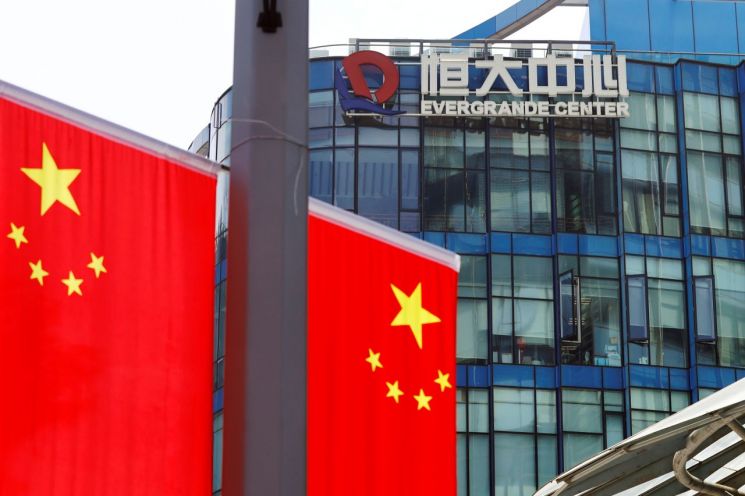
[Asia Economy Reporter Park Byung-hee] It has been confirmed that Evergrande Group's financial subsidiary, a major real estate developer in China currently facing a liquidity crisis, has failed to pay most of the principal and interest on investment products to its customers.
According to Jeil Financial News and others on the 1st, Evergrande's financial affiliate, Evergrande Caifu, paid only 10% of the principal and interest to holders of investment products maturing the previous day, failing to pay the remaining 90%.
Evergrande has raised funds not only through bank loans or bond issuance but also by selling fund-like financial investment products with high returns through its subsidiary Evergrande Caifu, investing the secured funds in construction projects across various regions and new business sectors such as electric vehicles. This falls under the realm of 'shadow banking,' which is outside the strict control of Chinese financial authorities. Although conditions vary slightly by product, one financial product promised an interest rate of 10.5% over a 413-day maturity period.
However, as Evergrande's financial situation rapidly deteriorated recently, it declared that it would no longer be able to make normal repayments starting from products maturing on the 30th of last month. It announced plans to first pay customers 10% of the principal and interest and to pay the remaining amount sequentially later or substitute it with physical assets such as apartments and commercial buildings under construction.
Most of the people who protested recently in front of Evergrande's headquarters in Shenzhen, Guangdong Province, were those who had purchased Evergrande Caifu's investment products but were unable to receive their principal and interest on time.
Evergrande failed to pay $83.5 million (approximately 99.3 billion KRW) and $47.5 million (approximately 55.9 billion KRW) in interest on dollar bonds scheduled for the 23rd and 29th of last month, respectively. Additionally, it has not been able to properly pay interest on some bank loans since last month.
In effect, Evergrande is in a state equivalent to default, but the unpaid dollar bond interest has a contractual 30-day grace period, so an official default has not yet been recognized.
Credit rating agency Fitch downgraded Evergrande's credit rating from CC to C on the 29th of last month.
On the 29th of last month, Evergrande announced that it had signed a contract to sell its 19.93% stake in Shengjing Bank for 9.993 billion yuan (approximately 1.83 trillion KRW) to a state-owned enterprise. However, since the entire amount was used to repay loans Evergrande had taken from Shengjing Bank, it did not significantly help resolve the immediate issue of bond interest repayments.
However, some market observers suggest that with the state-owned enterprise's acquisition of the Shengjing Bank stake, Chinese authorities have indicated their intention to manage the Evergrande crisis, somewhat lowering the likelihood of the worst-case scenario where the Evergrande crisis spreads into disorderly financial risk contagion.
© The Asia Business Daily(www.asiae.co.kr). All rights reserved.

















