Ministry of the Interior and Safety National Audit Report
Overcoming the COVID-19 Crisis and Innovating Disaster Safety Management System
Autonomous Decentralization 2.0 and Regional Vitality Recovery... Promoting Government Innovation Leading Digital Transformation
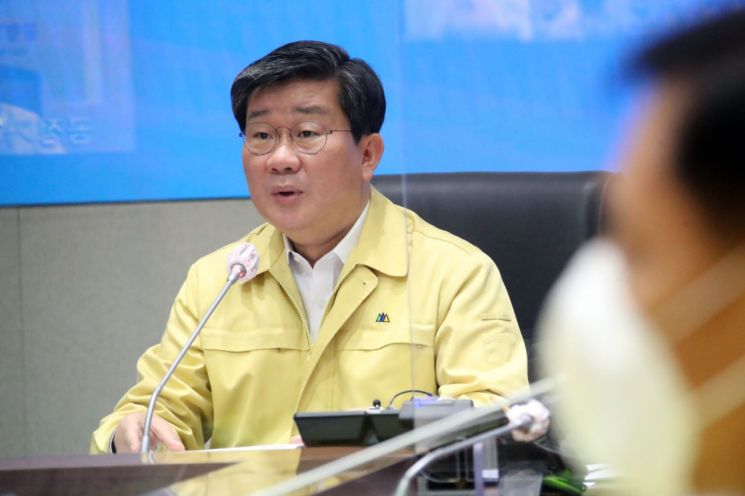
[Asia Economy Reporter Lim Cheol-young] As the number of new COVID-19 cases has recently recorded the highest daily figures for seven consecutive days, the Ministry of the Interior and Safety (MOIS) is continuing its full-scale response between central and local governments. Additionally, it plans to continuously build the institutional foundation for 'Local Autonomy 2.0' and further advance the 'Digital Government' infrastructure that has been promoted so far.
On the 1st, MOIS announced in its 2021 National Assembly audit report that it operated a government joint special inspection team to conduct a full inspection of vulnerable facilities until August, and from September, it plans to continue on-site inspections by operating city and provincial compliance inspection teams. Previously, the government joint special inspection team inspected 112,341 vulnerable facilities, detected 16,432 violations, filed complaints for 24 cases, and imposed business suspension measures for 33 cases. Furthermore, 1,565 corrective actions and 14,699 guidance and advisory measures were taken. MOIS is strengthening management of self-quarantine by monitoring 24 hours using an app until October, conducting joint police surprise inspections, and taking legal action upon unauthorized departures, while also improving the location accuracy of the self-quarantine app.
Preparedness and response capabilities for public safety will also be enhanced. MOIS submitted a government proposal to increase the disaster safety budget from 20.6 trillion won this year to 21.4 trillion won next year. By 2026, a nationwide comprehensive survey of steep slope risk areas will be conducted, and through the 'Disaster Safety Data Platform' to strengthen disaster preparedness, data from various agencies will be linked to implement a proactive management system using big data analysis.
Moreover, to enable rapid damage recovery, an ICT-based integrated management system will be established, and integrated management centers will be installed in cities and provinces to continuously strengthen resource mobilization systems. MOIS has established three integrated management centers last year, seven this year, and plans to add seven more next year. It will also expand insurance products covering glass breakage and movable property damage to address blind spots in flood and windstorm insurance, and to activate 'Disaster Safety Mandatory Insurance,' a government-wide management status evaluation will be conducted in April next year, with a comprehensive information system to be established by 2023.
Minister Jeon Hae-cheol said in his greeting, "With two divisions of the Central Disaster and Safety Countermeasure Headquarters, we are overseeing government-wide support for smooth quarantine operations and rapid vaccination by local governments, while providing COVID-19 coexistence support funds to the public," adding, "We are strengthening proactive prevention capabilities by continuously expanding the government-wide disaster safety budget and establishing a rapid disaster response system using ICT."
Establishing Institutional Foundation for 'Local Autonomy 2.0'... Continued Promotion of Task Transfers, Autonomous Police System, and Local Finance Innovation
MOIS is also working to ease institutional requirements for direct participation, as individual laws related to residents' ordinance petitions, which allow residents to directly request the enactment, amendment, or repeal of ordinances to local councils, are about to be enforced. Efforts are being made to revise the Resident Referendum Act and Resident Recall Act. The bill on the 'Act on Residents' Ordinance Initiatives' passed the National Assembly plenary session in September. In addition, MOIS is promoting the legalization of residents' autonomy councils, which form the basis of resident autonomy, and plans to establish an online participation channel called the 'Resident Direct Participation Platform' in December.
Furthermore, the second phase of fiscal decentralization will be continuously pursued. According to MOIS, the local consumption tax rate will be gradually raised to 21% this year, 23.7% in 2022, and 25.3% in 2023. Accordingly, the ratio of national tax to local tax is expected to improve from 78:22 in 2018 to 72.6:27.4 in 2023. Minister Jeon stated, "Following the full revision of the Local Autonomy Act last December, we are promoting the enactment and revision of related laws and enforcement decrees to establish an institutional foundation for substantial local autonomy, and we will complete the second phase of fiscal decentralization to financially support local autonomy."
Tasks such as task transfers, the autonomous police system, and local finance innovation will also be continuously improved. MOIS plans to promote the enactment of the second Local Government Task Transfer Act to transfer tasks closely related to residents' lives to local governments in bulk, monitor the autonomous police system fully implemented in July, and discover regionally tailored public safety service models to enhance public satisfaction.
Additionally, MOIS will continue to invest budgets in tasks such as consumption and job creation to overcome regional economic crises, strengthening local tax revenue management, and regional balanced New Deal projects. In particular, to respond to the population decline crisis, it plans to establish designation criteria and prepare comprehensive support policies through a task force (TF) from the central government.
Promoting Digital Transformation and Government Innovation... Expanding Digital Certificates and Public Institutions' Transition to 'Cloud'
Moreover, MOIS plans to implement data-driven scientific administration and promote digital new deals in the public sector while improving the quality of public participation and collaboration systems. First, to build a data-based administrative infrastructure, MOIS will establish a 'Data Integrated Management Platform' by 2024 to register and manage shared data within the government and perform government-wide data analysis and utilization.
To expand digital certificates, it plans to increase the issuance of blockchain-based mobile IDs for driver's licenses in 2022 and for national veterans' IDs and foreigner registration cards in 2023, and expand mobile electronic certificates to 300 types, including family relation certificates and licenses, by December. The MyData pilot service, currently offered for 24 types this year, will be expanded to 35 types next year.
Also, the number of small-scale data centers in public institutions transitioning to the cloud will increase to 430 this year, 5,748 in 2023, and 10,009 in 2025. The infrastructure for video conferencing will be strengthened from a maximum of 300 participants per meeting and 5,000 concurrent users to a minimum of 500 participants per meeting and 10,000 concurrent users. Tasks to enhance public convenience, such as private electronic signatures and Digital One Pass, will be implemented by the end of this year. The scope of the 'National Secretary' service will also expand from nine types, including COVID-19 vaccination information and support funds, to 38 types next year.
Minister Jeon said, "To implement a data-driven scientific administrative system, we are establishing government-wide governance and formulating a basic plan to activate data-based administration, while also changing work methods to be data-friendly," adding, "To lead the digital new deal in the public sector, we are promoting mobile ID issuance, MyData service provision, and full transition to the cloud."
© The Asia Business Daily(www.asiae.co.kr). All rights reserved.

















