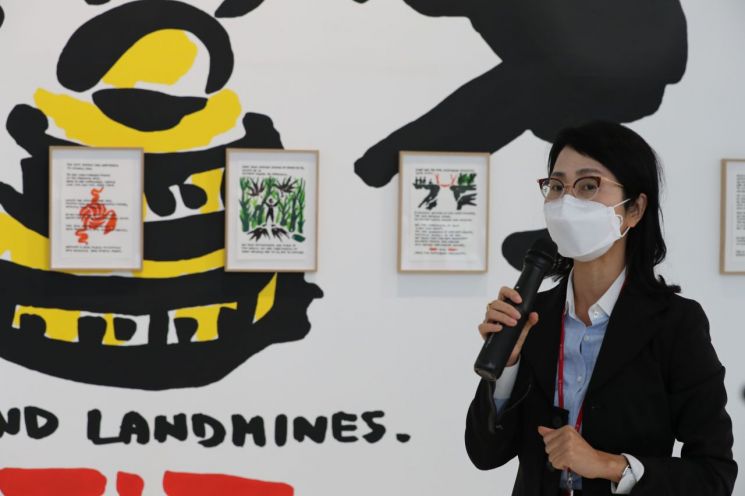
[Asia Economy Reporter Lee Ji-eun] "The 'Chul-gyeong-dong' at the Inter-Korean Border Office, completed in 2001, was a place where exit and entry inspections to North Korea were conducted. However, as inter-Korean exchanges expanded and a new building was constructed, it was left abandoned. We have newly remodeled Chul-gyeong-dong and reborn it as a cultural and artistic space called 'Uni Maru'."
Kim Ki-hyuk, head of the Inter-Korean Border Office, met with reporters on the 29th at the Inter-Korean Border Office in Paju, Gyeonggi Province, stating, "This is a project to return the space of conflict, dispute, and a symbol of division (DMZ) back to the people," highlighting the significance of the opening exhibition of the 'DMZ Peaceful Unification Cultural Space.'
The Ministry of Unification has been conducting the DMZ Peaceful Unification Cultural Space exhibition online since the 15th. Utilizing five locations within the DMZ, including Chul-gyeong-dong, Dorasan Station, the Paju demolition surveillance post (GP), Jejin Station in Goseong County, Gangwon Province, and the National Unification Education Institute, the exhibition showcases works by renowned domestic and international artists.
The Ministry of Unification had been preparing the DMZ Peaceful Unification Cultural Space exhibition since last year, but due to the severe COVID-19 situation, they decided to start with an online exhibition. They are also considering small-scale on-site visits depending on the COVID-19 situation.
This exhibition features 32 famous artists from Korea and abroad, including Nam June Paik, Yang Hye-kyu, and Olafur Eliasson, presenting a total of 34 works. Through the perspectives of participating artists, the exhibition interprets the government's efforts and achievements in implementing inter-Korean agreements such as the Panmunjom Declaration, as well as themes of unification and peace, ecology and preservation, connection and solidarity, and expansion of exchanges.
Director Jung Yeon-sim, who oversaw the exhibition, explained, "There have been many DMZ-related exhibitions, but this is the first time a proper space within the DMZ itself has been prepared and used for an exhibition," adding, "We invited 32 artists to gather international voices focusing on the nature and ecology of the DMZ."
Artist Hong Soon-myung, who participated in this exhibition with the work 'LOST,' captured the feelings experienced when visiting the 'Enemy Gravesite' within the DMZ on canvas. He created a fictional character inspired by actual armed infiltrators and depicted his back as he looks toward his hometown. He said, "All the bodies in the enemy gravesite have been returned to their home countries, but the armed infiltrators buried there could not return," adding, "When major incidents occur, I focused on the small stories overshadowed by those events that are not conveyed to us."
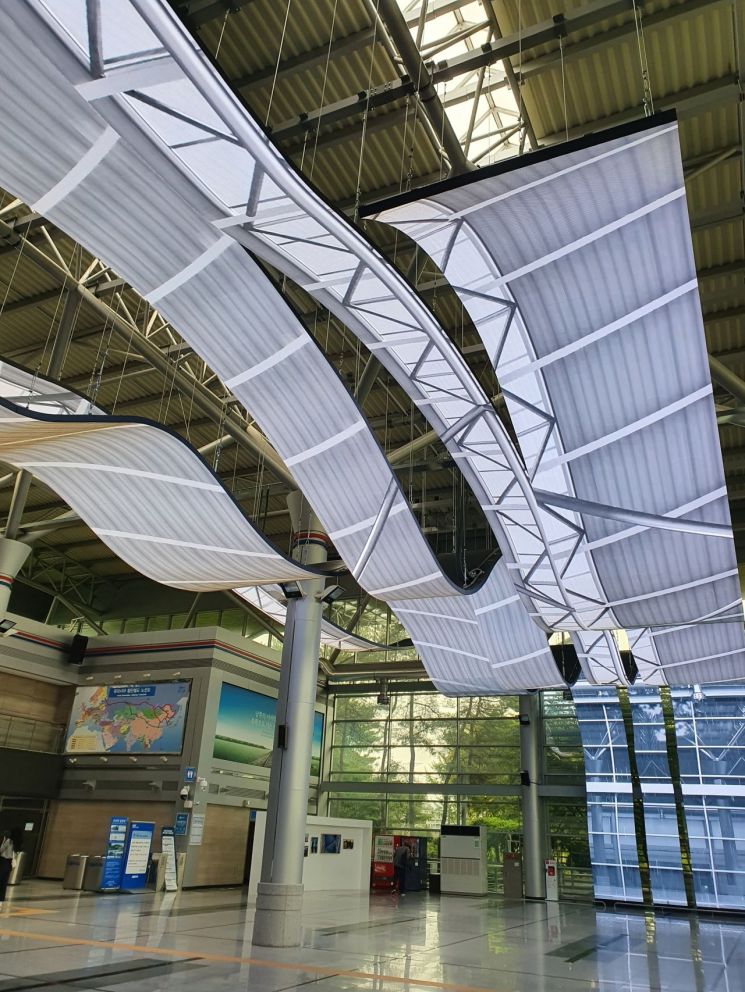
At Dorasan Station, where train operations have stopped due to COVID-19, works by three artists, including Lee Ye-seung, well known for designing BTS's 'Gwanghwamun Billboard,' were exhibited. On five undulating wave-shaped long facades, videos blending traditional patterns with modern sensibilities are displayed with sound, conveying the artists' aspirations for peace.
© The Asia Business Daily(www.asiae.co.kr). All rights reserved.


















