[Asia Economy Honam Reporting Headquarters Reporter Cho Hyung-joo] A research team led by Professor Jin-ho Kim of the Graduate School of Energy Convergence at GIST (Gwangju Institute of Science and Technology) announced on the 29th that they have developed a new artificial intelligence (AI)-based analytical technology that detects and extracts consumption patterns of household energy users living in houses or apartments.
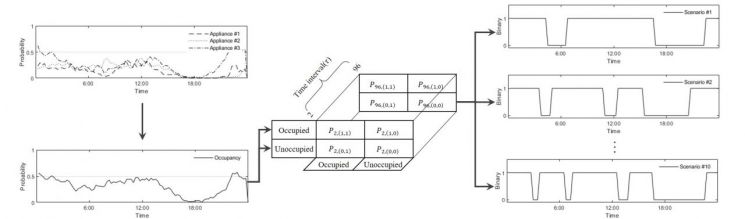
The research team utilized second-level power consumption measurement data of home appliances used in households and extracted appliance usage and human occupancy patterns through a new probabilistic approach methodology.
To estimate the actual participation potential of demand response resources, analysis of energy load characteristics including user behavior based on information data is necessary. In the simulation operation algorithm for estimating demand response potential, the user's inconvenience related to the dynamic characteristics of appliances was quantified and reflected.
This technology was applied to the demand response market for carbon reduction, intuitively suggesting market incentive design directions to improve macro-level environmental responsiveness. Through this study, the research team confirmed that when one household participates as a demand response resource for 250 days, it can contribute approximately 10 MWh of energy to the power grid, which corresponds to an effect of reducing about 7.7 tons of carbon dioxide.
They also suggested that if part of the output from fossil fuel power generators is replaced with demand response resources, a new market incentive can be created to return environmental benefits from carbon reduction to consumers.
Professor Jin-ho Kim said, “Through this research achievement, big data-based analysis capable of converting household energy demand into a large integrated resource is possible,” adding, “In the future, by expanding the application sectors of this technology, it can contribute to improving the efficiency of sector coupling in various fields such as water, heat, gas, and electric vehicles, as well as to policy development for this purpose.”
This research was conducted with the support of the Ministry of Trade, Industry and Energy and the Korea Energy Technology Evaluation Institute, and was published in the September 2021 issue of ‘IEEE Transactions on Smart Grid,’ a journal ranked within the top 10% in the field of electrical and electronic engineering.
© The Asia Business Daily(www.asiae.co.kr). All rights reserved.
![Clutching a Stolen Dior Bag, Saying "I Hate Being Poor but Real"... The Grotesque Con of a "Human Knockoff" [Slate]](https://cwcontent.asiae.co.kr/asiaresize/183/2026021902243444107_1771435474.jpg)
















