[Asia Economy Reporter Su-yeon Woo] As the government continues to extend social distancing measures such as Level 4 in the Seoul metropolitan area, it has eased some restrictions like business hours and limits on private gatherings. However, most self-employed individuals feel that these measures have little effect on their business operations.
On the 29th, the Federation of Korean Industries commissioned the market research firm Monoresearch to conduct a "COVID-19 Quarantine Guidelines Awareness and Performance Outlook Survey" targeting 532 self-employed people nationwide. The results showed that despite some recent easing of quarantine guidelines, 85.9% of respondents said the changes did not help or made no difference to their business operations. Additionally, self-employed individuals continue to experience hardship and pessimism, with expectations of about a 17-18% decrease in sales and net profit in the fourth quarter of this year compared to the same period last year.
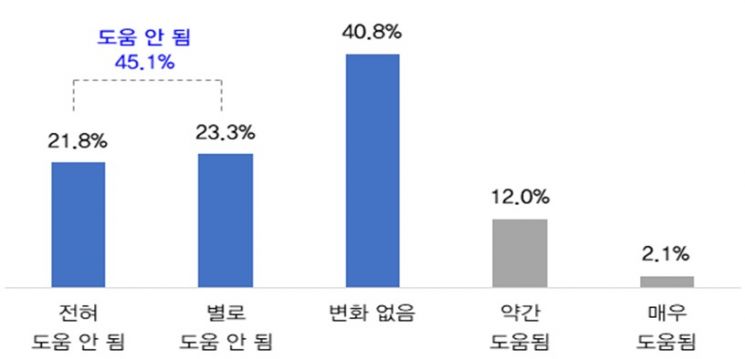 Self-employed people's perception of eased quarantine rules compared to before / Data provided by the Federation of Korean Industries
Recently, the government extended the operating hours for restaurants and cafes in the Seoul metropolitan area from 9 PM to 10 PM and relaxed private gathering restrictions to include vaccinated individuals. However, self-employed respondents said these adjustments did not significantly help their business operations. The proportion of those who answered that the measures were not helpful at all or barely helpful was 45.1%, and 40.8% said there was no change compared to before.
Due to growing concerns over the spread of the Delta variant, self-employed individuals also have a negative outlook on their business performance in the fourth quarter of this year. Compared to the fourth quarter of last year, which coincided with the third wave of COVID-19 in Korea (November 2020 to January 2021) and caused significant damage, 78.5% of self-employed respondents expect sales to decrease in the fourth quarter of this year, and 77.5% anticipate a decline in net profit. The average expected performance for Q4 2021 compared to the same period last year showed a 16.9% decrease in sales, a 17.9% decrease in net profit, and a 9.7% reduction in employment.
The biggest recent difficulties cited were ▲poor sales due to weakened consumer sentiment (21.2%) ▲rent burden (18.6%) ▲impact of business restrictions (12.1%) ▲tax and utility burdens (10.2%) ▲labor cost burdens (10.1%).
Regarding government support measures that should be expanded most to help overcome the COVID-19 crisis in local commercial districts, the most frequently chosen was ▲tax relief and other tax support (24.2%), followed by ▲direct financial support (21.3%), ▲rent reduction support (18.7%), and ▲low-interest loans and other financial support (17.3%).
Meanwhile, as plans are reportedly being considered to revise the COVID-19 quarantine system criteria to comprehensively include not only the current number of new confirmed cases but also fatality rates and severity rates, 57.5% of self-employed respondents expressed support for such changes. Additionally, 62.8% were in favor of an early transition to "With COVID-19" (a phased return to normal life). Among the 334 self-employed individuals who support an early transition to With COVID-19, a majority (54.4%) said the appropriate timing would be either by the end of October (28.4%) or immediately (26.0%).
Yoo Hwan-ik, Director of Corporate Policy at the Federation of Korean Industries, stated, "As COVID-19 prolongs and social distancing at levels 3 to 4 has been maintained for over two months, the effectiveness of the quarantine system is showing its limits, and the damage and anxiety among self-employed individuals are at their peak. Future policy design should involve thorough communication with those on the ground and prepare to minimize conflicts and shocks."
© The Asia Business Daily(www.asiae.co.kr). All rights reserved.

















