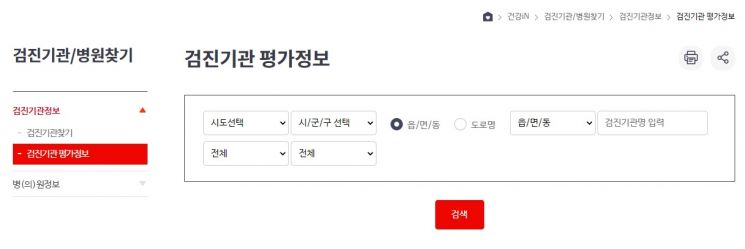
 National Health Insurance Service website screening institution evaluation information inquiry screen [Image source=Captured from the National Health Insurance Service website]
[Asia Economy Reporter Lee Chunhee] Evaluation results that allow easy identification of the quality of institutions conducting regular national health screenings will be disclosed.
The Ministry of Health and Welfare announced on the 29th the results of the 3rd cycle (2018?2020) clinic-level evaluations conducted from the first half of 2019 to the first half of this year, as well as the selection results of the top institutions in the 3rd cycle health screening evaluation, to improve the quality of national health screenings.
Screening institution evaluations are conducted every three years, divided into hospital-level and clinic-level categories. The evaluation results for hospital-level screening institutions were disclosed in February last year.
Additionally, for the first time this year, to encourage voluntary quality management by screening institutions and to help the public choose excellent screening institutions, the 'Top Screening Institutions (clinic-level, hospital-level and above)' were selected and disclosed by screening type.
The 3rd cycle clinic-level screening institution evaluation covered a total of 20,136 clinics. Based on an annual screening population of 300, the institutions were divided into two groups: Group 1 with 6,199 institutions screening 300 or more people, and Group 2 with 13,937 institutions screening fewer than 300 people, and evaluations were conducted accordingly.
The evaluation was conducted across eight screening types, including general screening, infant and toddler screening, oral screening, and five major cancer screenings (stomach, colorectal, liver, breast, cervical cancer). Group 1 was evaluated through document surveys and on-site visits, with scores classified into three grades: excellent, average, and poor. Group 2 was assessed based on whether basic education was completed, categorized as 'education completed' or 'education not completed.'
Comparing these evaluation results with the previous 2nd cycle (December 2016 to December 2017), the application of strengthened evaluation criteria resulted in a slight decrease in average scores and the proportion of excellent grades compared to three years ago. From this 3rd cycle health screening evaluation, the Ministry introduced a fail system where any screening type scoring below 60 points is rated as 'poor,' applied weighted importance to evaluation areas, and strengthened evaluations by conducting direct visits to institutions with a high likelihood of poor performance.
As a result, the average score of all screening institutions dropped by 1.2 points from 87.9 to 86.7, and the proportion of institutions rated 'excellent' decreased by 4.2 percentage points from 48.9% to 44.7%. Notably, the general screening excellent grade rate plummeted by 19.7 percentage points from 49.3% to 29.6%. The Ministry explained that "the decline in average scores is analyzed to be due to the application of weighted scores in difficult evaluation areas and the deduction of points for administrative sanctions." Conversely, the excellent grade rate for cervical cancer screening increased by 20.3 percentage points from 62.0% to 82.3%.
Among the top institutions by screening type, those ranked within the top 10% in evaluation results and receiving excellent grades in all evaluation areas were selected as 'Top Screening Institutions,' totaling 1,156 institutions: 319 hospital-level and 837 clinic-level institutions. Top screening institutions receive incentives such as exemption from the next cycle evaluation and promotional support through the designation as top institutions.
On the other hand, institutions rated as poor will receive follow-up management including online and offline education, expert consultation, and occasional on-site inspections to support the enhancement of their internal capabilities.
The results can be checked on the National Health Insurance Service website or the 'The Health Insurance' application (app), and will also be made easily accessible to the public through health screening notification letters sent individually.
Im In-taek, Director of the Health Policy Bureau at the Ministry of Health and Welfare, stated, "By disclosing the 3rd cycle evaluation results, we aim to guarantee the public's right to know and encourage efforts to improve the quality of screening institutions through follow-up management, thereby continuously improving the national health screening service."
© The Asia Business Daily(www.asiae.co.kr). All rights reserved.

















