
Naver is eliminating star ratings, which have been embroiled in social controversies such as rating terrorism. This comes 11 years after star ratings were first introduced in 2010. Keyword reviews will be introduced soon, and star rating reviews will disappear from Naver by the first quarter of next year. The driving force behind this bold change to a service familiar to users was Naver’s MZ generation (Millennials + Generation Z) planners.
The MZ Generation’s ‘Bold Attempt’
According to Naver on the 29th, the main figures behind the abolition of star ratings are Kim Yejin (25), Shin Yujin (25), Park Jiwon (27) from the ‘Station Zero’ team, and planner Kim Jisoo (34) from Naver Place. Station Zero was established when Han Seongsuk became CEO of Naver. Mainly composed of new employees, they work across various Naver services and are deployed on projects. These younger employees, who have a perspective closer to users, come up with diverse ideas. They serve as a kind of secret weapon for Naver, an IT company where service innovation is paramount. The four of them held meetings day and night to gather ideas about ‘star rating reviews.’
Since most domestic platforms such as Kakao, Coupang, and Baedal Minjok use star rating systems, abolishing star ratings was a groundbreaking move in the industry. Jisoo explained the background behind the bold decision, saying, “Expressing reviews as a single scoring system has its limits, and star rating terrorism has become a social problem.” Since last year, they have repeatedly conducted internal data analysis and surveys to determine whether star ratings provide sufficient information. Jiwon emphasized, “We conducted interviews with actual users and incorporated their voices into the service as much as possible through user voting.”
Until now, star ratings have been a comprehensive indicator for evaluating cafes and restaurants. However, going forward, Naver’s reviews will focus on showing which aspects a business excels in. Yejin said, “If users previously filtered businesses by low star ratings, now they will find businesses that match the characteristics they are looking for.”
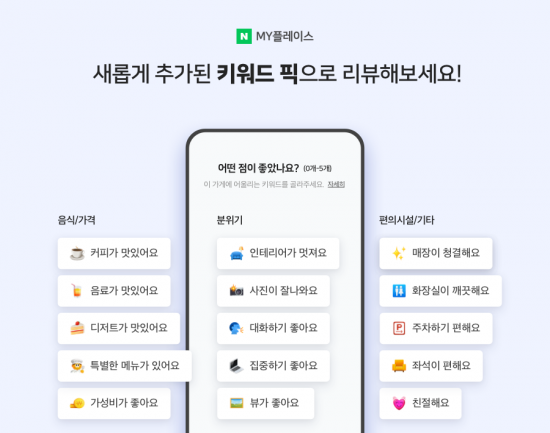
‘Keywords’ Rise Instead of Star Ratings
From now on, keywords will be the core of Naver reviews instead of star ratings. ‘Keyword reviews’ are not about leaving a score like traditional star ratings but selecting keywords?sentences that describe a business’s features or strengths. Users can participate in reviews by verifying their visit to a store through Naver’s reservation system or the existing ‘receipt review’ feature. They choose from representative keywords for each industry, such as ‘The ingredients are fresh’ or ‘The dessert is delicious.’ The existing text review and photo review functions will remain unchanged.
Yujin pointed out, “Even if a cafe has five stars because the coffee is delicious, it doesn’t matter to users who go there for dessert.” They considered reviews that reflect users’ preferences instead of the uniform star ratings. This led to the creation of keyword reviews. Keywords include features that users consider important when choosing a business. Yejin added, “By looking at keywords, you can instantly understand places good for special occasions, solo dining, or convenient parking.”
They are confident that Naver’s reviews without star ratings will become a communication channel between business owners and users. Jisoo said, “For business owners, it helps communicate with regular customers and attract new ones. Review writers can build their records and content, and search users will receive information tailored to their preferences.”
© The Asia Business Daily(www.asiae.co.kr). All rights reserved.


















