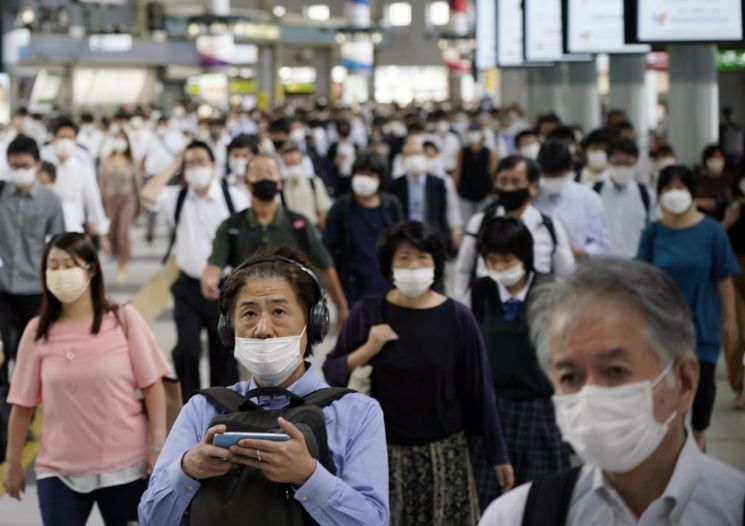
[Asia Economy Reporter Bu Aeri] Japan will exit the state of emergency for COVID-19 response centered on the metropolitan area and transition to a normal system starting next month.
On the 28th, the Japanese government decided at a COVID-19 task force meeting chaired by Prime Minister Suga Yoshihide not to extend the state of emergency, which was in effect until the end of this month in 19 regions including Tokyo and Osaka among the 47 prefectures nationwide.
The "Priority Measures to Prevent Spread," which are equivalent to a state of emergency and applied in eight regions including Miyagi Prefecture, will also be lifted entirely.
For the first time in about six months since April 4, Japan will have no state of emergency or priority measures related to COVID-19.
Prime Minister Suga explained during a report to the National Diet, "The total number of vaccine doses administered has exceeded 160 million, and the vaccination rate has surpassed that of the United States."
He continued, "We must strive to enhance society's ability to respond to infection spread through vaccination and medical system improvements, so that infection prevention measures and daily life can coexist," declaring a transition to 'With Corona (gradual recovery of daily life).'
Prime Minister Suga emphasized, "We need to promote COVID-19 measures based on the gradual easing of restrictions while continuing to improve the medical system and vaccination," and added, "I hope the new government will carry this forward."
Amid public opinion that he failed to adequately respond to COVID-19 and a drop in approval ratings, Prime Minister Suga will not run in the Liberal Democratic Party presidential election and will step down after one year in office.
Even after lifting the state of emergency, the Japanese government plans to implement a transitional measure allowing the governors of the relevant prefectures to enforce appropriate infection control measures for one month.
In this regard, basically, restaurants certified for infection control in the lifted areas will be allowed to operate until 9 p.m. (non-certified establishments until 8 p.m.), with alcohol sales permitted.
Additionally, the government plans to gradually ease restrictions related to infection control by utilizing proof of vaccination, such as increasing the maximum number of attendees at large-scale events like sports games from the current 5,000 (50% of capacity) to up to 10,000.
The Japanese government has been considering easing infection control measures as the vaccination rate has increased and the rise in new cases has slowed.
Japan's daily new infections exceeded 25,000 in August due to the spread of the Delta variant but have recently decreased to a weekly average of 2,378 (as of the 27th).
The percentage of people who have received two doses of the COVID-19 vaccine in Japan is 57.2% of the total population, and those who have received at least one dose is 68.7%.
Previously, Japan lifted the state of emergency in nine regions including Tokyo on June 21, but as new infections surged ahead of the Olympics, the fourth state of emergency was declared starting with Tokyo after 22 days.
However, concerns have been raised as this lifting decision was made while daily new cases in Tokyo continued to exceed 2,000, a level similar to when the fourth state of emergency was declared.
© The Asia Business Daily(www.asiae.co.kr). All rights reserved.

















