[Asia Economy Reporter Su-yeon Woo] Despite the sluggish performance of our economy last year, the contribution of exports to economic growth increased, strengthening the role of manufacturing exports as an economic pillar.
According to the "Analysis of the Contribution Effect of Exports on the National Economy (2020)" released on the 29th by the Korea International Trade Association's International Trade and Commerce Research Institute, South Korea's nominal exports decreased by 5.5% compared to the previous year, but real exports, excluding the effect of price declines, actually increased by 2.3%. Supported by this, the contribution of exports to economic growth last year recorded 0.6 percentage points, the highest since 2018, helping to offset the negative growth (-0.9%).
The share of value added induced by exports in the Gross Domestic Product (GDP) also rose to 23.1%, improving by 0.8 percentage points compared to 2019. This was attributed to the expanded demand for bio-health products such as pharmaceuticals and medical supplies due to COVID-19, alongside strong exports of high value-added products like semiconductors, SSDs, and OLEDs.
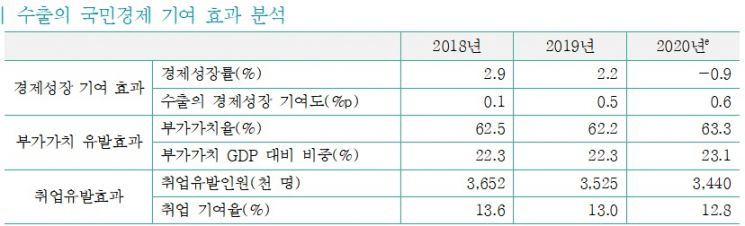
Meanwhile, the number of jobs induced by exports last year was 3.44 million, accounting for 12.8% of total employment. By manufacturing item, the order was automobiles (514,000), special-purpose machinery (285,000), semiconductors (246,000), and electrical equipment (206,000).
Items with increased employment induced compared to 2019 included ▲pharmaceuticals (22,000) ▲other chemical products (21,000) ▲semiconductors (16,000) ▲computers and peripheral devices (16,000). Conversely, items with decreased employment included ▲automobiles (-79,000) ▲coal and petroleum products (-25,000) ▲special-purpose machinery (-22,000).
While semiconductors and computers had a large effect on value-added generation from exports, their employment inducement effect was small. In contrast, pharmaceuticals and chemical products showed both higher value-added and employment inducement effects compared to the manufacturing average. Food products had a small scale of value-added generation, but the number of jobs induced per million dollars of exports was the highest among manufacturing sectors.
Seong-eun Kang, a researcher at the Trade Association, stated, "Despite the global economic downturn, South Korea's economy quickly recovered based on manufacturing exports, and COVID-19 rather served as an opportunity to reaffirm the importance of manufacturing." He added, "Industries such as bio-chemicals, electric vehicles, and semiconductors that create high value-added should be supported with industrial advancement policies to secure global competitiveness, while sectors with large job creation effects like automobiles, special machinery, and food products need employment support measures tailored to their industry characteristics."
© The Asia Business Daily(www.asiae.co.kr). All rights reserved.
![Clutching a Stolen Dior Bag, Saying "I Hate Being Poor but Real"... The Grotesque Con of a "Human Knockoff" [Slate]](https://cwcontent.asiae.co.kr/asiaresize/183/2026021902243444107_1771435474.jpg)
















