Results of the Statistics Korea Agriculture, Forestry and Fisheries Census
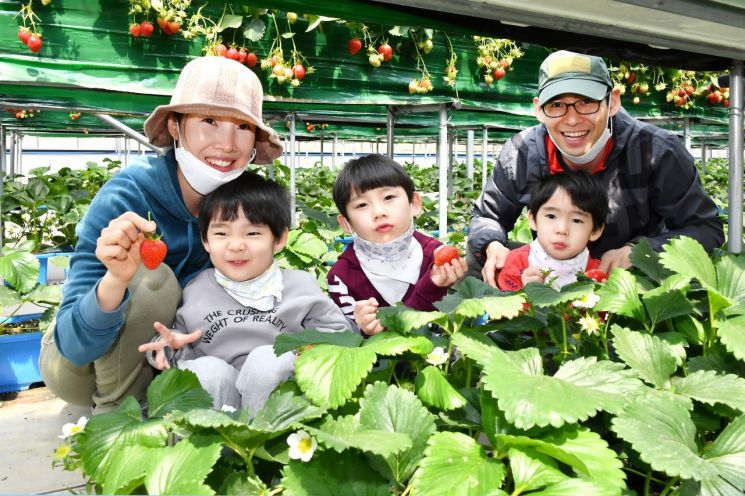
[Sejong=Asia Economy Reporter Kim Hyunjung] It has been revealed that the number of 'urban farmers' who live in urban areas and engage in farming is increasing. However, the overall population of households involved in agriculture, forestry, and fisheries (agroforestry households) is declining, and aging is intensifying.
According to the '2020 Agriculture, Forestry and Fisheries Census Results (Final)' announced by Statistics Korea on the 28th, the number of farm households in eup and myeon areas was 752,000, a 12.1% decrease compared to five years ago, while the number of farm households in dong areas was 283,000, a 21.8% increase compared to five years ago. Statistics Korea classifies households as farm households if they directly cultivate more than 1,000㎡ of rice paddies or fields regardless of residence, or if the sales amount of agricultural and livestock products they directly produced in the past year is 1.2 million KRW or more, or if the appraised value of livestock they raise is 1.2 million KRW or more.
The province with the most farm households was Gyeongbuk (166,000 households), followed by Jeonnam (137,000 households) and Chungnam (122,000 households). Fishing households were most numerous in Jeonnam (15,600 households), Gyeongnam (7,300 households), and Chungnam (6,500 households). Forestry households were most numerous in Gyeongbuk (20,300 households), followed by Gyeongnam (14,700 households) and Jeonnam (14,200 households).
Last year, the proportion of households with sales of agricultural, livestock, and fishery products exceeding 50 million KRW was 7.9% for farm households and 24.7% for fishing households. Compared to five years ago, these increased by 0.1 percentage points and 2.8 percentage points, respectively.
The overall decline and aging of the agroforestry household population continued. As of December 1 last year, there were 1,185,000 agroforestry households and 2,651,000 people. This included 1,035,000 farm households with 2,314,000 people, 46,000 fishing households with 104,000 people, and 103,000 forestry households with 233,000 people.
Compared to 2015, the total number of agroforestry households decreased by 4.2% (52,000 households), and the population decreased by 9.3% (272,000 people). The proportion of agroforestry households among all households dropped from 6.5% to 5.7%, and the proportion of agroforestry population among the total population also decreased from 5.7% to 5.1%.
The proportion of elderly people aged 65 and over in agroforestry households was 41.7%. This is 3.9 percentage points higher than 37.8% in 2015 and marks the highest level since the related survey was transferred to Statistics Korea in 2000 (forestry was transferred in 2005, and the census has been conducted since 2010).
The proportion of elderly people in the total population is 16.0%, but the proportion of elderly in agroforestry households is 2.6 times that of the total elderly population. The average age of agroforestry household heads also rose by 1.0 year compared to five years ago, reaching 65.8 years. In particular, the proportion of elderly in farm households was 42.3%, higher than in fishing households (36.1%) and forestry households (37.7%). The average age of household heads was also higher in farm households at 66.1 years compared to fishing households (62.9 years) and forestry households (64.4 years). The proportion of female agroforestry household heads was 20.0%, an increase of 2.5 percentage points compared to five years ago.
© The Asia Business Daily(www.asiae.co.kr). All rights reserved.

















