Name Changed from 'Guhwang-dong' to 'Bunhwangsa' Dangganjiju
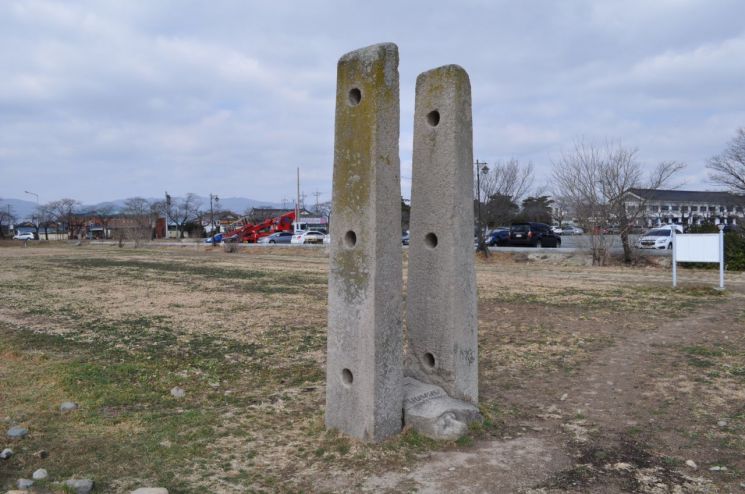
Between the south entrance of Bunhwangsa Temple in Gyeongju and Hwangnyongsa Temple, there is a Dangganjiju (flagpole support). It is a support structure that fixes the danggan, a pole on which flags (painted with Buddhist paintings) are hung. These have been erected at temple entrances since the early Unified Silla period. Based on the arrangement of Dangganjiju in ancient temple garam (places where monks lived and practiced Buddhism), the scale and layout of Bunhwangsa Temple's garam during the Silla era, and the presence of a damaged Dangganjiju believed to be from Hwangnyongsa Temple at the entrance of the Hwangnyongsa site, it is presumed that this was used at Bunhwangsa Temple. Considering this, the Cultural Heritage Administration has renamed it from 'Gyeongju Guhwang-dong Dangganjiju' to 'Gyeongju Bunhwangsa Dangganjiju.' On the 28th, they announced the preliminary designation as a national treasure. Opinions from various sectors will be collected for a month, and the final decision on designation will be made after review by the Cultural Heritage Committee.
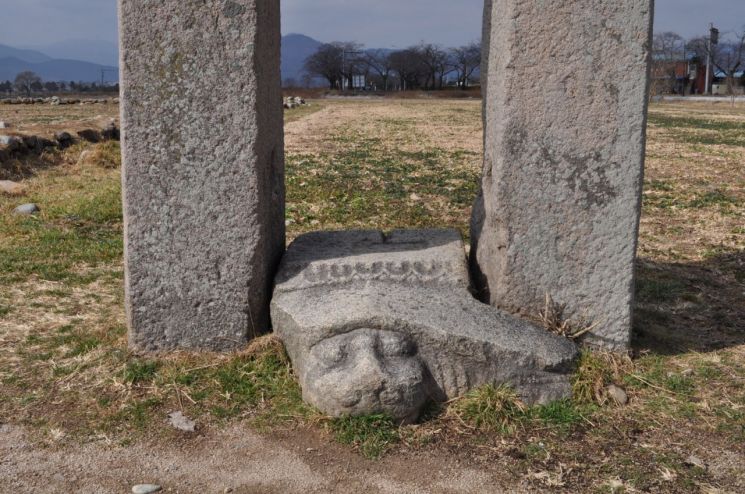
The Gyeongju Bunhwangsa Dangganjiju shows little difference between its appearance in photos taken during the Japanese colonial period and its current state. The danggan (pole erected to hang flags) set between the two supports has disappeared, but the two supports with the same construction technique and style, along with the turtle-shaped gandaeseok (stone base supporting the danggan) beneath them, remain relatively intact in their original positions. The turtle-shaped gandaeseok is only found at the Gyeongju Bunhwangsa Dangganjiju. The Dangganjiju is generally square pillar-shaped, narrowing slightly towards the top. The top part is processed to curve from the inner surface to the outer surface. The circular holes (竿孔) passing from the inner to the outer surface have a diameter of 15 cm. There are three holes arranged at the upper, middle, and lower parts to fix the danggan. A Cultural Heritage Administration official explained, "This is a technique frequently applied to Dangganjiju of the Unified Silla period," adding, "The overall shape and appearance are similar to those of the already designated treasures such as the Gyeongju Mangdeoksa Dangganjiju, Gyeongju Bomunsa Dangganjiju, and Gyeongju Namgansa Dangganjiju. It is presumed to have been created around the same period."
© The Asia Business Daily(www.asiae.co.kr). All rights reserved.
![Clutching a Stolen Dior Bag, Saying "I Hate Being Poor but Real"... The Grotesque Con of a "Human Knockoff" [Slate]](https://cwcontent.asiae.co.kr/asiaresize/183/2026021902243444107_1771435474.jpg)

















