Jungdawn Jo, Associate Research Fellow at KIPF, 'Study on Strengthening Correction Functions for Consumption Tax Rates'

[Sejong=Asia Economy Reporter Kim Hyunjung] To strengthen the corrective function of tobacco consumption tax, it has been argued that a 'differential tax rate structure' should be introduced, imposing higher taxes as nicotine and tar content increase.
On the 28th, in the Tax and Fiscal Brief published by the Korea Institute of Public Finance, Associate Research Fellow Jung Daun stated in the "Study on Consumption Tax Rates for Strengthening Corrective Functions" that "Although tobacco consumption tax implicitly includes the purpose of corrective function, the tax rate determination process does not reflect the negative external effects of tobacco demand," adding, "Considering the costs caused by smoking, smokers' health costs, and external costs from secondhand smoke, the socially desirable tobacco consumption tax rate structure is one that imposes higher taxes as the nicotine and tar content of tobacco increases."
The tobacco tax burden in South Korea has been steadily increasing. In 2008, when the price of a pack of cigarettes was 2,500 won, the tobacco consumption tax was 641 won and the total tax burden was 1,564.7 won, accounting for 63% of the cigarette price. By 2015, as the price of a pack rose to 4,500 won, the tobacco consumption tax increased to 1,007 won and the total tax burden to 3,323.4 won, reaching 74% of the cigarette price.
The problem is that although the current smoking rate has been declining annually, a clear decrease in demand due to rising cigarette prices has not been observed. Associate Research Fellow Jung explained, "The smoking rate decreased by about 2 percentage points compared to before 2014, with 20.9% in 2015 and 21.0% in 2016, but no significant difference can be found," adding, "This indirectly shows that the price elasticity of demand in response to tobacco consumption tax increases is low."
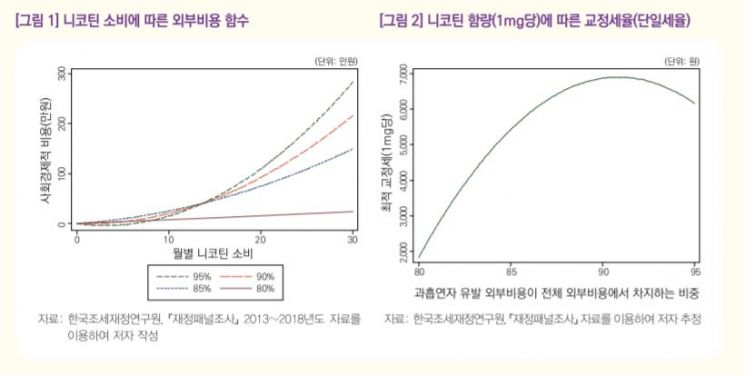
According to Associate Research Fellow Jung's analysis of the tobacco demand function, smokers of high-nicotine cigarettes showed more inelastic price elasticity of demand compared to smokers of low-nicotine cigarettes. Similar results were found when based on tar content. Additionally, analysis of the corrective function tobacco consumption tax rate model revealed that the external costs caused by smokers with high monthly nicotine consumption are significantly larger.
He explained, "The price elasticity of tobacco demand varies depending on the smoker's smoking intensity and behavior, and if the costs caused by heavy smokers are greater, it may be more efficient policy-wise to reform tax rates including corrective functions targeting them," adding, "Therefore, setting tobacco consumption tax rates considering the external costs according to the degree of nicotine and tar consumption can achieve a more socially efficient corrective purpose for tobacco demand."
However, based on the review that lower income and education levels tend to consume higher concentration nicotine and high-tar tobacco products, Associate Research Fellow Jung emphasized the need to consider tax burden issues among consumer groups.
He added, "If the tax rate system is reformed, the tax burden on low-income groups may immediately increase," but also noted, "Considering the costs caused by heavy smoking in these groups, the overall social tax increase could be more efficient, so further discussion is necessary."
© The Asia Business Daily(www.asiae.co.kr). All rights reserved.
![Clutching a Stolen Dior Bag, Saying "I Hate Being Poor but Real"... The Grotesque Con of a "Human Knockoff" [Slate]](https://cwcontent.asiae.co.kr/asiaresize/183/2026021902243444107_1771435474.jpg)

















