Brainard Fed Board Member, Williams New York Fed President Speak in Succession
Doves Draw the Line on Rate Hikes Despite Accepting Tapering
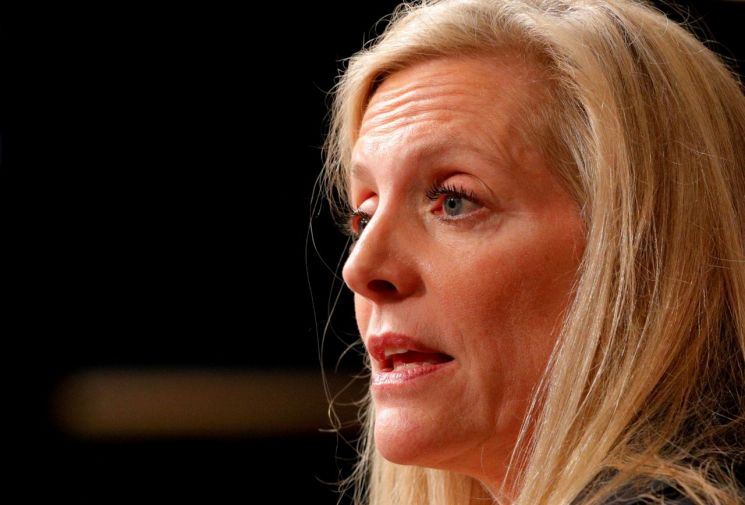
[Asia Economy New York=Correspondent Baek Jong-min] Senior dovish officials of the U.S. Federal Reserve (Fed), emphasizing economic stimulus, have consecutively stressed the need to taper asset purchases but argued that interest rate hikes should not be rushed. This highlights the anticipated conflict between dovish and hawkish Fed members regarding future U.S. benchmark interest rate increases.
On the 27th (local time), Fed Governor Lael Brainard, John Williams, President of the New York Federal Reserve Bank, and Charles Evans, President of the Chicago Federal Reserve Bank, each expressed their views on tapering and interest rate hikes.
Brainard, who is also mentioned as a potential next Fed Chair, stated, "The employment conditions for tapering seem to be met," expressing support for tapering within this year.
President Williams also evaluated, "There has been significant progress toward the inflation target and maximum employment. If the economy improves as expected, tapering will be justified."
President Evans expressed the opinion that tapering should be implemented within this year.
Fed Chair Jerome Powell mentioned at the post-September FOMC meeting press conference, "Most Fed members agree to start tapering within this year and finish by mid-next year."
Unlike tapering, senior Fed officials expressed negative views on interest rate hikes. Although the Fed’s recently released dot plot indicated that half of the Fed members support rate hikes next year, dovish members still oppose raising rates.
Governor Brainard said, "The Fed’s maximum employment and average inflation goals for raising the benchmark interest rate are much higher than those for tapering." He added, "I want to emphasize that the tapering decision cannot be taken as any signal for interest rate hikes."
Brainard also anticipated that the rise in inflation would slow and that progress toward maximum employment would fall short of the Fed’s goals.
The Wall Street Journal reported that Brainard warned against hastily deciding on interest rate hikes.
President Williams also stated, "There is still a long way to go to reach full employment, and over time it will become clearer whether the 2% inflation target has been achieved," indicating disagreement with early rate hikes.
President Evans also approached interest rate hikes cautiously. He said, "Future decisions regarding short-term rates seem much less clear at this time," and added, "(Future rate hikes) are expected to depend on whether we are on a path toward sufficiently high and sustainable inflation."
Governors Brainard, Williams, and Evans all expect inflation to slow next year. Their remarks can be interpreted as opinions that rate hikes should not be rushed if inflation slows.
The Fed has claimed that inflation is temporary but recently revised upward the core Personal Consumption Expenditures (PCE) price index increase rate to 3.7% for this year in its economic outlook.
President Evans also warned of the adverse effects of early rate hikes. He said, "What I worry about is that when the pain of COVID-19 disappears worldwide, we might not escape downward pressure on inflation."
Meanwhile, on the same day, Brainard claimed that the Fed is lagging behind other central banks in responding to climate change. Progressive Democrats in the U.S. are pushing Brainard as the next Fed Chair, criticizing Jerome Powell’s insufficient response to climate change. Powell’s term ends in February next year.
© The Asia Business Daily(www.asiae.co.kr). All rights reserved.
![Clutching a Stolen Dior Bag, Saying "I Hate Being Poor but Real"... The Grotesque Con of a "Human Knockoff" [Slate]](https://cwcontent.asiae.co.kr/asiaresize/183/2026021902243444107_1771435474.jpg)
















